This product is in good condition. At NexWave Games, good means:
Additionally, all discs at NexWave Games are carefully inspected and assessed for quality. When discs arrive, we do not accept any that are so badly damaged that they are unlikely to work. We only accept discs with light scratches at most. Discs with scratches are then treated in our professional disc repair machine. By warming the disc and polishing it with soft brushes, these machines can remove a very thin layer from the disc. This removes the layer containing surface scratches and improves the disc’s readability. This ensures the disc works properly, even on consoles with ageing lasers that have difficulty reading games! Great news for the player.
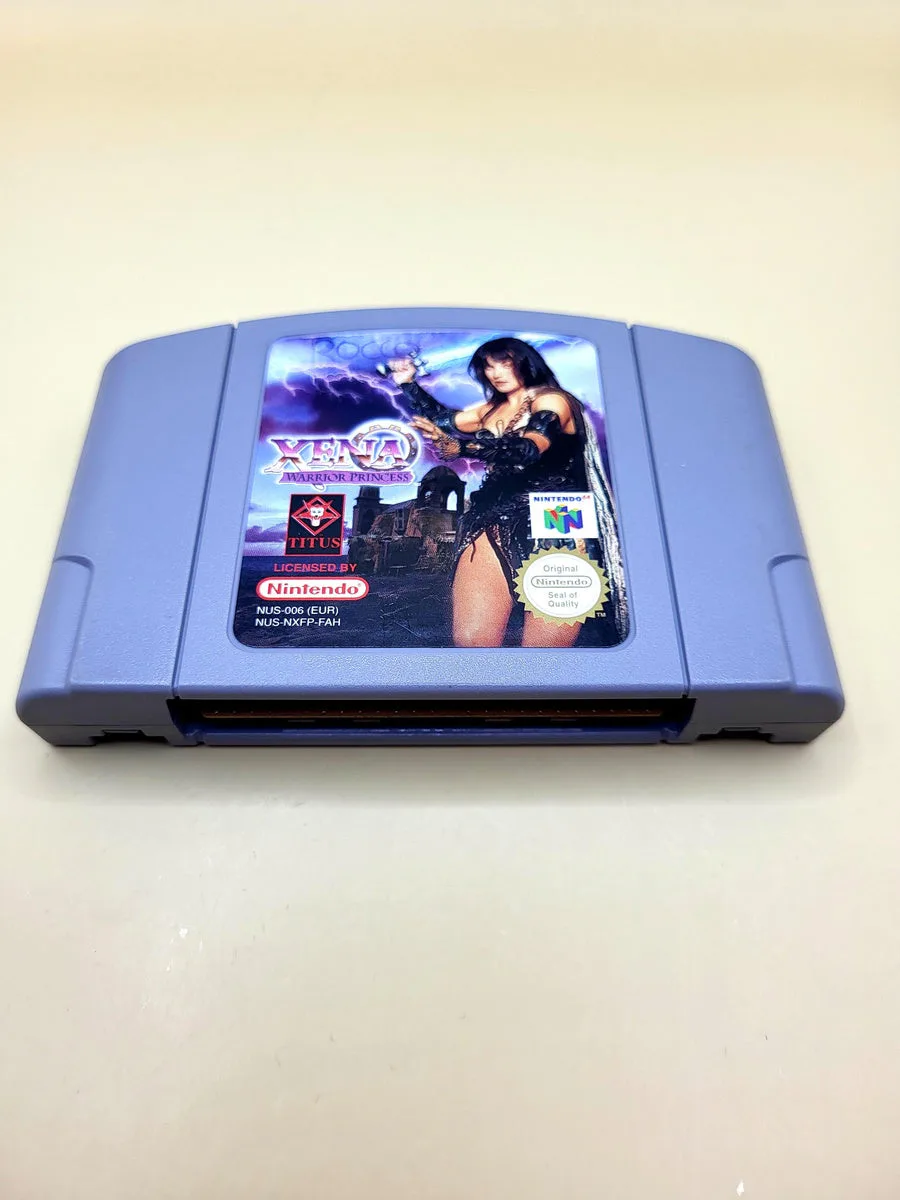
Xena: Warrior Princess for Nintendo 64
Xena: Warrior Princess for Nintendo 64, also known as The Talisman of Fate, is a fighting game with spatial arenas. You choose Xena, Gabrielle or another television-world character and combine punches, kicks and special attacks. You can move around an opponent and select a different target when several warriors participate. A fight therefore requires attention not only to reach but also to what happens beside and behind your character.
In Quest you fight a sequence of opponents before ultimately challenging Despair. You can follow this path alone or cooperate with one other player. Versus allows up to four human or computer-controlled fighters simultaneously, individually or in teams. Roster adds another choice: you select several characters beforehand, then the next warrior replaces a defeated team member. Your entire selection therefore does not stand in the arena simultaneously.
Practice provides space to rehearse moves and combinations, while difficulty and round length can be adjusted. Each human participant needs a Nintendo 64 controller; four players therefore require four controllers, without an additional adapter. A separate Controller Pak can save settings and is not included as standard. This is the N64 fighting game, not the similarly named PlayStation adventure in which Xena travels through continuous areas.
Region and language
Our Nintendo 64 games are PAL editions, unless stated otherwise. This product contains a loose cartridge for the European market. A box is only included if explicitly stated in the product details. We note any different region in the product details. In almost all cases, the game is playable at least in English, and often in the other five common European languages too.
Manual
With Xena: Warrior Princess for Nintendo 64, you receive a loose cartridge. A box and manual are not included unless we explicitly state otherwise in the product details. This is the standard way we supply this copy.
The history of Xena: Warrior Princess
Saffire developed Xena: Warrior Princess for Nintendo 64 and Titus released it in 1999. The television series supplied its heroes, rivals and mythological background, but the game concentrated on arena fighting. The story surrounding the stolen Talisman of Fate provides a reason to pit these characters against one another. Xena and Despair both claim control over the object, after which a contest must determine who may govern fate.
When announcing shipments, Titus emphasised that four players could fight simultaneously. This distinguished it from many traditional duels on the same console. Nintendo 64’s direct controller ports supported that design. A fight could pit two teams against each other or one warrior against several opponents. The controls therefore included a way to choose a target alongside separate buttons for jumping and attacking.
The different match formats build on the same system of characters and moves. Quest uses it for a succession of challenges ending with a final opponent, while Roster makes choosing replacements important. Variety therefore comes primarily from the composition of battles rather than a large world to explore. This also explains why the N64 edition must be considered separately from other Xena games. The television licence is the same, but platform and developer determine the experience on the cartridge.
Similar games for Nintendo 64
Mortal Kombat Trilogy on Nintendo 64, like Xena, uses health bars and character-specific special moves. It nevertheless keeps two active warriors facing each other, even with team selections. Xena lets four fighters move through a spatial arena simultaneously in Versus. Your attention consequently shifts from a single duel to several potential attackers. Trilogy’s distinctive finishers and digitised characters also create a different tone from Xena’s television world.
ClayFighter 63⅓ on Nintendo 64 shares the emphasis on characters with strikingly different attacks. Its clay figures and grotesque jokes create a different atmosphere from Xena’s weapons and mythological rivals. ClayFighter centres on two participants and uses three strengths of punches and kicks. Xena places different emphases through freer movement and target selection. Both require practice with a chosen character, but other fighters’ positions play a more prominent role in Xena.
Super Smash Bros. on Nintendo 64 also lets four players fight on one screen and form teams. Its objective differs: you try to knock someone off platforms, whereas Xena depletes warriors’ health. Smash builds many attacks around stick direction and recovering from a fall. Xena uses separate punches, kicks and target selection. Their shared four-player capability therefore does not produce the same kind of match.
Killer Instinct Gold on Nintendo 64 focuses on long combos and interrupting them with a Combo Breaker. Xena also has character-specific sequences, but larger fights require considering several participants’ positions. Starting an elaborate attack can leave an opening for another warrior. Players focusing on repeating a single duel will find a different structure in Killer Instinct from Xena’s changing team relationships within the arena.
Rakuga Kids on Nintendo 64 uses playful drawn characters in traditional side-view duels. Xena instead connects a television licence to spatial weapon battles with several potential opponents. Both have health bars and distinctive special moves, so learning a character remains important. The difference becomes clear when you evade: Xena lets you move around a target, while Rakuga Kids presents confrontation expressly as a two-sided fight.