This product is like new. At NexWave Games, like new means:
Additionally, all discs at NexWave Games are carefully inspected and assessed for quality. When discs arrive, we do not accept any that are so badly damaged that they are unlikely to work. We only accept discs with light scratches at most. Discs with scratches are then treated in our professional disc repair machine. By warming the disc and polishing it with soft brushes, these machines can remove a very thin layer from the disc. This removes the layer containing surface scratches and improves the disc’s readability. This ensures the disc works properly, even on consoles with ageing lasers that have difficulty reading games! Great news for the player.
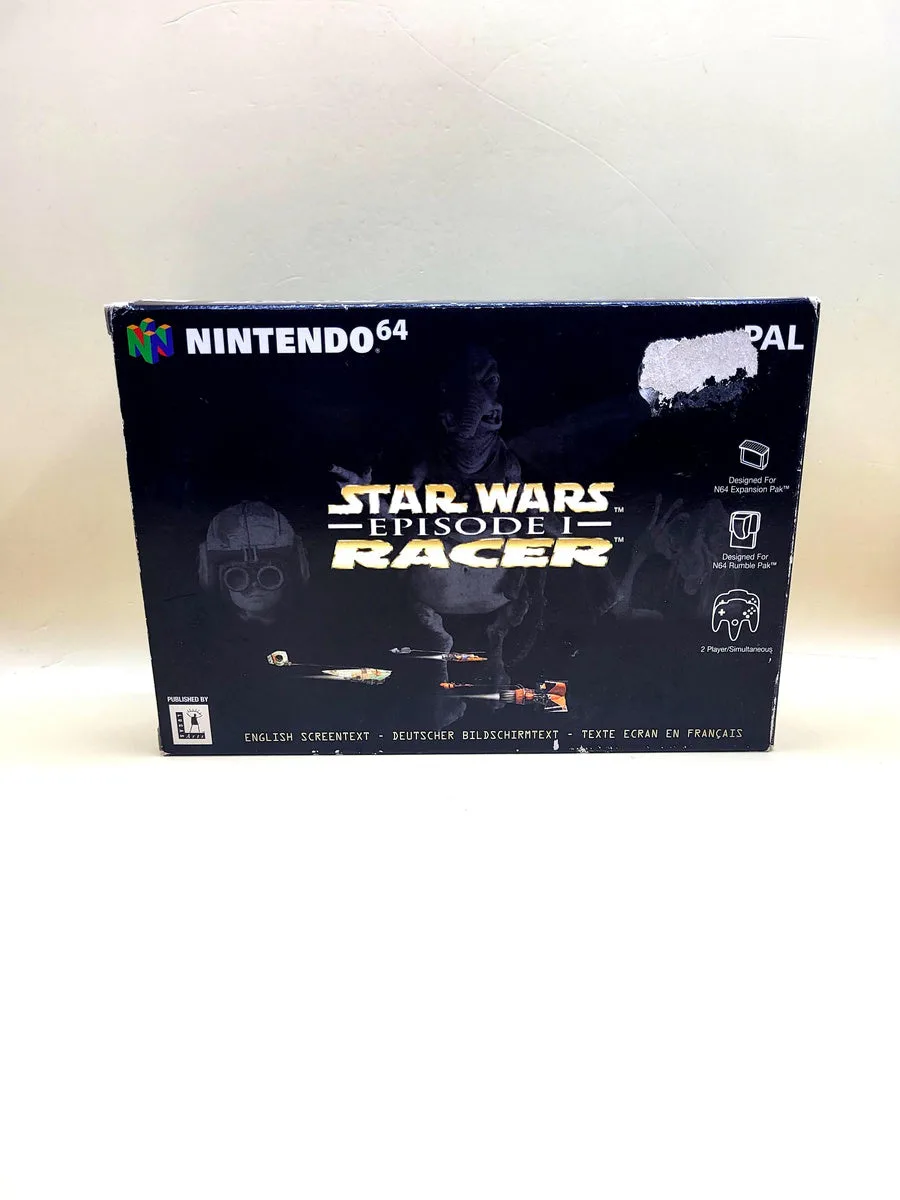
Star Wars Episode I: Racer for Nintendo 64
Star Wars Episode I: Racer for Nintendo 64 turns the podrace from The Phantom Menace into a complete racing game. You steer a small cockpit suspended behind two enormous engines, with Anakin Skywalker and other competitors as pilots. The routes lead not only through Tatooine, but also past snow, mines and industrial structures on other planets. Narrow passages, jumps and forks demand that you look beyond the very next corner.
While driving, you build up speed to use a temporary boost. This raises the engine temperature: pushing too long can make your vehicle explode. Collisions also damage the engines. You can repair them on the move, but travel more slowly while doing so. Between tournament races, you spend prize money at Watto's on parts and pit droids. New parts improve different attributes; cheaper second-hand components already have damage. Your preparation therefore also affects what you can risk on the track.
In Tournament, you unlock races and additional pilots. Free Play lets you configure a race on unlocked circuits, while Time Attack focuses on your own time. Two players can race locally on a split screen, each with their own N64 controller. Your progress is saved on the cartridge. A Rumble Pak provides optional vibration; an Expansion Pak improves the display, but is not required to play.
Region and language
Our Nintendo 64 games are PAL editions and come with a Dutch or English box, unless stated otherwise. By default, you receive the version for the European market. We note it in the product details if the region is different or the box is in another language. In almost all cases, the game is playable at least in English, and often in the other five common European languages too.
Manual
Star Wars Episode I: Racer for Nintendo 64 includes the manual unless the product title states otherwise. If the booklet is missing, the title says “No Manual”. This lets you see before ordering whether the game comes with a manual.
The manuals included with our games usually contain at least English and often around six European languages. The exact languages vary by edition, so Dutch is not always included. The booklet explains the controls and the main rules. You can use it to check how to control the game, which actions are available and how its different features work.
The history of Star Wars Episode I: Racer
LucasArts brought Star Wars Episode I: Racer to Nintendo 64 in 1999, the same year in which The Phantom Menace began the prequel films. The game took one part of that film as its starting point: Anakin entering a dangerous race in his homemade podracer. Instead of retelling the entire film, LucasArts developed its vehicles, opponents and tracks into a separate competition with its own progression.
The familiar desert race did not set the limits of the design. Other planets offered snowfields, tunnels and installations, each demanding a different racing line. Watto's shop connected those races with working on your machine. Damage, repairs and purchased parts thus give practical meaning to the fragile engines from the film. You learn not only a route, but also how much strain your current vehicle can withstand before you need to ease off the throttle.
The original Nintendo 64 release combined this with analogue control and a direct duel on one television. Expansion Pak support belonged to this cartridge generation, without that memory upgrade being necessary for ordinary racing. Later rereleases brought the game to modern systems with adapted controls. This description concerns the original N64 version, not those rereleases or the separate sequel Racer Revenge.
Similar games for Nintendo 64
F-Zero X shares the high speed and the need to choose a racing line early. There, you control a hovering machine on futuristic circuits, and extra acceleration consumes some of your energy meter. Racer instead links its boost to hot engines that you can damage and repair. You also spend your winnings at Watto's on parts, whereas F-Zero X does not have the same shop and maintenance cycle.
Wipeout 64 likewise offers futuristic races in which corners and differences in speed demand considerable attention. Collected weapons let you fire directly at opponents there. Racer does not give you a comparable arsenal to pick up on the track and attack other competitors. Your advantage comes mainly from your racing line, vehicle upgrades and the moment you choose to boost or repair. That changes how you try to pass a fast rival.
Extreme-G puts fast motorcycles on twisting, futuristic tracks and combines racing with weapons. Racer seats you in a cockpit behind two large engines, with their damage and temperature as additional concerns. Both demand that you judge a corner early, but Racer breaks up the races with purchases and repair preparation at Watto's. Your choice of parts therefore serves a different purpose from the weapons you collect while playing Extreme-G.
Diddy Kong Racing also lets you discover new races and vehicles as you progress. However, it connects races with an explorable island, bosses and three vehicle types. Racer keeps its progression centred on podraces and race menus, with Watto's shop as a stop between events. Here, variety comes from planets and pilots, not from switching from a kart to a hovercraft or aeroplane to follow different routes.
Mario Kart 64 and Racer give two players their own part of the television screen to defeat each other through knowledge of the corners. Mario Kart also allows up to four players to race and uses items such as shells and bananas. Racer limits its local duel to two competitors, each with a controller. You must also watch your engines there: a repair costs speed, while a poorly judged boost can cause overheating.