This product is like new. At NexWave Games, like new means:
Additionally, all discs at NexWave Games are carefully inspected and assessed for quality. When discs arrive, we do not accept any that are so badly damaged that they are unlikely to work. We only accept discs with light scratches at most. Discs with scratches are then treated in our professional disc repair machine. By warming the disc and polishing it with soft brushes, these machines can remove a very thin layer from the disc. This removes the layer containing surface scratches and improves the disc’s readability. This ensures the disc works properly, even on consoles with ageing lasers that have difficulty reading games! Great news for the player.
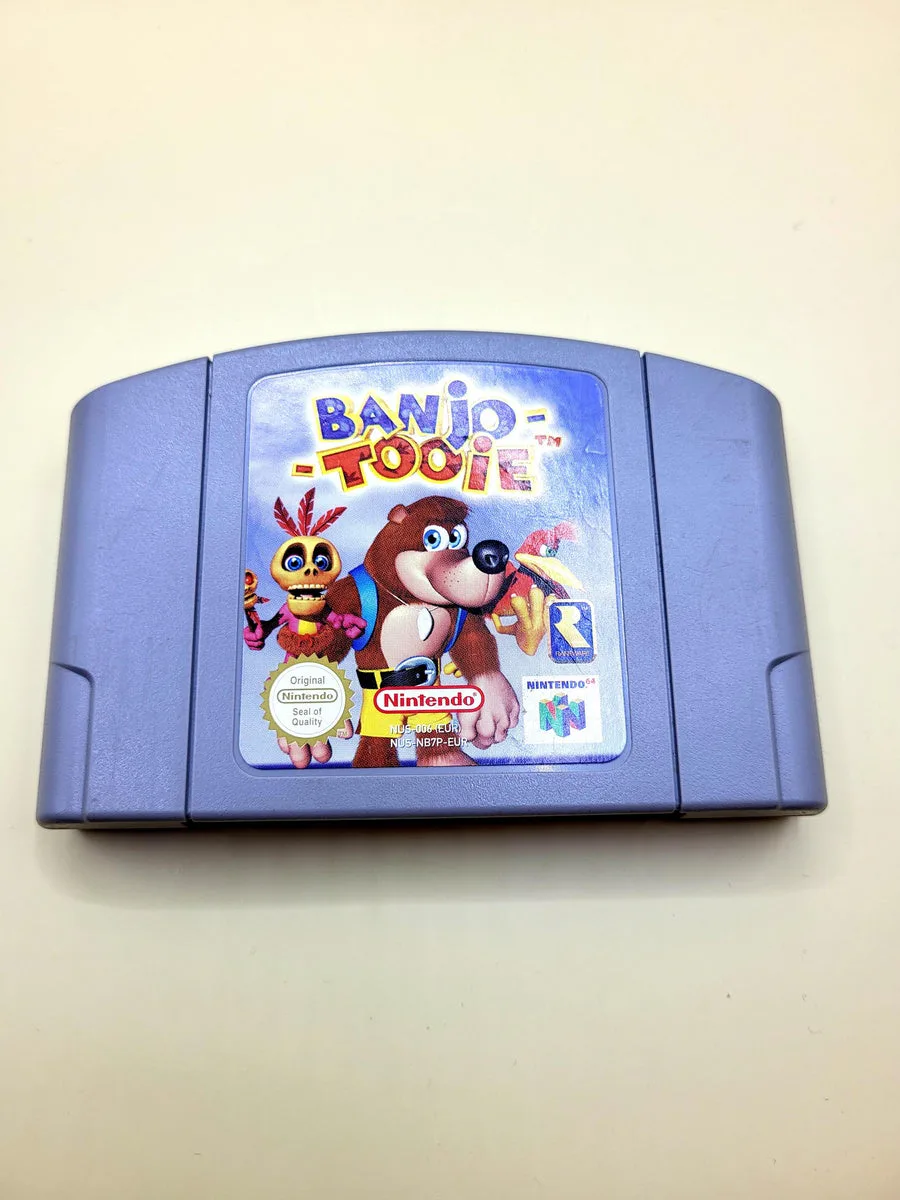
Banjo-Tooie for Nintendo 64
Banjo-Tooie for Nintendo 64 takes Banjo and Kazooie to the Isle o' Hags, where Gruntilda and her sisters are causing trouble again. The platform adventure revolves around earning jigsaw pieces, helping inhabitants and discovering connections between large areas. An abandoned mine, an amusement park and a factory each call for different actions. Not every problem can be solved on your first visit. A new move from a later area may give you a reason to return to somewhere you visited earlier.
The duo retains the moves from Banjo-Kazooie and learns new abilities from Jamjars. Kazooie gains different types of eggs, including explosive ones and controllable mechanical versions. Special pads let you separate bear and bird, then switch between them. Banjo uses his backpack differently when Kazooie is not inside, while the bird reaches other places on her own. Mumbo Jumbo is also controllable and casts spells at designated locations. Humba Wumba handles transformations into other creatures and objects.
You play the main adventure alone. There are also fourteen separate competitive games, including football-like challenges, bumper cars and egg-shooting battles. Up to four players can compete on the same Nintendo 64, each with their own controller. These competitions are separate from the campaign: splitting up Banjo and Kazooie therefore does not turn the story into a cooperative adventure for two players.
Region and language
Our Nintendo 64 games are PAL editions, unless stated otherwise. This product contains a loose cartridge for the European market. A box is only included if explicitly stated in the product details. We note any different region in the product details. In almost all cases, the game is playable at least in English, and often in the other five common European languages too.
Manual
With Banjo-Tooie for Nintendo 64, you receive a loose cartridge. A box and manual are not included unless we explicitly state otherwise in the product details. This is the standard way we supply this copy.
The history of Banjo-Tooie
Rare made Banjo-Tooie as the sequel to Banjo-Kazooie. Nintendo released it for Nintendo 64 in North America in 2000 and in Europe on 12 April 2001. The story takes place two years after the first adventure. Gruntilda's return connects the two games, but the journey leaves her old lair. Rare shifted the emphasis towards larger areas with more connections between them, so a task does not always stay within the boundaries of a single world.
In the original question-and-answer session with the development team, Rare explained that it was using the same game engine, with modifications for the sequel. Ideas from the more extensive plans for Banjo-Kazooie also inspired new worlds. The familiar moves remained, while individual abilities and a controllable Mumbo provided new puzzle possibilities. Grant Kirkhope continued to compose the music. This gave the sequel an audible and visible connection with the first game while expanding its spatial structure.
The original Nintendo 64 manual distinguishes between three saved adventures and a separate selection of competitions. You can also select previously reached bosses, minigames and cinematic sequences again. This fits Rare's expansion of an exploration game into a cartridge with more standalone challenges. Meanwhile, the story remains a solo journey in which you keep track of abilities and unresolved tasks yourself. Later Xbox rereleases and their links with other versions are not required to play this original campaign.
Similar games for Nintendo 64
Banjo-Tooie and Banjo-Kazooie share the bear, the bird and the task of earning jigsaw pieces on Nintendo 64. The first game concentrates most tasks within separate worlds connected to Gruntilda's lair. Tooie links more areas and more often has you return later with a new ability. Splitting up the duo also changes the puzzles. You therefore plan more across several visits, whereas Kazooie more often revolves around investigating one world at a time.
Super Mario 64 and Banjo-Tooie let you explore three-dimensional spaces on Nintendo 64 and collect rewards to progress. Mario builds many challenges around his established jumps and temporary caps; Tooie adds new moves, different eggs, transformations and separate characters. A missed star in Mario often calls for a better route or execution. An unresolved task in Tooie may mean that you first need to learn an ability elsewhere.
Donkey Kong 64 and Banjo-Tooie are large Rare adventures on Nintendo 64 in which characters with different capabilities use the same areas differently. Donkey Kong 64 has you unlock and switch between five Kongs to tackle their own collectibles and challenges. Tooie divides actions between the duo, their separate appearances, Mumbo and Humba's transformations. Both require you to keep track of things, but Tooie places extra emphasis on connecting a problem with another place in the world.
Kirby 64: The Crystal Shards shares the use of special powers to solve obstacles on Nintendo 64. Kirby copies properties from enemies and combines them to reach crystal shards. Banjo-Tooie permanently teaches moves and links some tasks to a later visit. Kirby mainly moves along sideways routes, whereas Tooie lets you search freely through large spaces. The difference therefore concerns both the chosen power and how much spatial awareness a task demands.
Yoshi's Story and Banjo-Tooie use eggs as projectiles on Nintendo 64, but give them different roles. Yoshi mainly aims during a sideways journey past fruit and secrets. Kazooie's different egg types also solve spatial puzzles and open possibilities in previously visited areas. Yoshi's storybook-like levels revolve around short routes and careful collecting; Tooie has you spend longer connecting inhabitants, abilities and places in a continuous adventure.