This product is like new. At NexWave Games, like new means:
Additionally, all discs at NexWave Games are carefully inspected and assessed for quality. When discs arrive, we do not accept any that are so badly damaged that they are unlikely to work. We only accept discs with light scratches at most. Discs with scratches are then treated in our professional disc repair machine. By warming the disc and polishing it with soft brushes, these machines can remove a very thin layer from the disc. This removes the layer containing surface scratches and improves the disc’s readability. This ensures the disc works properly, even on consoles with ageing lasers that have difficulty reading games! Great news for the player.
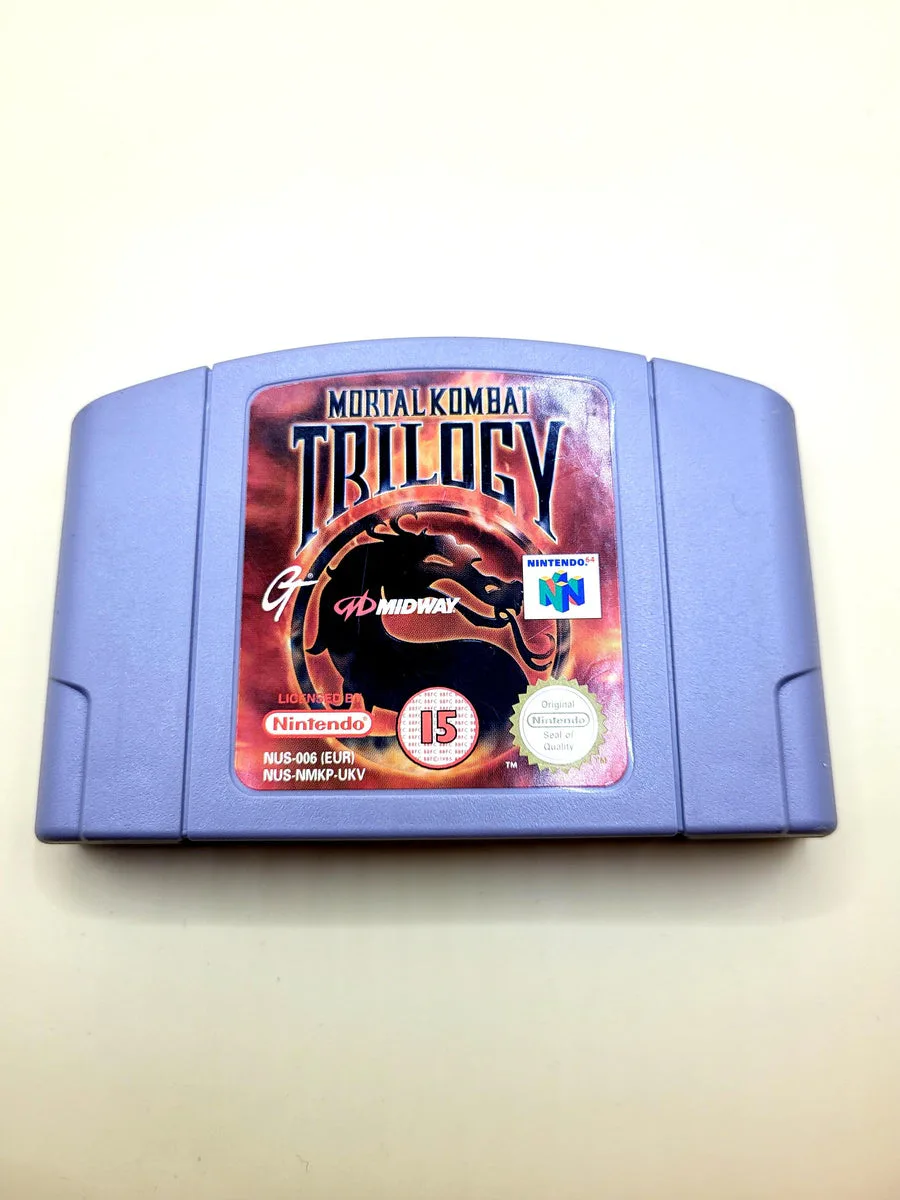
Mortal Kombat Trilogy for Nintendo 64
Mortal Kombat Trilogy for Nintendo 64 brings warriors and arenas from the early Mortal Kombat years together in one fighting game. You can choose Scorpion, Liu Kang or Kitana, for example, and face a sequence of computer opponents or one other player. The action remains a side-view duel: jumping, crouching, blocking and choosing your distance determine which attack connects. High and low punches and kicks provide the foundation, complemented by each warrior’s own special moves.
The Run meter lets you close the distance quickly and link attacks together. The separate Aggressor meter grants extra fighting power temporarily once filled. You therefore need to follow both health bars and your attacking opportunities. A missed jump can create an opening for an uppercut; constantly retreating leaves room for an advancing attack. Winning a fight can be followed by Fatalities and other distinctive finishers, requiring their own inputs and the right timing.
Locally, two players fight each other with one Nintendo 64 controller each. Team battles let you choose multiple warriors who enter in succession, not simultaneously. This N64 edition has its own selection and is not identical in content to the CD versions. The game does not save progress to the cartridge or a Controller Pak. You therefore play individual fights and tournament sequences, without an adventure campaign to resume later.
Region and language
Our Nintendo 64 games are PAL editions, unless stated otherwise. This product contains a loose cartridge for the European market. A box is only included if explicitly stated in the product details. We note any different region in the product details. In almost all cases, the game is playable at least in English, and often in the other five common European languages too.
Manual
With Mortal Kombat Trilogy for Nintendo 64, you receive a loose cartridge. A box and manual are not included unless we explicitly state otherwise in the product details. This is the standard way we supply this copy.
The history of Mortal Kombat Trilogy
Mortal Kombat Trilogy emerged in 1996 as a meeting of the early series, following Mortal Kombat 3 and Ultimate Mortal Kombat 3. It was not a package in which you launched three original games separately. Instead, warriors and environments were brought together within one combat system. A team at Williams Entertainment worked on the Nintendo 64 edition alongside the original Midway designers. The manual lists these teams separately, revealing the collaboration behind this cartridge.
The story returns to Shao Kahn’s attempts to dominate Earth. The earlier tournaments, Liu Kang’s victory and Sindel’s return form the background for a new confrontation. For the player, continuity primarily comes from encountering different warriors within the same rules. The Run meter maintains pressure at close range, while Aggressor adds an extra temporary surge of power. Trilogy is therefore more than a selection of familiar names on a new title screen.
The Nintendo 64 cartridge brought those familiar moves to the new console’s controller. The original manual assigns jumping and crouching to the directional pad, while the action buttons divide high and low attacks. Separate buttons are available for blocking and running. Team selection also follows the duel format: selected warriors replace one another when someone is defeated. Combat between two active opponents therefore remained the foundation, even when a match consisted of several successive fights.
Similar games for Nintendo 64
ClayFighter 63⅓ on Nintendo 64 shares the health bars, button sequences and unusual finishers of traditional duels. Its deformable clay figures turn many hits into jokes, whereas Mortal Kombat Trilogy emphasises gruesome warriors. Controls also differ: ClayFighter uses three strengths for punches and kicks. Trilogy divides basic attacks into high and low and adds its own Run meter for quickly applying pressure.
Killer Instinct Gold on Nintendo 64 also lets you connect special moves into long attack chains. Its Combo Breakers make interrupting a sequence a central part of combat. Mortal Kombat Trilogy uses a different system for combinations, blocking and temporary Aggressor power. Both reward memorising inputs, but their rules cannot be transferred directly. Killer Instinct’s two health bars also create a different match structure.
Super Smash Bros. on Nintendo 64 uses a damage percentage that determines how far someone flies. You therefore try to send an opponent outside the arena, whereas Trilogy revolves around emptying a health bar. Both require reading jumps and distance, but Smash adds platforms, recovery moves and loose items. Its four-player simultaneous battles also differ from Mortal Kombat’s two active warriors.
Rakuga Kids on Nintendo 64 likewise retains side-view duels with health bars and special attacks. Its characters, however, seem to have stepped out of drawings and graffiti. This immediately contrasts with Trilogy’s digitised warriors and menacing arenas. Playing both reveals the shared search for openings and defence against projectiles. Their presentation and distinctive attack patterns prevent the same basic idea from producing the same fighting rhythm.
Xena: Warrior Princess on Nintendo 64 places health-bar battles in arenas where fighters move around one another more freely. Four fighters can participate simultaneously. Trilogy preserves duels between two active opponents, even when you select a team beforehand. Xena therefore requires watching several directions and selecting a target. Character-specific moves provide the similarity; spatial positioning and the number of simultaneous attackers change the approach.