This product is in good condition. At NexWave Games, good means:
Additionally, all discs at NexWave Games are carefully inspected and assessed for quality. When discs arrive, we do not accept any that are so badly damaged that they are unlikely to work. We only accept discs with light scratches at most. Discs with scratches are then treated in our professional disc repair machine. By warming the disc and polishing it with soft brushes, these machines can remove a very thin layer from the disc. This removes the layer containing surface scratches and improves the disc’s readability. This ensures the disc works properly, even on consoles with ageing lasers that have difficulty reading games! Great news for the player.
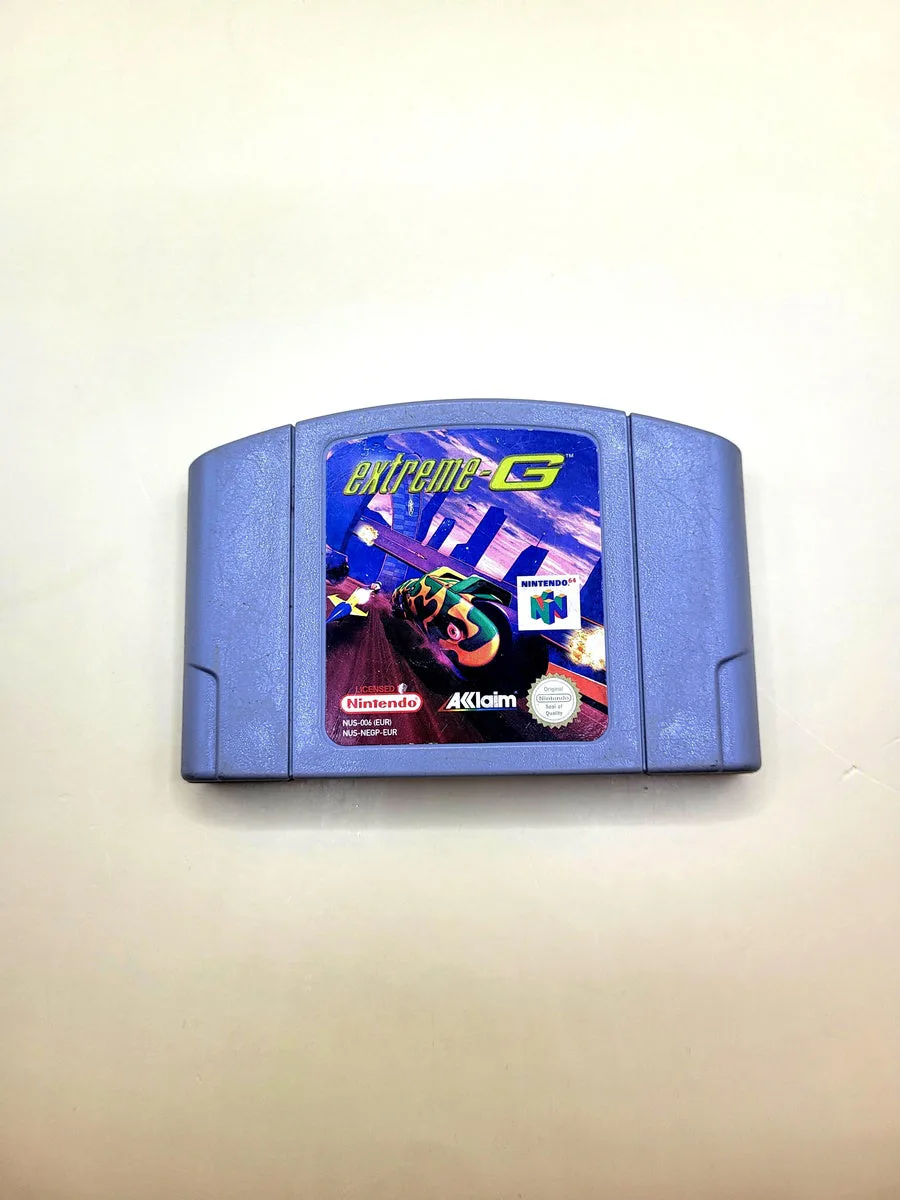
Extreme-G for Nintendo 64
Extreme-G for Nintendo 64 puts you on armed futuristic motorcycles on tracks with steep descents, loops and corkscrews. You choose a bike with its own characteristics and try to read the road as the view changes rapidly. The twelve regular circuits span four environments: desert, city, mines and canyons, and a space station. Entering a corner well often gains you more than recovering from a collision immediately afterwards.
Your built-in weapon is supplemented by pickups along the track, including missiles and mines. Attacks slow rivals down, but you must also watch your own shield. Three nitro charges per race provide short bursts of acceleration; save them for a section where you can maintain the extra speed. Extreme Contest links races to progression. Practice, Time Trials and Shoot-'em-up place different emphasis on training, lap times and shooting.
Head to Head, Battle Arena and Flag Game support two to four players on a split screen, each with their own N64 controller. Cup Challenge lets larger groups take turns using two controllers. You can use a separate Controller Pak for progress and lap records. Without that memory card, passwords restore access to reached circuits and difficulty levels; they do not replace saved lap records.
Region and language
Our Nintendo 64 games are PAL editions, unless stated otherwise. This product contains a loose cartridge for the European market. A box is only included if explicitly stated in the product details. We note any different region in the product details. In almost all cases, the game is playable at least in English, and often in the other five common European languages too.
Manual
With Extreme-G for Nintendo 64, you receive a loose cartridge. A box and manual are not included unless we explicitly state otherwise in the product details. This is the standard way we supply this copy.
The history of Extreme-G
Probe Entertainment developed Extreme-G, and Acclaim released it for Nintendo 64 in 1997. It began a futuristic racing series of its own, using motorcycles instead of the hovering ships found in many other games in the genre. The track shapes were central to that choice from the start. High walls, rapid descents and corners that continue overhead make the road itself a major part of the opposition.
The original presentation centred on a combination of speed and combat. The packaging emphasised winding tracks and armed motorcycles; in the game, you can also turn weapons off to concentrate on driving. This gives the same route more than one character. A fairly straight section can offer a chance for a sharp lap time in a time trial, but become a dangerous place for missiles and mines when opponents are present.
The first Extreme-G also preserves two ways of continuing: data on a Controller Pak and passwords for reached sections. This reflects a cartridge era when a memory card was not necessarily fitted to every controller. Meanwhile, local races and arena contests use the four controller ports. This Nintendo 64 release is the original 1997 game; the different tracks and systems of its sequels are not part of this cartridge.
Similar games for Nintendo 64
Wipeout 64 and Extreme-G combine futuristic circuits with weapons and shields. Wipeout's hovering ships use airbrakes, among other controls, to negotiate corners, while Extreme-G puts you on a motorcycle through loops and sharply banking sections. Wipeout clearly divides its challenges into racing, time trials and elimination. Extreme-G also adds separate arenas and a flag game, so the objective can extend beyond a conventional finishing line.
F-Zero X shares Extreme-G's high speeds, unusual track shapes and differing vehicle characteristics. In F-Zero, boosting consumes your own energy, and attacking mainly involves physical contact between machines. Extreme-G gives you three nitro charges and lets you use projectiles or mines. Both require you to recognise the next corner early, but managing acceleration and obstructing a rival work differently.
Mario Kart 64 and Extreme-G let a collected item change a carefully driven race. Mario Kart uses shells, bananas and familiar characters on fantasy routes. Extreme-G chooses armed motorcycles, shield energy and much more pronounced changes in elevation. Their similarity lies in weighing attacks against keeping moving; their difference becomes clear when reading the track. In Extreme-G, the road can already be disappearing above or below you as you try to aim a weapon.
Diddy Kong Racing also gives weapons and shortcuts a role, but connects its solo races to an island with doors and bosses. Karts, hovercrafts and planes change how you approach a route. Extreme-G stays with futuristic motorcycles and a competition structure without that exploration adventure. Both reward circuit knowledge, but in Diddy you also seek access to new challenges in the surroundings between races.
Excitebike 64 and Extreme-G use motorcycles but demand very different attention from the rider. Excitebike revolves around motocross tracks, jumps and your motorcycle's angle when landing. Extreme-G turns the track into a futuristic roller coaster and adds shooting and shield management. Preparing an approach well helps in both games, but in Excitebike the terrain is the main technical challenge, not a missile from the rider behind you.