This product is in good condition. At NexWave Games, good means:
Additionally, all discs at NexWave Games are carefully inspected and assessed for quality. When discs arrive, we do not accept any that are so badly damaged that they are unlikely to work. We only accept discs with light scratches at most. Discs with scratches are then treated in our professional disc repair machine. By warming the disc and polishing it with soft brushes, these machines can remove a very thin layer from the disc. This removes the layer containing surface scratches and improves the disc’s readability. This ensures the disc works properly, even on consoles with ageing lasers that have difficulty reading games! Great news for the player.
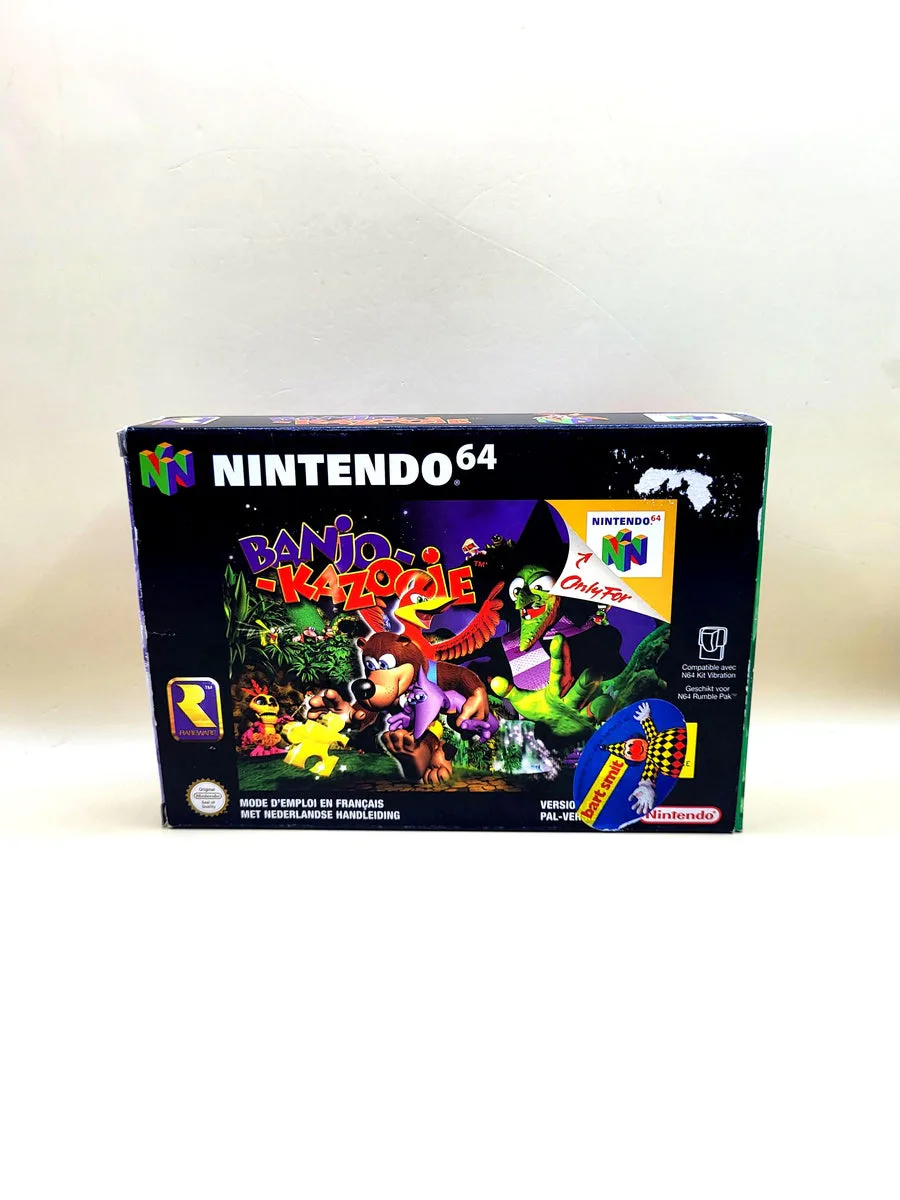
Banjo-Kazooie for Nintendo 64
In Banjo-Kazooie for Nintendo 64, you travel with Banjo the bear and Kazooie the bird through the home of the witch Gruntilda. She has kidnapped Banjo's sister Tooty. The passages in her lair lead to nine worlds, from a sunny beach to a rusty cargo ship. You search for jigsaw pieces to open new worlds and musical notes to progress through the lair. Along the way, you help inhabitants, rescue Jinjos and investigate places that seem unreachable from the ground.
You control the two main characters as a team. Banjo climbs and swims; Kazooie extends jumps with her wings, carries the bear on her legs and fires eggs. Bottles teaches you new moves along the way. Flying from special pads requires feathers, so you also need to watch your supplies. Mumbo Jumbo can transform the pair into other creatures. This makes you read the same surroundings differently: a narrow opening or dangerous ground may become a route after a transformation.
You play this platform adventure alone, with one Nintendo 64 controller. Its appeal lies in looking around, recognising tasks and combining an increasing number of actions. Finding a jigsaw piece does not immediately send you back to the central lair: you can keep searching in the same world. This lets you visit a remote building, explore a swimming route and talk to an inhabitant during one excursion, without repeatedly starting again at the entrance.
Region and language
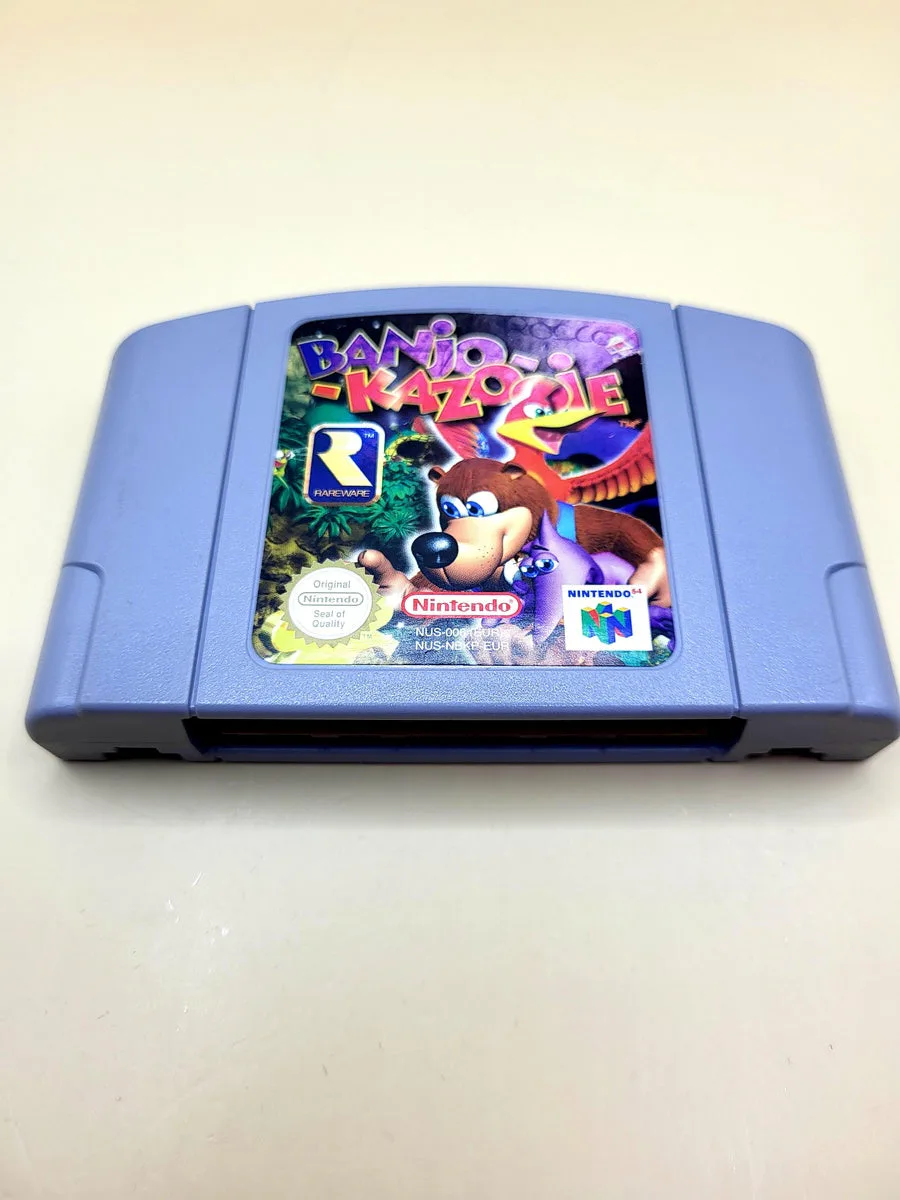
Our Nintendo 64 games are PAL editions, unless stated otherwise. This product contains a loose cartridge for the European market. A box is only included if explicitly stated in the product details. We note any different region in the product details. In almost all cases, the game is playable at least in English, and often in the other five common European languages too.
Manual
With Banjo-Kazooie for Nintendo 64, you receive a loose cartridge. A box and manual are not included unless we explicitly state otherwise in the product details. This is the standard way we supply this copy.
The history of Banjo-Kazooie
Rare developed Banjo-Kazooie and Nintendo released it for Nintendo 64 in 1998. The European edition followed on 17 July. A different project preceded the finished game. In Rare's anniversary interview, designer Gregg Mayles explained that development began as an adventure game in 1995, after Donkey Kong Country 2. Several versions carried the name Dream, and the team also briefly experimented with a side-scrolling platform game featuring three-dimensional elements.
According to Mayles, the team chose Super Mario 64 as the game it wanted to measure itself against. This influence did not produce the same mission structure. Rare wanted players to earn several jigsaw pieces in succession without leaving the world. Mayles also described imagining what you would see from different positions while designing. Heights, hidden passages and recognisable buildings were intended not just to form a route, but also to provoke curiosity or tension during exploration.
Humour and talking objects connect the worlds. The mechanical Clanker, a ship and a huge tree become places with their own problems and routes. In the sequel Banjo-Tooie, Rare further expanded the abilities and connections between areas. This original Nintendo 64 version sticks to the combined moves of bear and bird. Controlling the two characters separately and the sequel's local competitions therefore do not belong to this cartridge.
Similar games for Nintendo 64
Banjo-Kazooie and Super Mario 64 let you freely search three-dimensional worlds on Nintendo 64 for rewards that open new areas. Mario often centres on an individual star mission, returning you to the castle when you complete it. Banjo-Kazooie lets you keep exploring after a jigsaw piece. You also progress through learned moves and transformations into other creatures, whereas Mario mainly uses his established jumps and temporary caps.
Banjo-Tooie builds on Banjo-Kazooie's duo, jigsaw pieces and musical notes on Nintendo 64. The sequel also lets bear and bird act separately and more often links tasks to other areas or abilities learned later. Banjo-Kazooie keeps its worlds more self-contained. You therefore spend more time thoroughly investigating one area, while Tooie asks you to remember unresolved problems in several places.
Donkey Kong 64 shares Rare's combination of large three-dimensional areas, platforming and numerous collectibles on Nintendo 64. There you switch between five Kongs with their own abilities and items belonging to a particular character. Banjo-Kazooie usually has its two main characters work together as one controllable team. You mainly learn when to use a combined move or one of Mumbo's transformations, rather than repeatedly fetching another team member.
Kirby 64: The Crystal Shards and Banjo-Kazooie use special abilities to make hidden objects reachable on Nintendo 64. Kirby copies powers from enemies and can combine them; Banjo and Kazooie build a permanent repertoire of moves. Kirby mainly follows a sideways route through three-dimensional scenery. In Banjo-Kazooie, you must choose your own direction, search around buildings and account for your camera angle and the depth of jumps.
Yoshi's Story shares colourful animal characters, secret hunting and the use of a projectile on Nintendo 64. Yoshi aims eggs and collects fruit in side-scrolling storybook worlds. Banjo-Kazooie uses Kazooie's eggs alongside climbing, swimming and flying through freely explorable spaces. Both ask you to look beyond the quickest route, but Banjo divides progress between jigsaw pieces, musical notes and new moves in an adventure connected by a central hub.