This product is like new. At NexWave Games, like new means:
Additionally, all discs at NexWave Games are carefully inspected and assessed for quality. When discs arrive, we do not accept any that are so badly damaged that they are unlikely to work. We only accept discs with light scratches at most. Discs with scratches are then treated in our professional disc repair machine. By warming the disc and polishing it with soft brushes, these machines can remove a very thin layer from the disc. This removes the layer containing surface scratches and improves the disc’s readability. This ensures the disc works properly, even on consoles with ageing lasers that have difficulty reading games! Great news for the player.
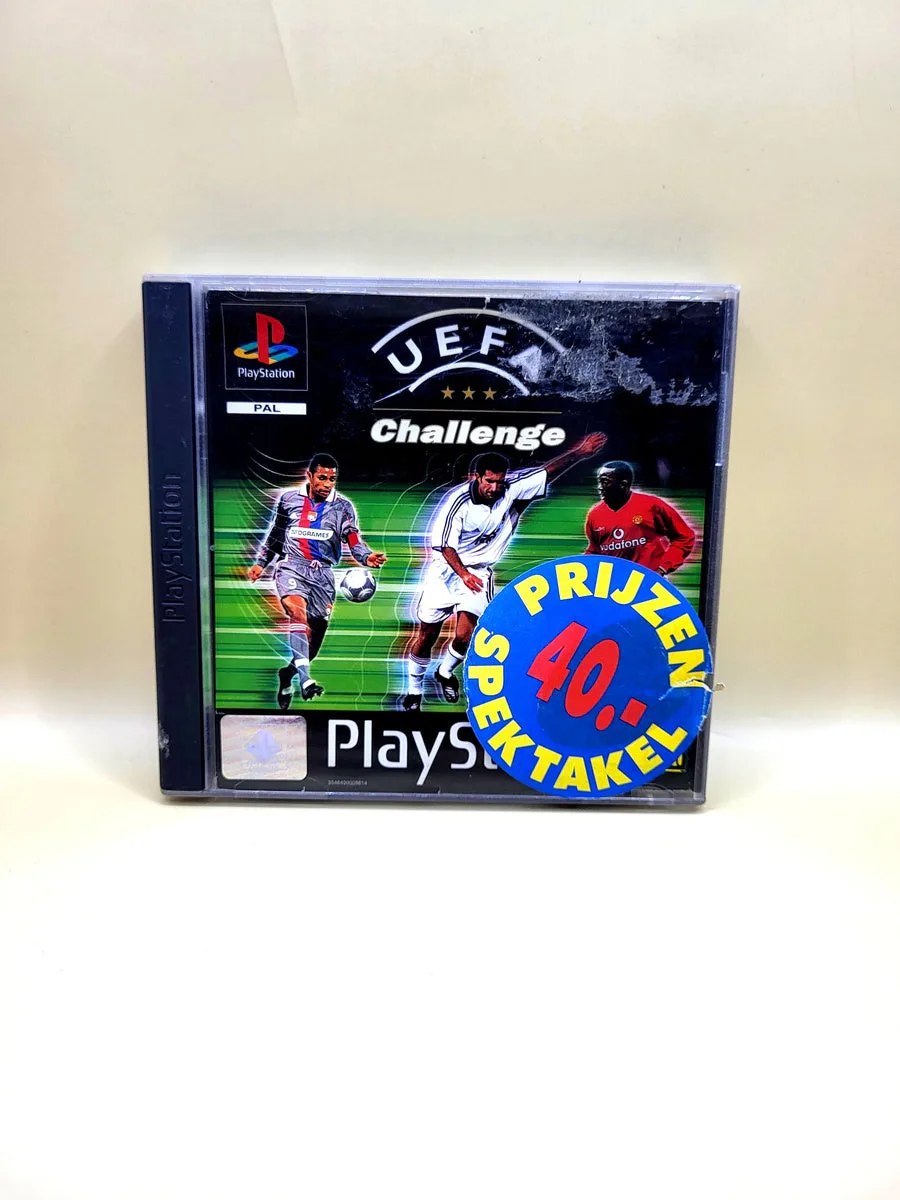
UEFA Challenge for PlayStation 1
UEFA Challenge for PlayStation 1 lets you play football matches with European clubs and national teams. You choose a team, set the line-up and try to create space for a shot through passing. A through ball reaches an attacker behind the defence, while a cross calls for a header or volley. When possession is lost, you switch to a defender and choose between a standing challenge and a sliding tackle. Separate buttons for passing, shooting and high balls give every attack different next steps.
You can choose individual matches and tournaments, but also take a team through multiple seasons. In that longer competition, you try to earn promotion and avoid relegation. The UEFA licence provides real clubs, players and kits, including Manchester United, Real Madrid and Juventus. Stadiums such as Old Trafford and Anfield place matches in recognisable settings. It is about playing football yourself on the pitch: choosing a formation does not take movement, passing and finishing out of your hands.
You play alone against the computer or locally with others. For two players, connect two PlayStation controllers; three or four need a PlayStation Multitap and one controller per person. The standard controller works, with support for analogue control and DualShock vibration. You retain game data on a PlayStation memory card requiring eight free blocks.
Region and language
Our PlayStation 1 games are PAL editions and come with a Dutch or English box, unless stated otherwise. By default, you receive the version for the European market. We note it in the product details if the region is different or the box is in another language. In almost all cases, the game is playable at least in English, and often in the other five common European languages too.
Manual
UEFA Challenge for PlayStation 1 includes the manual unless the product title states otherwise. If the booklet is missing, the title says “No Manual”. This lets you see before ordering whether the game comes with a manual.
The manuals included with our games usually contain at least English and often around six European languages. The exact languages vary by edition, so Dutch is not always included. The booklet explains the controls and the main rules. You can use it to check how to control the game, which actions are available and how its different features work.
The history of UEFA Challenge
Infogrames released UEFA Challenge in 2001, with development at its Sheffield studio. The company was trying to establish its own place on PlayStation between Electronic Arts’ and Konami’s football series. The official UEFA licence gave recognisable clubs and players an important role. At the same time, the title did not restrict itself to one Champions League season: national teams and a competition covering multiple seasons were also part of the package. The Challenge name thus referred to a broader football game.
The PlayStation release arrived when Sony’s first console continued alongside the newer PlayStation 2. Infogrames released UEFA Challenge on both consoles and PC. Its creators had to connect the matches with screens for team selection, settings and competitions. Matt, who later founded Mooflower, lists the game in his own portfolio with work on that menu environment. His credit names PlayStation, PlayStation 2 and Windows, showing that development also took place beyond the football pitch.
Its reception showed how high football expectations had become. An April 2001 PlayStation review praised the number of choices but criticised aspects including ball movement and delayed responses to input. That context explains why an official licence alone was not enough to stand out. UEFA Challenge nevertheless preserves the clubs, game structure and presentation of that moment. It therefore offers a separate perspective on late PS1 football, alongside the better-known series receiving their next instalments during the same period.
Similar games for PlayStation 1
FIFA 99 for PlayStation 1, like UEFA Challenge, lets you play matches yourself with club and national teams. EA adds the European Dream League, in which twenty leading European clubs form a competition of their own. You can also create your own cups and leagues. UEFA Challenge emphasises multiple seasons with promotion and relegation in its longer campaign. Both therefore offer club football beyond an individual match: in FIFA 99 you can also assemble your own field of entrants, while UEFA Challenge has you defend your place on the competition ladder.
ISS Pro Evolution 2 for PlayStation 1, like UEFA Challenge, combines international teams with club football. Konami gives building a team its own structure in Master League, where matches make further development possible. UEFA Challenge presents real UEFA clubs and a multi-season competition focused on promotion and relegation. In both, you control the action on the pitch. The difference lies in the structure surrounding those matches and the way the clubs are represented.
UEFA Champions League Season 1999/2000 for PlayStation 1 also uses an official UEFA licence and recognisable European clubs. It focuses on that particular Champions League season, with individual matches and a cup campaign. UEFA Challenge includes national teams alongside clubs and offers a competition lasting multiple seasons. The similarity is therefore licensed European football; the differences lie in the breadth of team selection and the kind of sporting objective you pursue.
UEFA Euro 2000 for PlayStation 1, like UEFA Challenge, puts an official UEFA name on the box but focuses on the European Championship for national teams. Qualifying and the finals form a recognisable route through one summer of football. UEFA Challenge also lets you play with clubs and complete multiple seasons with promotion and relegation. In both, you build attacks and adjust the team; the tournament nevertheless determines a different series of matches and choice of teams.
This Is Football 2 for PlayStation 1 shares UEFA Challenge’s attacking build-up, shooting and defending with a directly controlled player. Sony adds school football and Timewarp, a competition featuring famous teams from earlier decades. UEFA Challenge uses the clubs and players of around 2001 and lets you progress through multiple seasons with promotion and relegation. The similarity lies in extensive club and national football. This Is Football 2’s historical team selection and school matches give the games a different context from that competition ladder.