This product is like new. At NexWave Games, like new means:
Additionally, all discs at NexWave Games are carefully inspected and assessed for quality. When discs arrive, we do not accept any that are so badly damaged that they are unlikely to work. We only accept discs with light scratches at most. Discs with scratches are then treated in our professional disc repair machine. By warming the disc and polishing it with soft brushes, these machines can remove a very thin layer from the disc. This removes the layer containing surface scratches and improves the disc’s readability. This ensures the disc works properly, even on consoles with ageing lasers that have difficulty reading games! Great news for the player.
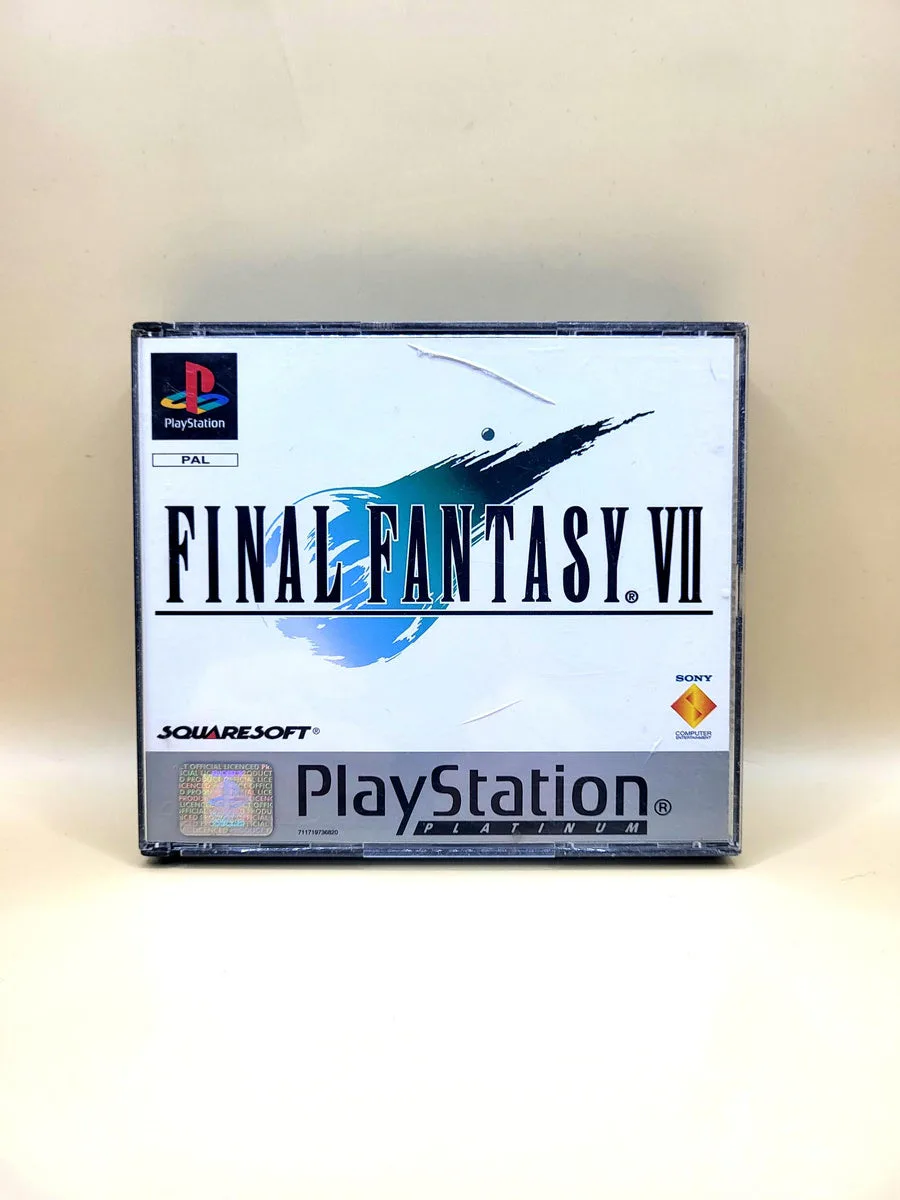
Final Fantasy VII for PlayStation 1
Final Fantasy VII for PlayStation 1 is a Japanese RPG in which mercenary Cloud Strife joins the resistance group Avalanche. In Midgar, the group opposes Shinra, a company that draws energy from the planet. The opening missions take place among reactors, residential districts beneath steel plates and the company's headquarters. Later, you head out into the world with Cloud and his allies. There, the struggle takes on a different scale and his own past becomes increasingly important.
During battles, you choose commands for three party members as their time gauges fill. You attack, use items or cast magic through Materia: coloured orbs placed in weapons and defensive equipment. Redistributing Materia changes each character's role. When a party member takes damage, their Limit gauge fills. This allows them to perform a powerful personal technique. Against bosses, it helps to consider not just damage but also protection and healing when preparing your party.
Between story sequences, you visit shops, search side paths and later travel across the world map using different vehicles. Chocobos and the attractions at Gold Saucer offer other activities alongside the main story. You play alone with a standard PlayStation controller. You save your progress manually to a PlayStation memory card, on the world map or at save points. This Platinum edition contains the original PlayStation game on three discs, not the later remake.
Region and language
Our PlayStation 1 games are PAL editions and come with a Dutch or English box, unless stated otherwise. By default, you receive the version for the European market. We note it in the product details if the region is different or the box is in another language. In almost all cases, the game is playable at least in English, and often in the other five common European languages too.
Manual
Final Fantasy VII for PlayStation 1 includes the manual unless the product title states otherwise. If the booklet is missing, the title says “No Manual”. This lets you see before ordering whether the game comes with a manual.
The manuals included with our games usually contain at least English and often around six European languages. The exact languages vary by edition, so Dutch is not always included. The booklet explains the controls and the main rules. You can use it to check how to control the game, which actions are available and how its different features work.
The history of Final Fantasy VII
Final Fantasy VII appeared in 1997 and was the series' first main entry on PlayStation. Square switched its playable characters from sprites to polygons. In towns and interiors, the developer combined those figures with pre-rendered backgrounds. Computer-animated sequences also took an important role in telling the story. The transition is visible when a scene switches from a playable street view to a movie sequence without the surroundings suddenly seeming to become an entirely different place.
Director Yoshinori Kitase later described on PlayStation Blog how CD-ROM capacity made that amount of movie footage possible. The technology also brought new problems: the team had to keep loading times for battles and scenes under control. Artists from the computer-animation industry joined Square to create the sequences, bringing a different working approach from the one the game designers knew. Changing a few seconds of film could take much more work and money than adjusting a normal gameplay scene.
Alongside that presentation, the team built the Materia system, allowing you to give characters their own distribution of spells and abilities. Individual party members' backgrounds also received attention, including optional allies who are easy to miss. Kitase said he only truly felt the game's international impact when players brought their copies for him to sign during a promotional tour. The later Platinum packaging is a reissue of that original adventure, not a new chapter or a redesigned battle system.
Similar games for PlayStation 1
Final Fantasy VI also uses time gauges and a group of travellers who bring their personal troubles into a larger conflict. Where VII lets you distribute Materia across three active party members, VI uses four fighters with individual commands such as stealing or using tools. VI's sprites show an older style than VII's polygons and computer-animated films. VI also shifts between different protagonists more often, while Cloud remains much more clearly the fixed centre of VII's journey.
Final Fantasy VIII shares VII's cinematic presentation, time gauges and three active fighters. Guardian Forces and the Junction system replace Materia orbs there. You collect spells and link them to character stats, giving preparation a different meaning. Squall's training and his relationship with Rinoa form VIII's main thread. VII begins with Avalanche and Shinra, building its journey around the world around Cloud, his memories and the consequences of energy consumption.
Final Fantasy IX on PlayStation 1 also combines pre-rendered backgrounds with three-dimensional characters and major movie sequences. Its adventure, however, chooses castles, theatre and familiar fantasy roles instead of VII's reactors and corporate armies. You use four party members and learn abilities through equipment. VII allows a freer distribution of roles through Materia and keeps three fighters active. Both place lighter activities and personal conversations alongside a story about war and lives under threat.
Like VII, The Legend of Dragoon offers a long journey across several PlayStation discs, with three fighters and close attention to their backgrounds. During attacks, however, its Addition system requires timed button presses. Dragon powers also give characters a separate form for powerful techniques. VII places more emphasis on menu commands, Materia combinations and filled Limit gauges. Both call for thoughtful party composition, but in Dragoon your timing during normal attacks remains a much more visible part of combat.
Wild Arms shares the journey with three protagonists and the combination of magic with unusual weapons. Its world, Filgaia, has its own Western atmosphere, however, and exploration includes many puzzles in which characters use tools. VII more often spreads such breaks across minigames and story events. Wild Arms also uses conventional turns in combat, while VII works with time gauges. Their main similarity lies in equipping a small party and gradually discovering a world under threat.