This product is like new. At NexWave Games, like new means:
Additionally, all discs at NexWave Games are carefully inspected and assessed for quality. When discs arrive, we do not accept any that are so badly damaged that they are unlikely to work. We only accept discs with light scratches at most. Discs with scratches are then treated in our professional disc repair machine. By warming the disc and polishing it with soft brushes, these machines can remove a very thin layer from the disc. This removes the layer containing surface scratches and improves the disc’s readability. This ensures the disc works properly, even on consoles with ageing lasers that have difficulty reading games! Great news for the player.
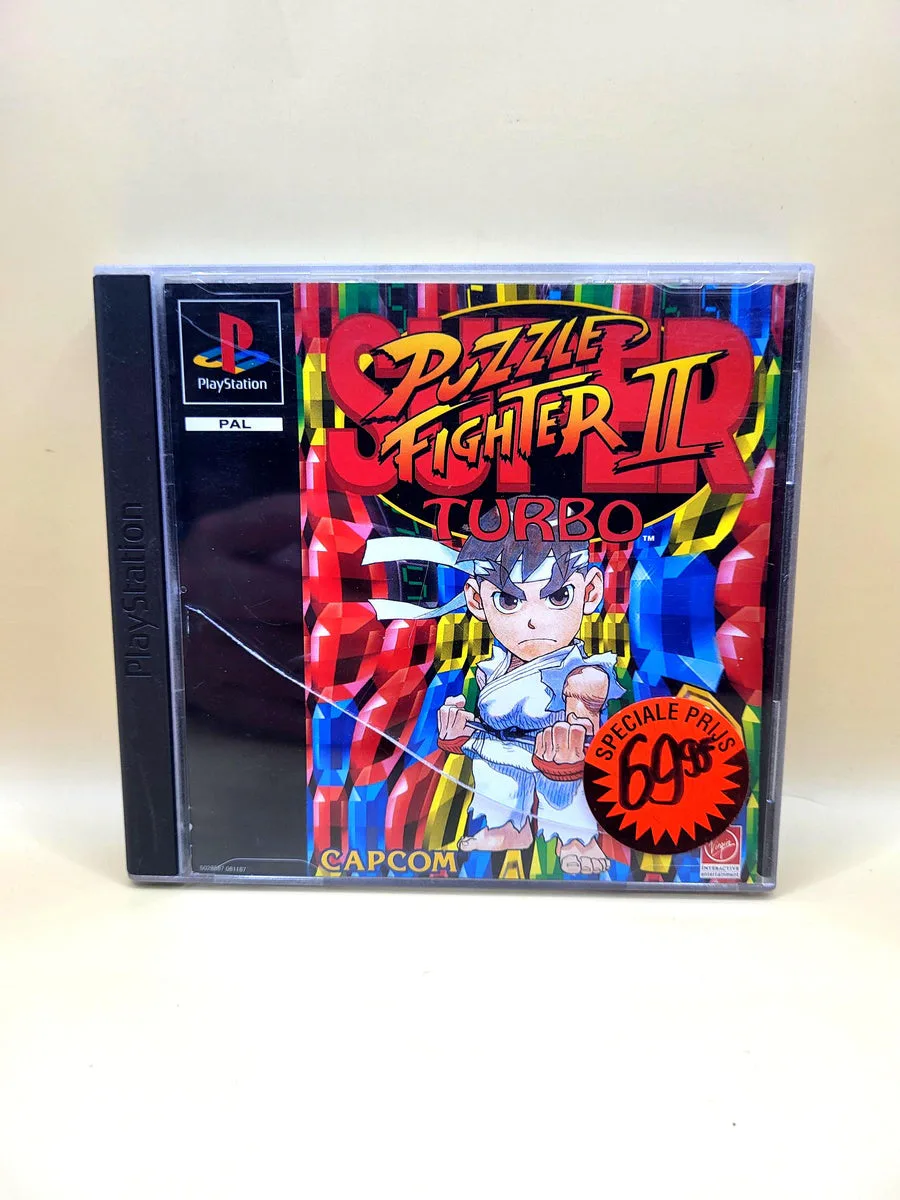
Super Puzzle Fighter II Turbo for PlayStation 1
Super Puzzle Fighter II Turbo for PlayStation 1 is a puzzle game in which you rotate and place falling pairs of gems. You build groups of the same colour and break them with a matching Crash Gem. This sends obstacles to your opponent's playfield. Ryu, Chun-Li, Morrigan and other Capcom characters act out the battle beside the fields, but you control the gems. Victory comes from stacking and timing, not from performing fighting combinations.
Larger rectangles of a single colour form Power Gems and can produce a heavy counterattack. Incoming Counter Gems count down before becoming normal gems. You therefore need to keep space available to absorb attacks while preparing another chain reaction. Each selected character uses its own pattern for sent gems. Your character choice consequently affects how your attacks land on the other side, while you continue using the same basic rules on your own board.
Arcade lets you play against computer-controlled opponents. For a local two-person duel, each player uses a controller; no Multitap is needed. Street Puzzle adds matches that unlock extras, which you can find through the Goodies menu. Save those unlocks on a PlayStation memory card before quitting. Short matches and rising pressure let you play a single rematch or spend longer practising how to build and break larger groups.
Region and language
Our PlayStation 1 games are PAL editions and come with a Dutch or English box, unless stated otherwise. By default, you receive the version for the European market. We note it in the product details if the region is different or the box is in another language. In almost all cases, the game is playable at least in English, and often in the other five common European languages too.
Manual
Super Puzzle Fighter II Turbo for PlayStation 1 includes the manual unless the product title states otherwise. If the booklet is missing, the title says “No Manual”. This lets you see before ordering whether the game comes with a manual.
The manuals included with our games usually contain at least English and often around six European languages. The exact languages vary by edition, so Dutch is not always included. The booklet explains the controls and the main rules. You can use it to check how to control the game, which actions are available and how its different features work.
The history of Super Puzzle Fighter II Turbo
Capcom originally brought Super Puzzle Fighter II Turbo to arcades in 1996. Home versions followed, including the European PlayStation release in 1997 through Virgin Interactive. The title plays with Street Fighter's naming conventions but belongs to another genre. Familiar fighters received small, comically drawn versions and reacted to the puzzle battle. Capcom thus used established characters to give a game about colours, falling gems and chain reactions its own identity on the same console.
The design links clearing to attacking: what you break on your own field creates new problems for your opponent. Fixed attack patterns for each character add meaning to the choice between Street Fighter and Darkstalkers figures. The home release added a way to collect rewards through Street Puzzle. You could therefore pursue longer-term goals alongside direct competition, without changing the rules for rotating and breaking gems.
HD Remix appeared for newer systems in 2007, adding revised visuals, other gameplay variants and online features, among other changes. That release must be distinguished from this original PlayStation 1 disc. Here you get the older console version with local duels, Arcade and Street Puzzle, not the later reworking. Two simultaneous puzzle fields, individual attack patterns and brief cartoon attacks give the game its particular character. The fighters provide the presentation; planning your gems remains the core.
Similar games for PlayStation 1
Tetris Plus also drops shapes into a field from above and asks you to keep space available. It clears complete horizontal rows, whereas Puzzle Fighter requires you to bring a Crash Gem to a coloured group. Tetris Plus adds puzzles in which you help a professor reach the bottom before the ceiling catches him. Puzzle Fighter channels that pressure into a direct duel: your successful clearing action fills your opponent's board further.
Like Puzzle Fighter, Bust-A-Move 2: Arcade Edition revolves around matching colours and keeping track as the field fills up. You shoot bubbles upwards from an aimed launcher rather than placing falling pairs. Three matching bubbles can disappear, while Puzzle Fighter requires the right breaking gem. Bust-A-Move therefore mainly has you practise shooting angles and detaching suspended groups, whereas here you prepare larger stacks for another chain reaction.
Devil Dice has you roll dice across a three-dimensional playfield so adjacent top faces show the same number. It shares Puzzle Fighter's planning of groups and use of chain reactions, but uses spatial orientation instead of coloured pairs. Rolling a die changes the number on top; rotating a gem pair mainly changes the positions of its two colours. You therefore plan ahead differently, even when both games ask you to keep enough space available under pressure.
Mr. Driller also combines coloured blocks with quick decisions and predicting falling groups. You control a character drilling downwards and must avoid being crushed by blocks that come loose. Puzzle Fighter keeps its characters beside the board and lets you place the new gems. One game therefore asks for a safe route through existing material, while the other revolves around building groups that you deliberately clear later.
Ballistic uses colour matches and chain reactions, but sends balls along a track towards an opening. From a central cannon, you shoot new balls into that stream to remove groups. Puzzle Fighter instead gives you a rectangular field in which you stack falling pairs. In Ballistic, you choose the shooting direction and the moment you hit the moving sequence; here you decide where a new gem lands and when a Crash Gem activates a prepared group.