This product is like new. At NexWave Games, like new means:
Additionally, all discs at NexWave Games are carefully inspected and assessed for quality. When discs arrive, we do not accept any that are so badly damaged that they are unlikely to work. We only accept discs with light scratches at most. Discs with scratches are then treated in our professional disc repair machine. By warming the disc and polishing it with soft brushes, these machines can remove a very thin layer from the disc. This removes the layer containing surface scratches and improves the disc’s readability. This ensures the disc works properly, even on consoles with ageing lasers that have difficulty reading games! Great news for the player.
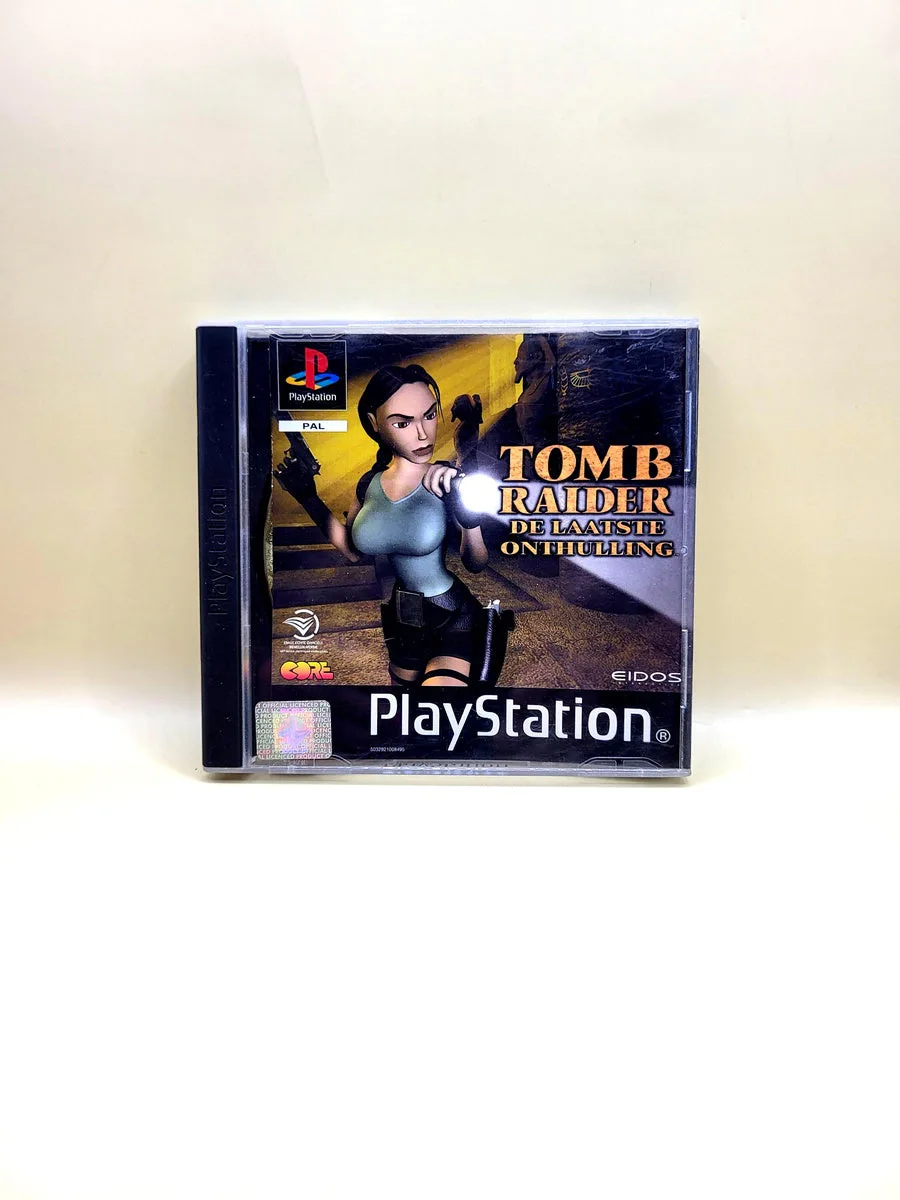
Tomb Raider: The Last Revelation for PlayStation 1
In Tomb Raider: The Last Revelation for PlayStation 1, Lara Croft tries to put right her own mistake. When she takes an amulet from a tomb in Egypt, she releases the god Set. You explore temples and burial chambers to imprison him again. An introduction featuring young Lara and her mentor Werner Von Croy in Cambodia lays the foundations for their strained relationship. Puzzles, dangerous jumps and encounters with supernatural enemies follow.
You view the surroundings from behind Lara and use walking, climbing, swimming and crawling to get farther. You swing on ropes across open spaces and climb poles to another floor. The inventory plays a major role: you combine discovered objects and can, for example, attach a laser sight to a compatible weapon. A passage that initially seems to lead nowhere may later turn out to be part of a larger puzzle. It therefore helps to remember connections between rooms and how mechanisms work.
The adventure is for one player and works with a standard PlayStation controller; a DualShock also provides analogue controls and vibration. You save your progress manually through Save Game in the inventory onto a Memory Card with enough free space. You do not have to collect or consume save crystals to do this. You can therefore prepare for a risky jump and record your last safe position. Afterwards, you return to looking for ledges, avoiding traps and working out which object belongs with a mechanism.
Region and language
Our PlayStation 1 games are PAL editions and come with a Dutch or English box, unless stated otherwise. By default, you receive the version for the European market. We note it in the product details if the region is different or the box is in another language. In almost all cases, the game is playable at least in English, and often in the other five common European languages too.
Manual
The manual is missing from this copy of Tomb Raider: The Last Revelation for PlayStation 1. That is why the product title says “No Manual”. You receive the game in its box, without the instruction booklet. This makes the contents clear before you order.
The original printed manual usually contains at least English and often around six European languages. The languages vary by edition; Dutch is not always included. This information describes the original booklet and does not mean that it comes with this copy. A copy with a manual is offered separately when available.
The history of Tomb Raider: The Last Revelation
Tomb Raider: The Last Revelation was released in 1999, developed by Core Design and published by Eidos Interactive. It was the fourth main instalment in a series that had received a new adventure annually since 1996. After Tomb Raider III's world tour, the studio chose a story that concentrates on Egypt following the introduction in Cambodia. Lara's search consequently gained a clearer geographical connection, with temples, burial chambers and places drawing on Egyptian history and mythology.
Designers Richard Morton and Andy Sandham later explained in an official interview that the team planned the story together with the locations from the outset. They wanted to explore one region in depth and make Lara experience the consequences of her own actions. Young Lara and Von Croy make this personal: their earlier partnership explains why their later confrontations mean more than a struggle over a valuable object. Releasing Set also gives Lara a mistake to put right.
The rules remained recognisable, but ropes, climbable poles and combining inventory objects expanded the puzzles. Saving also changed compared with Tomb Raider III on PlayStation: you could record your position through the inventory without consumable crystals. The next instalment, Tomb Raider: Chronicles in 2000, returned to separate flashbacks. This original PlayStation release therefore represents the moment when Core Design built one connected Egyptian adventure around Lara's own responsibility, within the familiar controls of the early series.
Similar games for PlayStation 1
Tomb Raider for PlayStation 1, like The Last Revelation, has you explore ancient buildings, operate switches and perform precise jumps. The first game follows the Scion through different regions and uses fixed save crystals on PlayStation. The Last Revelation concentrates on Egypt after Cambodia and lets you save without those crystals. Combining inventory objects and swinging on ropes also give you more ways to work out a route or puzzle in the fourth game.
Tomb Raider II for PlayStation 1 connects Lara's jumps and puzzles with the search for the Dagger of Xian. You travel between markedly different settings and regularly face armed human opponents. The Last Revelation brings its story together mainly in Egypt, with an amulet and the release of Set providing the starting point. The established directional controls remain recognisable, but ropes, poles and combining objects call for different solutions to obstacles in the surroundings here.
Tomb Raider III for PlayStation 1 introduced the crawling, sprinting and overhead traversal that you also use in The Last Revelation. The third game travels from India to places including London and Antarctica and lets you play three destinations in an order you choose. After its introduction, The Last Revelation uses an Egyptian main storyline. An important practical difference is saving: III consumes collected crystals for this during levels; The Last Revelation lets you save from the inventory without that supply.
Tomb Raider: Chronicles for PlayStation 1 follows on narratively from Lara's disappearance in Egypt. Her friends reminisce, and you then experience four earlier adventures in very different settings. The precise jumps and exploration of rooms feel familiar, but the separate stories each have their own structure. The Last Revelation keeps the focus on one Egyptian mystery for longer. If you want to follow the development of Lara and Von Croy, this predecessor provides the background to their relationship.
Legacy of Kain: Soul Reaver for PlayStation 1 shares the exploration of large three-dimensional spaces and solving puzzles to progress. Raziel can shift between a material and a spectral world, letting you use the same place in a different way. The Last Revelation relies on Lara's human movements and tools, such as ropes and combined inventory objects. Raziel's revenge story and Lara's attempt to imprison Set again give the search a very different motivation and atmosphere in each game.