
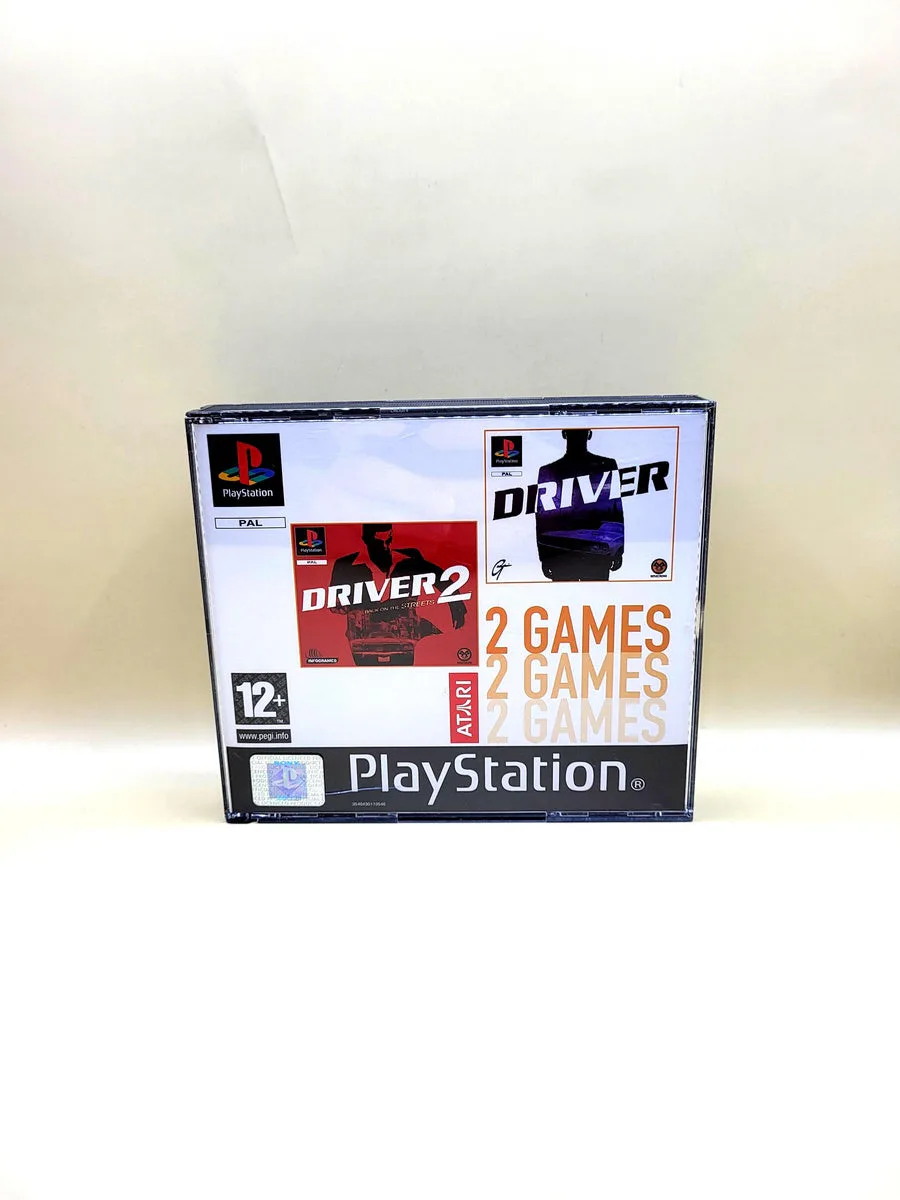
Driver 1,2 And Limited DVD Collection - PlayStation 1 - PS1
€ 99,99
€ 26,99
Currently sold out
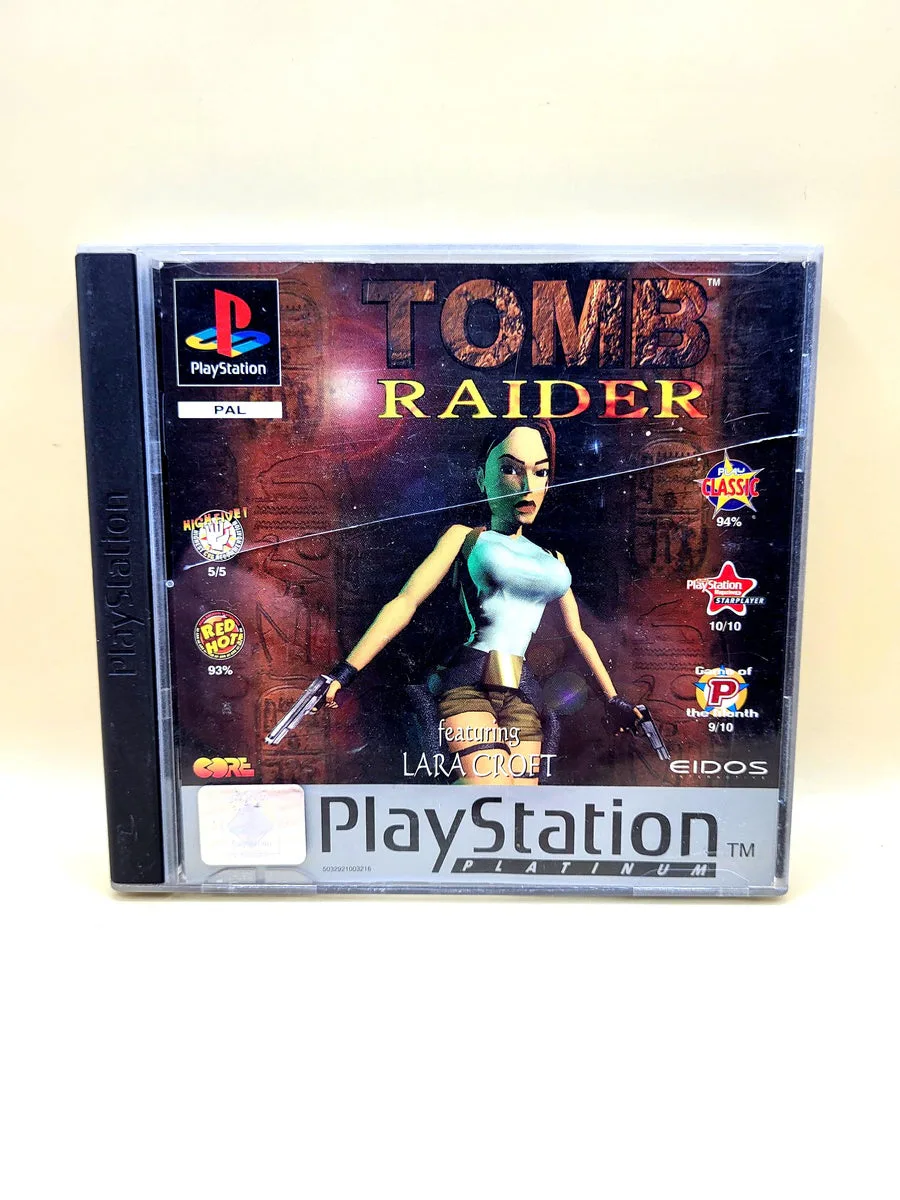
Goed. Heeft een kleine scheur in het doosje.
In Tomb Raider for PlayStation 1, you follow Lara Croft as she searches for the Scion, an ancient artefact whose pieces lie scattered across different regions. Her assignment begins in Peru and takes her through Greek ruins, Egyptian structures and Atlantis. You explore large three-dimensional spaces, search for switches and keys, and discover how rooms connect. Reaching a door on the far side often first requires a detour along ledges, waterways and moving traps.
Lara can walk, run, jump, swim and grab ledges. You turn her on the spot to line up a jump carefully; walking slowly towards an edge helps you judge the distance. Moving blocks and operating mechanisms matter just as much as shooting. Her twin pistols have unlimited ammunition, while heavier weapons consume cartridges you find. Wolves, bears and other enemies interrupt your exploration, but not every new room begins with a fight.
This is a single-player adventure played with a standard PlayStation controller. At Lara’s home, you can practise movements before setting off. The original console version uses fixed crystals to save mid-level progress to a PlayStation memory card; you also get a chance to save after completing a level. Saving freely at any point, as in the original PC version, is not part of this release. Secrets and the statistics after each level give you further reasons to look around carefully.
Our PlayStation 1 games are PAL editions and come with a Dutch or English box, unless stated otherwise. By default, you receive the version for the European market. We note it in the product details if the region is different or the box is in another language. In almost all cases, the game is playable at least in English, and often in the other five common European languages too.
Tomb Raider for PlayStation 1 includes the manual unless the product title states otherwise. If the booklet is missing, the title says “No Manual”. This lets you see before ordering whether the game comes with a manual.
The manuals included with our games usually contain at least English and often around six European languages. The exact languages vary by edition, so Dutch is not always included. The booklet explains the controls and the main rules. You can use it to check how to control the game, which actions are available and how its different features work.
Core Design developed Tomb Raider, which Eidos released in 1996. It appeared on Saturn, PlayStation and PC, introducing Lara Croft as the lead character in a new action adventure. The original concept came from Toby Gard; Paul Douglas served as lead programmer and Vicky Arnold wrote the script. Combining a visible heroine, large 3D spaces and precisely calculated movements required a different approach from the side-scrolling adventures many players had known before.
The developers built rooms around a recognisable grid so that Lara’s walking distance and jumping range matched the architecture. In later recollections, Douglas cited Prince of Persia’s animation and tile-based layout as influences. This helps explain why observation and positioning play such important roles. Nathan McCree composed music that enters at important moments, leaving room for footsteps, ambient sounds and silence. Discovering a new place therefore often takes precedence over a constant accompaniment of action.
Tomb Raider laid the foundations for a series that continued with Tomb Raider II as early as 1997. The first PlayStation release remains a distinct game, with its original graphics, controls and save crystals. The later Tomb Raider: Anniversary rebuilt the adventure, while Tomb Raider I-III Remastered added different presentation and control choices. Those changes and the additional PC levels from Unfinished Business are not included in this original PlayStation version, regardless of later Platinum packaging.
Tomb Raider II has you judging distances, swimming and searching for keys with Lara on the same PlayStation. The sequel adds climbable walls, vehicles and more human enemies. You can also save at any time through the passport. The first Tomb Raider keeps the journey more focused on remote ruins and uses fixed save crystals. An unfamiliar corridor and the route back to a safe point therefore carry different weight here.
Tomb Raider III: Adventures of Lara Croft builds on the same combination of traps, hidden rooms and precise jumping. Lara can also crawl and sprint, and you can tackle part of the journey in an order of your choosing. The first game follows a fixed route with fewer movements. Its challenge therefore lies mainly in reading the space and correctly executing familiar jumps.
Tomb Raider: The Last Revelation also uses ancient structures, puzzles and Lara’s acrobatics, but concentrates its main adventure in Egypt. Combining items and revisiting connected areas take on greater importance. Tomb Raider from 1996 travels through different civilisations and uses clearly separated levels. You solve mechanisms here too, but do not need to keep track of the same extensive network of locations and inventory combinations as in the later Egyptian adventure.
Legacy of Kain: Soul Reaver shares the exploration of large 3D structures and the search for routes above or below you. Raziel can, however, shift between material and spectral realms, changing parts of the environment. Lara solves her route problems through jumping, swimming, blocks and switches. Soul Reaver ties its puzzles more closely to supernatural powers and a continuous landscape; Tomb Raider offers a journey through separate archaeological locations.
Like Tomb Raider, Fade to Black places a visible character in a three-dimensional world full of dangers and equipment to operate. Conrad Hart escapes an alien prison using, among other things, a pistol, a communicator and items from his inventory. Lara’s adventure puts greater emphasis on climbing, long jumps and changes in elevation. Both require careful turning and looking, but Fade to Black more often finds its tension in corridors, guards and science-fiction installations.
€ 99,99
€ 89,99
€ 69,99

€ 64,99
€ 59,99
€ 59,99
€ 59,99
€ 54,99
€ 54,99
€ 49,99