This product is like new. At NexWave Games, like new means:
Additionally, all discs at NexWave Games are carefully inspected and assessed for quality. When discs arrive, we do not accept any that are so badly damaged that they are unlikely to work. We only accept discs with light scratches at most. Discs with scratches are then treated in our professional disc repair machine. By warming the disc and polishing it with soft brushes, these machines can remove a very thin layer from the disc. This removes the layer containing surface scratches and improves the disc’s readability. This ensures the disc works properly, even on consoles with ageing lasers that have difficulty reading games! Great news for the player.
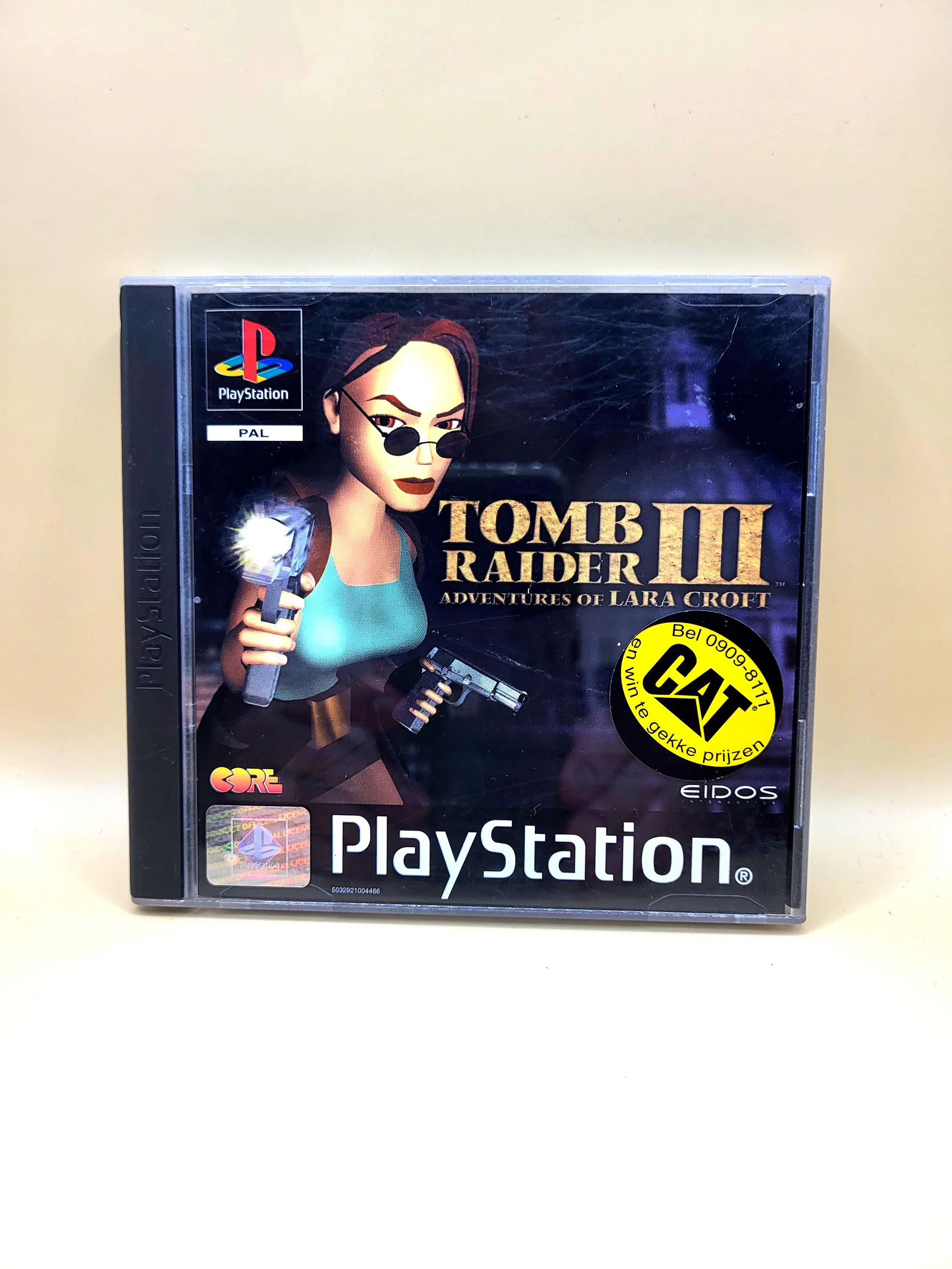
Tomb Raider III for PlayStation 1
In Tomb Raider III for PlayStation 1, you follow Lara Croft's search for artefacts connected to an ancient meteorite. The quest takes you through India, Nevada, London, the South Pacific and Antarctica. You explore temples, government compounds and dark underground passages from a viewpoint behind Lara. A switch may open a passage farther away, while an inconspicuous ledge leads to another route. Looking around carefully saves you detours and helps you discover hidden supplies.
Lara can now crawl through low openings, sprint short distances and traverse overhead bars while hanging from them. You use these moves alongside the familiar jumping, swimming and climbing. The direction Lara faces determines how you prepare a jump: taking a run-up and approaching an edge carefully remain important. Along the way, gunfights alternate with traps and spatial puzzles. Vehicles such as the quad bike and kayak require a different approach again, for example when you have to follow flowing water or drive across a gap.
You play this action-adventure alone with a standard PlayStation controller; a DualShock also offers analogue controls and vibration. After India, you choose the order of three destinations before the story comes together in Antarctica. In this original PlayStation version, you need a Memory Card and collected save crystals to save your position during a level. You use a crystal from the inventory, so you do not have to stay where you found it. This means you keep weighing up when to secure your progress.
Region and language
Our PlayStation 1 games are PAL editions and come with a Dutch or English box, unless stated otherwise. By default, you receive the version for the European market. We note it in the product details if the region is different or the box is in another language. In almost all cases, the game is playable at least in English, and often in the other five common European languages too.
Manual
The manual is missing from this copy of Tomb Raider III for PlayStation 1. That is why the product title says “No Manual”. You receive the game in its box, without the instruction booklet. This makes the contents clear before you order.
The original printed manual usually contains at least English and often around six European languages. The languages vary by edition; Dutch is not always included. This information describes the original booklet and does not mean that it comes with this copy. A copy with a manual is offered separately when available.
The history of Tomb Raider III
Core Design developed Tomb Raider III and Eidos Interactive released it in 1998. It was Lara Croft's third major adventure, following Tomb Raider in 1996 and Tomb Raider II in 1997. The series was receiving a new instalment every year at the time. For this game, the studio expanded the existing foundations with new moves, vehicles and a different travel structure. Lara remained recognisable as an explorer who uses jumps, weapons and discovered objects to find her way through large three-dimensional environments.
Eidos presented the game at E3 in May 1998. The press release at the time emphasised improved visuals, weather effects and the ability to choose the order of destinations. That last feature appears in the finished adventure: after the first chapter, you decide which of three journeys to take first. Moving from a jungle to London or Nevada gives each trip its own setting, while the mystery surrounding the meteorite links the different storylines together.
The new moves also changed how obstacles were designed. Low passages made crawling necessary, and overhead bars added routes across chasms. This increased the number of things you had to watch for while exploring. This PlayStation release also retains the original system of consumable save crystals; the PC version and later remasters handle this differently. Tomb Raider III thus shows how Core Design expanded the established pattern of exploration, puzzles and combat without abandoning Lara's precise controls based on the direction she faces.
Similar games for PlayStation 1
Tomb Raider for PlayStation 1 gives you the same foundations of judging distances, grabbing ledges and searching for switches. The first adventure focuses on the search for the Scion and does not yet include crawling or sprinting. Tomb Raider III asks you to combine more moves and switches more often between very different types of locations. In the original, you use save crystals where they stand; in III, you carry collected crystals with you and choose where to consume them.
Tomb Raider II for PlayStation 1 shares the combination of climbing, armed opponents and vehicles. There, you follow the search for the Dagger of Xian in a fixed order. Tomb Raider III adds crawling and sprinting and lets you choose part of the travel order. Saving differs too: II lets you save during play with a Memory Card without consumable crystals, whereas III makes that supply part of your decisions again.
Tomb Raider: The Last Revelation for PlayStation 1 builds on Lara's crawling, sprinting and overhead traversal. After an introduction in Cambodia, that adventure focuses on Egypt, with closer links between nearby areas and discovered puzzle items. Tomb Raider III instead travels between widely separated countries. The Last Revelation lets you save through the inventory without save crystals; III makes every crystal you use part of your resource management. Both demand carefully planned jumps and attention to hidden passages.
Tomb Raider: Chronicles for PlayStation 1 divides Lara's experiences into four separate flashbacks. You visit places including Rome, a Russian submarine and a modern office complex. As in Tomb Raider III, the surroundings therefore change considerably, but Chronicles uses short, separate stories rather than one search for meteorite artefacts. III also gives you control over the order of three destinations. In both games, you keep reading routes, collecting objects and guiding Lara precisely along dangerous edges.
Legacy of Kain: Soul Reaver for PlayStation 1 connects three-dimensional exploration and spatial puzzles with Raziel's revenge on Kain. You shift between the material and spectral worlds, changing passages and the shape of the surroundings. Tomb Raider III builds its obstacles around Lara's physical movements, vehicles and discovered tools. Where Raziel's realm shifting makes you see a space differently, Lara more often calls for an exact run-up, a controlled jump or a route through the water.