This product is like new. At NexWave Games, like new means:
Additionally, all discs at NexWave Games are carefully inspected and assessed for quality. When discs arrive, we do not accept any that are so badly damaged that they are unlikely to work. We only accept discs with light scratches at most. Discs with scratches are then treated in our professional disc repair machine. By warming the disc and polishing it with soft brushes, these machines can remove a very thin layer from the disc. This removes the layer containing surface scratches and improves the disc’s readability. This ensures the disc works properly, even on consoles with ageing lasers that have difficulty reading games! Great news for the player.
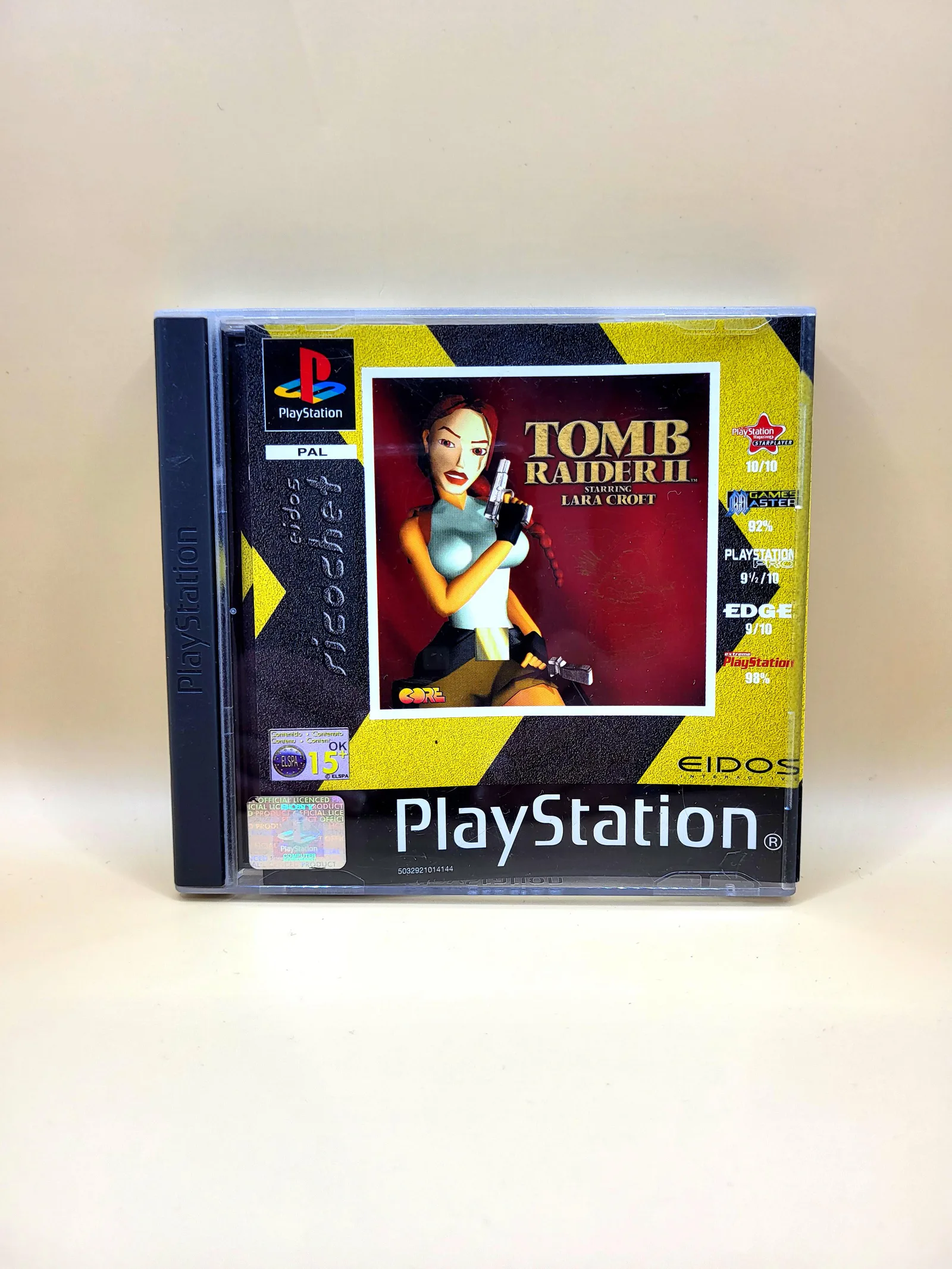
Tomb Raider II for PlayStation 1
Tomb Raider II for PlayStation 1 sends Lara Croft after the Dagger of Xian. Legend says this Chinese artefact can transform its owner into a dragon. Her search begins at the Great Wall of China and takes her to places including Venice, a sunken ship and Tibet. You investigate rooms, pull switches and look for keys while members of a violent cult pursue the same goal. The route combines archaeological puzzles with chases and gunfights.
You use Lara’s familiar jumps, swimming movements and ledge grabs, but can now also climb certain walls. A motorboat and snowmobiles give parts of the journey a different pace. Flares reveal dark corners; underwater, you must watch her air supply. Alongside her twin pistols, you find other weapons and their ammunition. Human enemies appear more often than in the first game, making movement while shooting and choosing your position particularly important.
You play alone with a standard PlayStation controller. Croft Manor gives you space to practise the controls and look around before starting the expedition itself. You can save your progress to a PlayStation memory card at any time using Save Game in the passport; fixed save crystals are not required. The individual levels also contain secrets to find. This is the original second adventure, without the extra Golden Mask levels created for the PC expansion.
Region and language
Our PlayStation 1 games are PAL editions and come with a Dutch or English box, unless stated otherwise. By default, you receive the version for the European market. We note it in the product details if the region is different or the box is in another language. In almost all cases, the game is playable at least in English, and often in the other five common European languages too.
Manual
Tomb Raider II for PlayStation 1 includes the manual unless the product title states otherwise. If the booklet is missing, the title says “No Manual”. This lets you see before ordering whether the game comes with a manual.
The manuals included with our games usually contain at least English and often around six European languages. The exact languages vary by edition, so Dutch is not always included. The booklet explains the controls and the main rules. You can use it to check how to control the game, which actions are available and how its different features work.
The history of Tomb Raider II
Core Design made Tomb Raider II after the first adventure introduced Lara Croft in 1996. Eidos released the sequel for PlayStation and PC in 1997. The team retained the recognisable movement and exploration of three-dimensional structures, but gave Lara a wider-ranging journey and new actions. Gavin Rummery was credited as lead programmer; Nathan McCree again provided music and sound. Her return therefore came just one year after the series began.
The sequel expanded the technology and game design in specific ways. Climbable walls added vertical routes, vehicles changed the scale of some areas, and flares let you illuminate dark passages yourself. Locations alternated ancient walls and monasteries with canals, industrial installations and a shipwreck. Finding a route therefore remained familiar while Lara more often entered environments built and used by people. The greater presence of armed enemies also changed the balance between quiet investigation and direct action.
Saving also changed on PlayStation: you could now choose when to save through the passport. This clearly distinguishes Tomb Raider II from the fixed crystals in the first console adventure. Later budget-label reissues belong to that same original generation of the game. Golden Mask appeared as a separate PC expansion and was later included with the remaster, but is not part of this PS1 version. The updated graphics and modern controls of Tomb Raider I-III Remastered should also be kept separate.
Similar games for PlayStation 1
Tomb Raider lets you learn Lara’s basic movements in remote ruins with traps, water and hidden passages. Tomb Raider II retains those precise jumps but adds vehicles, climbable walls and flares. The sequel also has more fights against people. Mistakes reveal another difference: in the first PS1 game, you look for save crystals, while in Tomb Raider II you choose when to save to the memory card through the passport.
Tomb Raider III: Adventures of Lara Croft offers another global journey with secrets, weapons and intricate routes. Lara gains movements such as crawling and sprinting, and you can tackle the middle regions in an order of your choosing. Tomb Raider II follows a single fixed path around the Dagger of Xian. If you mainly want to use the established jumps and climbable walls, this adventure does so without the third game’s extra crawling routes and choice of order.
Tomb Raider: The Last Revelation shares the focus on ancient artefacts, mechanisms and precisely placed jumps. The later game concentrates Lara’s main journey in Egypt and more often has you combine items and revisit areas. Tomb Raider II alternates China, Italy, a shipwreck and Tibet in consecutive levels. Both contain substantial puzzles, but the 1997 sequel divides the journey more clearly into separate stages and gives vehicles a more prominent visible role.
Tomb Raider: Chronicles uses the same classic foundation of exploration, avoiding traps and hanging from ledges. It tells several recollections of Lara’s earlier adventures, however, with distinct settings and rules for each story. Tomb Raider II builds its entire journey around one artefact and a continuous pursuit. You therefore stay with the same quest for longer, while Chronicles introduces new situations more often and includes episodes featuring a young Lara or a greater emphasis on stealth.
Like Tomb Raider II, Legacy of Kain: Soul Reaver asks you to examine a 3D environment carefully before jumping onwards or operating a mechanism. Raziel’s ability to shift between two realms changes the terrain and the solutions to puzzles. Lara uses physical movements, found items and vehicles. Soul Reaver gives you a connected Gothic world with supernatural rules; Tomb Raider II follows an expedition through sharply contrasting locations and separate levels.