This product is like new. At NexWave Games, like new means:
Additionally, all discs at NexWave Games are carefully inspected and assessed for quality. When discs arrive, we do not accept any that are so badly damaged that they are unlikely to work. We only accept discs with light scratches at most. Discs with scratches are then treated in our professional disc repair machine. By warming the disc and polishing it with soft brushes, these machines can remove a very thin layer from the disc. This removes the layer containing surface scratches and improves the disc’s readability. This ensures the disc works properly, even on consoles with ageing lasers that have difficulty reading games! Great news for the player.
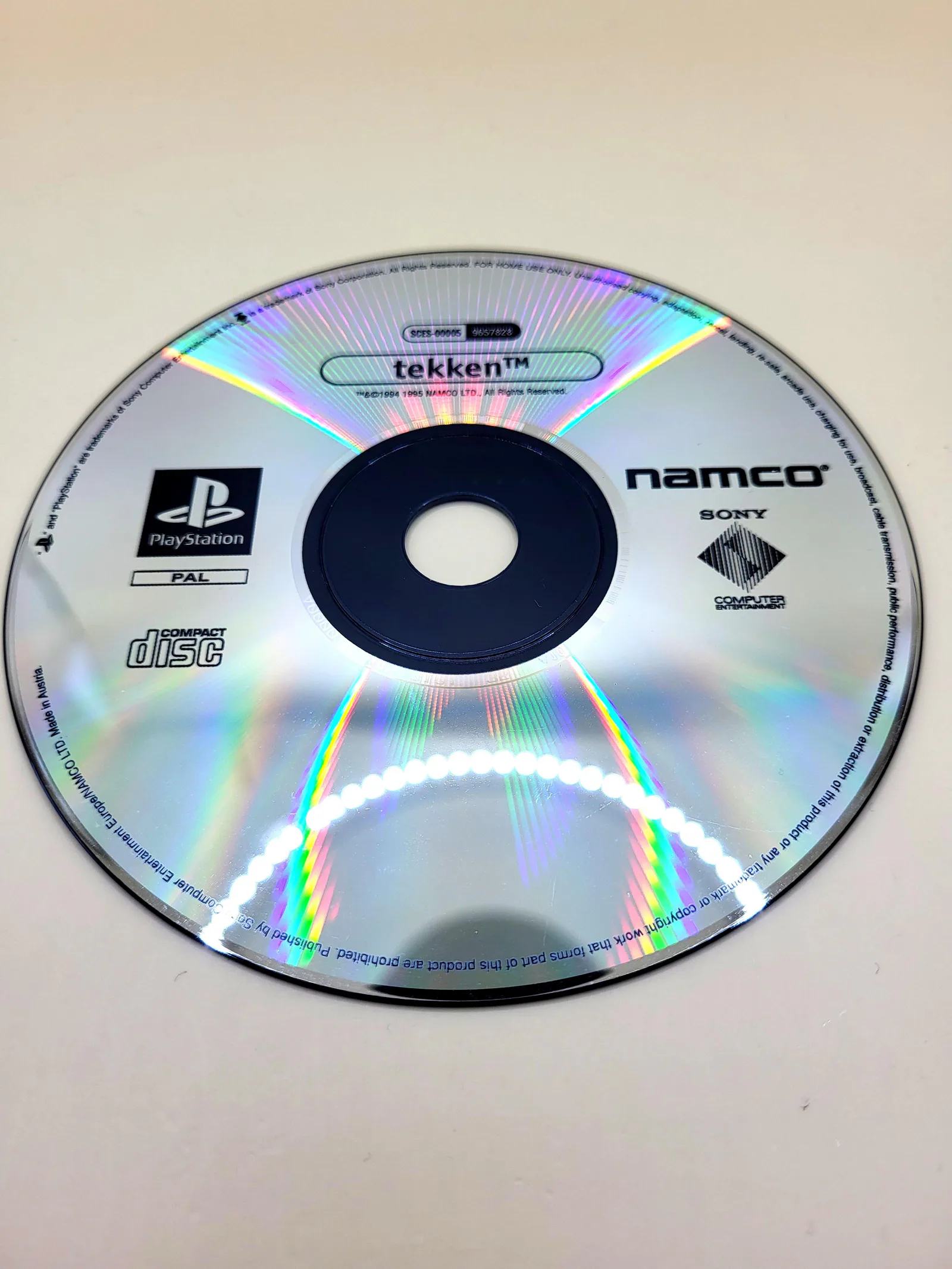
Tekken for PlayStation 1
In Tekken for PlayStation 1, you fight in the first King of Iron Fist Tournament. You choose from eight starting characters, including Kazuya Mishima, Nina Williams, King and Marshall Law. Each uses their own throws, punches and kicks, so changing characters also calls for a different approach. The four attack buttons represent your left arm, right arm, left leg and right leg. You build attacks through short combinations and directional inputs while watching your distance from your opponent.
A round revolves around emptying your opponent's health bar or having more energy left when time runs out. Blocking high and low, punishing a missed kick and using a throw at the right moment make a difference. After a knockdown, you can fight back with a rising attack. In Arcade, you work through computer-controlled rivals towards Heihachi. Your chosen fighter determines which personal rival you encounter along the way; victories also earn you additional playable characters.
You play alone against the computer or directly against another person on the same console. Two standard PlayStation controllers are needed for the latter; no Multitap is required. The home version has its own ending movies, adjustable match rules and a Galaga minigame during loading. Save your unlocked content and records to a PlayStation memory card using Card Save in Test Mode. Tekken does not save this data automatically: without that manual step, new results disappear when you switch off the console.
Region and language
Our PlayStation 1 games are PAL editions, unless stated otherwise. This product contains a loose disc for the European market. A box is only included if explicitly stated in the product details. We note any different region in the product details. In almost all cases, the game is playable at least in English, and often in the other five common European languages too.
Manual
With Tekken for PlayStation 1, you receive a loose disc. A box and manual are not included unless we explicitly state otherwise in the product details. This is the standard way we supply this copy.
The history of Tekken
Namco first brought Tekken to arcades in 1994 and to PlayStation in 1995. It therefore appeared early in the life of Sony's first console, when three-dimensional fighting games were still developing their own rules. The polygonal bodies and different camera viewpoints made the transition from drawn fighters to three-dimensional characters visible. At the same time, assigning four buttons to four limbs gave the series a distinctive control scheme that continued to appear in its sequels.
The PlayStation release added material that lasted longer at home than a single arcade session. Namco created a new opening, separate ending movies for the original eight fighters and a dedicated option for matches between two people. Sub-bosses also became playable through progress. The short Galaga game during the initial load referred back to Namco's own arcade history. These additions connected the new 3D technology to recognisable characters and provided reasons to start again after a first victory.
The stories also found their starting point here. Kazuya enters a tournament run by the Mishima organisation with a personal objective involving his father Heihachi. Other participants seek money, revenge or recognition, giving the same competition different backgrounds. Tekken 2 subsequently expanded the training facilities and game choices; Tekken 3 later changed movement further. This original PlayStation version shows the foundation, with a smaller starting roster and without the training features and additional game types introduced by its sequels.
Similar games for PlayStation 1
Tekken 2 for PlayStation 1 keeps the same connection between attack buttons and limbs. You therefore recognise the basics of punches, kicks and throws, but get more techniques and new fighters such as Jun and Lei. The sequel also has Practice, Survival and Team Battle. The first Tekken concentrates on the arcade competition and direct duels. That difference is most noticeable when you want to practise combinations outside a real match or try out longer team line-ups.
Tekken 3 for PlayStation 1 builds on short combinations, keeping your distance and high or low defence. It gives every fighter a sidestep to evade attacks and introduces Jin, Eddy and Xiaoyu, among others. The original Tekken has an earlier cast and a different movement foundation. Tekken Force and Tekken Ball also belong to the third game. Here, arcade fights, individual rivals and unlockable sub-bosses remain at the centre of the experience.
Soul Blade for PlayStation 1 shares Namco's three-dimensional one-on-one combat, but has most attacks performed with weapons. Reach, the edge of the arena and a depleting weapon gauge add different risks. Tekken mainly revolves around punches, kicks and throws without those ring-outs. Soul Blade also has Edge Master, where you collect other weapons through challenges. Tekken rewards arcade victories with characters, without a comparable journey across a world map.
Battle Arena Toshinden for PlayStation 1 also presents polygonal fighters in separate arenas. Eiji and Kayin use swords, while sideways dodges and ring-outs make positioning important. In Tekken, you mainly work with the reach of physical attacks and cannot defeat your opponent through a ring-out. Both games demand timing after a missed attack. Toshinden more often connects that timing to weapon swings and arena dimensions; Tekken connects it to each fighter's own attack strings and throws.
Street Fighter EX Plus Alpha for PlayStation 1 also uses 3D characters, but builds its fights around Street Fighter attacks and different attack strengths. Projectiles, jumps and a Super Combo gauge determine how you apply pressure. Tekken divides its attack buttons between limbs and puts more emphasis on close range, throws and attacks after a knockdown. Both have local duels, but the way you look for an opening differs: evading a fireball demands something different from recognising a low kick.