This product is like new. At NexWave Games, like new means:
Additionally, all discs at NexWave Games are carefully inspected and assessed for quality. When discs arrive, we do not accept any that are so badly damaged that they are unlikely to work. We only accept discs with light scratches at most. Discs with scratches are then treated in our professional disc repair machine. By warming the disc and polishing it with soft brushes, these machines can remove a very thin layer from the disc. This removes the layer containing surface scratches and improves the disc’s readability. This ensures the disc works properly, even on consoles with ageing lasers that have difficulty reading games! Great news for the player.
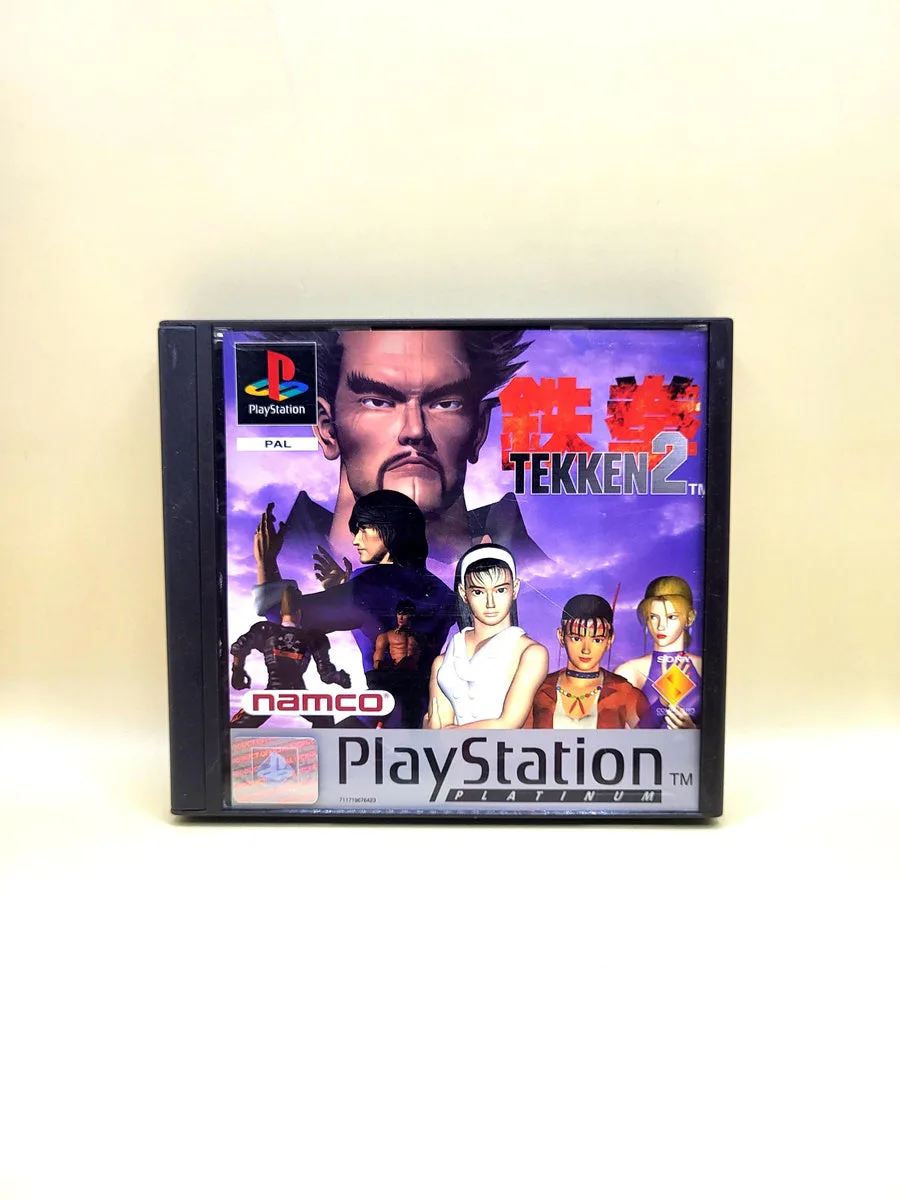
Tekken 2 for PlayStation 1
Tekken 2 for PlayStation 1 lets you enter the King of Iron Fist Tournament again, this time with Kazuya in charge of the Mishima organisation. You choose a fighter and use punches, kicks, throws and combinations to defeat an opponent. The four attack buttons remain linked to the two arms and two legs. Familiar participants gain expanded techniques, while newcomers such as Jun Kazama and Lei Wulong bring different stances and attack patterns.
In Arcade, you fight through a series of opponents and unlock additional characters. Practice gives you room to explore inputs, damage and combinations without starting a whole tournament each time. Survival has you fight several rivals in succession with limited health. Time Attack revolves around a fast completion time. In Team Battle, you assemble a group of fighters who replace one another after a defeat. Even there, only two fighters face each other at any one time.
You can play alone against the computer or compete with another person on the same PlayStation. Two standard controllers are required for matches against each other; Team Battle does not need a Multitap. The handicap setting lets you adjust the starting conditions of a duel. A PlayStation memory card stores unlocked characters, settings and records. Choose Card Save or enable Auto Save, because unsaved data disappears when you switch off the power. You can then return to your expanded roster and compare your own performances.
Region and language
Our PlayStation 1 games are PAL editions and come with a Dutch or English box, unless stated otherwise. By default, you receive the version for the European market. We note it in the product details if the region is different or the box is in another language. In almost all cases, the game is playable at least in English, and often in the other five common European languages too.
Manual
Tekken 2 for PlayStation 1 includes the manual unless the product title states otherwise. If the booklet is missing, the title says “No Manual”. This lets you see before ordering whether the game comes with a manual.
The manuals included with our games usually contain at least English and often around six European languages. The exact languages vary by edition, so Dutch is not always included. The booklet explains the controls and the main rules. You can use it to check how to control the game, which actions are available and how its different features work.
The history of Tekken 2
Namco brought Tekken 2 to arcades in 1995 and created the PlayStation release in 1996. The series was still in its early years, but its returning attack buttons and characters already provided a recognisable foundation. The sequel carried over the techniques of the revised arcade version and adapted computer opponents for home play. More room for practice and other challenges made this release more than a repeat of a short arcade session.
The new opening and individual ending movies supported the story between fights. Kazuya had won the previous tournament and taken over his father's organisation, while Heihachi returned to reclaim his position. New participants Jun and Lei expanded the roster and the range of fighting styles. Father and son consequently changed roles: a former final boss became one of the familiar faces with whom you could now enter the competition, with new interests behind the same tournament format.
For PlayStation, Namco added Team Battle, Practice, Survival and Time Attack, among other features. Practising with visible attack information in particular gave players a way to understand and repeat complicated sequences. Teams brought different fighting styles together in a series of successive duels. Tekken 3 would later change the cast and movement again. Tekken 2 preserves the stage before that: the original four-button foundation with an expanded home package, but without the universal sidestep and separate Tekken Force fights of the third game.
Similar games for PlayStation 1
Tekken for PlayStation 1 introduces the same four attack buttons and many of the returning fighters. You recognise King's throws and Nina's attacks, among others, but the first game offers fewer choices around the arcade competition. Tekken 2 adds Practice for focused training, Survival for successive opponents and Team Battle for groups. This lets you try techniques in more ways. The original Tekken shows the earlier roster and the initial relationship between Kazuya and Heihachi.
Tekken 3 for PlayStation 1 still uses the four-button controls, but gives every fighter a sidestep and brings Jin, Eddy and other new participants. Tekken Force and Tekken Ball also broaden the offering beyond the normal duels. Tekken 2 revolves around an earlier tournament generation and does not have those two additional features. Practice, Survival and Team Battle provide the main variety here, with the relationships between Kazuya, Heihachi and the participants of that time in the background.
Soul Blade for PlayStation 1 offers Practice, Survival and Team Battle just like Tekken 2, so you can both practise techniques and fight different opponents in succession. Weapon combat changes your focus, however: reach, ring-outs and a decreasing weapon gauge influence your decisions. Tekken 2 emphasises physical attacks, throws and getting up after a knockdown. Soul Blade also adds the Edge Master journey with collectible weapons. Tekken 2 mainly lets you discover other characters and their techniques.
Battle Arena Toshinden for PlayStation 1 combines polygonal fighters with weapons and clearly bounded arenas. You can dodge attacks sideways and force an opponent out of the ring. Tekken 2 has no such ring-outs and uses its four attack buttons for arms and legs. Both reward recognising an opening, but Toshinden more often connects this to a broad weapon swing and the edge of the playing area. With Practice, Tekken 2 also offers a separate place to explore your attack strings.
Street Fighter EX Plus Alpha for PlayStation 1 has polygonal characters and an extensive practice section, just like Tekken 2. Its controls instead follow Street Fighter's light, medium and heavy punches and kicks. You build a Super Combo gauge and account for projectiles. Tekken 2 divides buttons by limb and lets you work closer to your opponent with throws and attack strings. Timing and practice connect the two; reading distance and defence calls for a different approach.