This product is like new. At NexWave Games, like new means:
Additionally, all discs at NexWave Games are carefully inspected and assessed for quality. When discs arrive, we do not accept any that are so badly damaged that they are unlikely to work. We only accept discs with light scratches at most. Discs with scratches are then treated in our professional disc repair machine. By warming the disc and polishing it with soft brushes, these machines can remove a very thin layer from the disc. This removes the layer containing surface scratches and improves the disc’s readability. This ensures the disc works properly, even on consoles with ageing lasers that have difficulty reading games! Great news for the player.
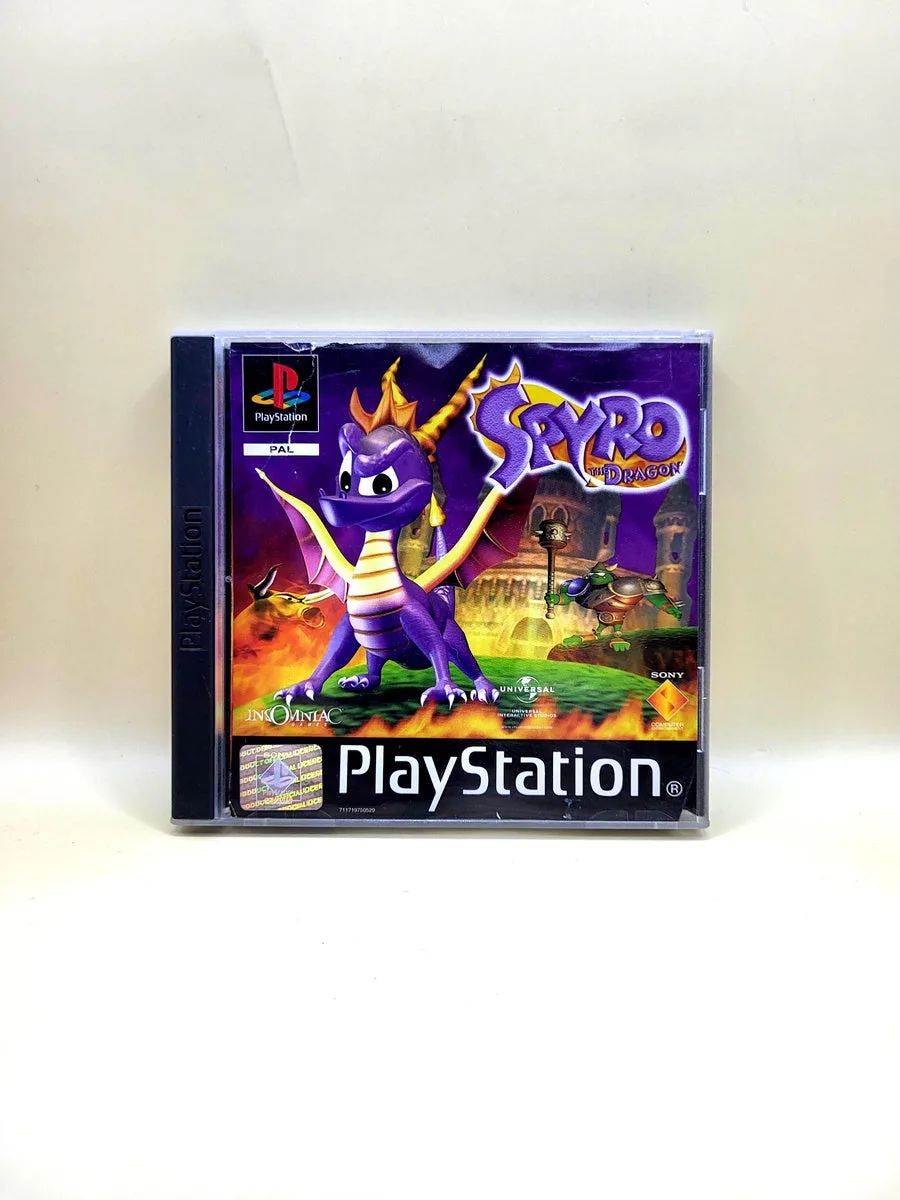
Spyro the Dragon for PlayStation 1
Spyro the Dragon for PlayStation 1 is a 3D platform game in which you free the dragons Gnasty Gnorc has imprisoned in crystal. From central home worlds, you enter portals leading to castles, mountain villages, caves and other areas. You collect gems, open treasure chests and chase thieves who have stolen dragon eggs. Much of the treasure lies along your route, but finding the last pieces means looking up, searching behind buildings and discovering which ledge will let you reach a distant bank.
Spyro jumps, glides and attacks with fire or a charge of his horns. Small armoured enemies need a charge, while larger opponents call for fire. Certain slopes give you extra speed for a long jump or a powerful impact. In separate flight areas, you fly freely through rings and destroy targets before time runs out. Sparx the dragonfly collects nearby gems and changes colour when you take damage. Butterflies help him regain his strength.
This adventure is strictly single-player, using one standard PlayStation controller or a supported analogue controller. The shoulder buttons help rotate the camera. Rescued dragons leave behind a platform that serves as a checkpoint; the fairy who appears there can also save your progress. To retain progress after switching off, you need a PlayStation memory card with one free block. An in-game checkpoint does not replace that memory card. Your inventory tracks the gems, dragons and eggs you are still looking for in each area.
Region and language
Our PlayStation 1 games are PAL editions and come with a Dutch or English box, unless stated otherwise. By default, you receive the version for the European market. We note it in the product details if the region is different or the box is in another language. In almost all cases, the game is playable at least in English, and often in the other five common European languages too.
Manual
Spyro the Dragon for PlayStation 1 includes the manual unless the product title states otherwise. If the booklet is missing, the title says “No Manual”. This lets you see before ordering whether the game comes with a manual.
The manuals included with our games usually contain at least English and often around six European languages. The exact languages vary by edition, so Dutch is not always included. The booklet explains the controls and the main rules. You can use it to check how to control the game, which actions are available and how its different features work.
The history of Spyro the Dragon
Insomniac Games brought Spyro the Dragon to the original PlayStation in 1998. The studio had previously made the shooter Disruptor and wanted a different direction for its next project. Producer Mark Cerny pointed out an opening for a game that would also appeal to a younger audience. Artist Craig Stitt wanted to use a dragon as the lead character. That suggestion became the starting point for a small hero who could breathe fire, run fast and glide above the ground.
Moving to a three-dimensional platform game raised new design questions. The team had to keep fast movement readable, make jumping distances clear and ensure the controls worked without requiring an analogue stick. Broad landscapes and recognisable buildings helped players find their way. The treasure hunt gave little corners a purpose of their own. Stewart Copeland composed the music, whose rhythms and melodies gave the different worlds their own character without needing a constantly narrated story.
This first adventure was followed by Spyro 2 in 1999 and Year of the Dragon in 2000, again from Insomniac. Those sequels added more tasks, moves and playable characters. The first game keeps a narrower focus on freeing dragons, finding gems and discovering flight routes. Toys for Bob later rebuilt the three adventures for Spyro Reignited Trilogy. Those later visuals and changes are not part of this PlayStation 1 release, which lets you play the original 1998 design.
Similar games for PlayStation 1
Spyro 2: Gateway to Glimmer for PlayStation 1 retains Spyro the Dragon's open areas, gems and gliding jumps. There you collect talismans and orbs and help residents with individual tasks. Spyro can also learn new abilities, such as swimming and climbing. The first game keeps its objectives closer to searching the surroundings and freeing dragons. Progress therefore comes more often from looking carefully and trying a new route than from completing a task discussed with a character.
Spyro: Year of the Dragon on PlayStation 1 also places portals between home worlds and individual areas. Its search centres on stolen dragon eggs, with extra playable friends and challenges such as skateboarding. Spyro the Dragon keeps you controlling the same dragon and mainly breaks up its regular platforming with flight areas. If you prefer learning one character's abilities, this offers a more consistent adventure; the third game switches more often to different controls and a new type of task.
Croc: Legend of the Gobbos for PlayStation 1 also combines a small animal hero with collecting crystals and freeing friends. Croc travels through more compact areas with doors, keys and a finishing gong. His controls make him turn first and then move forwards. Spyro moves more directly through broader landscapes and can glide across long distances. Where Croc often has you carefully search a room, Spyro regularly has you look across an entire valley to find a reachable ledge.
Crash Bandicoot 2: Cortex Strikes Back on PlayStation 1 connects its levels through a central room, much as Spyro sets off from home worlds. Crash usually follows a clearer route, jumping between obstacles while breaking crates. Spyro gives you more room to wander and choose your own order. A missed crate in Crash makes another attempt important; in Spyro, a side path or higher platform often remains for you to investigate later.
Rayman 2: The Great Escape for PlayStation 1, like Spyro, calls for three-dimensional jumps, collecting and rescuing prisoners. Rayman uses his hovering hair and magical projectiles and generally follows a more structured route through a level. Spyro lets you move back and forth more freely and offers different enemies to tackle with fire or a charge. Both reward accurate landings, but Spyro places more emphasis on thoroughly searching open areas.