This product is in good condition. At NexWave Games, good means:
Additionally, all discs at NexWave Games are carefully inspected and assessed for quality. When discs arrive, we do not accept any that are so badly damaged that they are unlikely to work. We only accept discs with light scratches at most. Discs with scratches are then treated in our professional disc repair machine. By warming the disc and polishing it with soft brushes, these machines can remove a very thin layer from the disc. This removes the layer containing surface scratches and improves the disc’s readability. This ensures the disc works properly, even on consoles with ageing lasers that have difficulty reading games! Great news for the player.
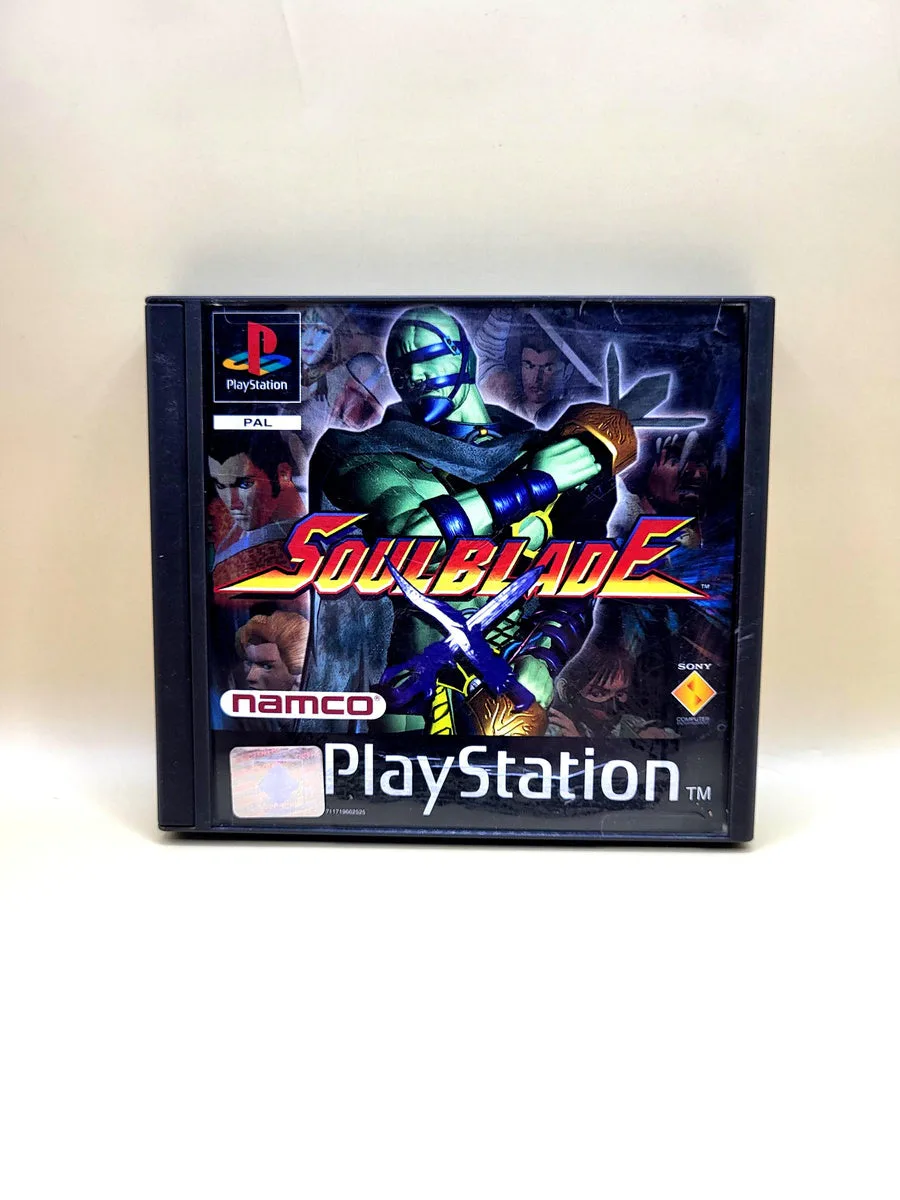
Soul Blade for PlayStation 1
Soul Blade for PlayStation 1 is a three-dimensional fighting game in which warriors seek the sword Soul Edge. You choose Mitsurugi, Taki or Sophitia, for example, and fight with a weapon that determines your reach and attack patterns. You have separate buttons for horizontal attacks, vertical attacks, kicks and guarding. A long-reaching strike keeps your opponent at a distance, but a missed attack leaves room for a quick response or a close-range throw.
Alongside your health bar, you need to watch the weapon gauge. Blocking attacks costs durability, and a Critical Edge attack also consumes that gauge. If your weapon is knocked from your hands, you fight unarmed for the rest of the round. The edge of the arena also demands attention: a ring-out decides the round without requiring the health bar to empty first. In Edge Master, you travel across a map, complete fights with special conditions and collect other weapons with their own properties.
Arcade, Practice, Survival, Time Attack and Team Battle give you different ways to play. You fight alone against the computer or against another person on the same console; a duel between people requires two standard PlayStation controllers. An arcade joystick is optional and a Multitap is not needed. Save your collected weapons and journey progress to a PlayStation memory card through Edge Master's save option. Settings and records also have their own save selection, with an automatic saving option.
Region and language
Our PlayStation 1 games are PAL editions and come with a Dutch or English box, unless stated otherwise. By default, you receive the version for the European market. We note it in the product details if the region is different or the box is in another language. In almost all cases, the game is playable at least in English, and often in the other five common European languages too.
Manual
Soul Blade for PlayStation 1 includes the manual unless the product title states otherwise. If the booklet is missing, the title says “No Manual”. This lets you see before ordering whether the game comes with a manual.
The manuals included with our games usually contain at least English and often around six European languages. The exact languages vary by edition, so Dutch is not always included. The booklet explains the controls and the main rules. You can use it to check how to control the game, which actions are available and how its different features work.
The history of Soul Blade
Namco developed the weapon-based fighting game called Soul Edge in Japan and renamed Soul Blade for its Western PlayStation release. The PlayStation version arrived in Japan in late 1996 and in Europe in 1997. It therefore stood alongside the early Tekken games, but chose a different foundation for combat. Swords, staffs and other weapons determined the fighters' reach. The fictional sixteenth-century quest linked their different backgrounds and personal objectives to one recurring object: the cursed sword.
For home play, Namco added a journey with its own challenges. Edge Master turned separate matches into a series of trials where an ordinary victory was not always enough. You might have to win by ring-out, for example, and received weapons with different balances of power, weight and durability. You could then use that collection elsewhere too. This gave the same fighter different possibilities without having to switch to another character. The memory card helped spread this longer quest over several play sessions.
The presentation also gained its own PlayStation features. A specially created CG opening introduced the world and its participants, while the ending scenes included interactive moments. The game also offered several music choices and extra costumes for the home release. After this first adventure, the series continued under the name Soulcalibur, with further changes to movement and weapon combat. This PlayStation 1 version preserves the earlier rules: a separate weapon gauge, ring-outs and Edge Master challenges, without adding later characters or systems from the sequels to this release.
Similar games for PlayStation 1
Tekken for PlayStation 1, like Soul Blade, places two polygonal fighters opposite each other and gives each their own collection of techniques. Its buttons are linked to limbs, whereas Soul Blade distinguishes horizontal attacks, vertical attacks, kicks and guarding. Tekken has no weapon gauge or ring-outs. Keeping your distance there therefore mainly revolves around punches, kicks and throws. In Soul Blade, the length of your weapon, the edge of the arena and wear from blocking continually influence your decisions.
Tekken 2 for PlayStation 1 shares Practice, Survival, Time Attack and successive team duels with Soul Blade. In both games, you can therefore practise techniques deliberately before taking on a longer series of fights. The difference lies in the rewards and combat rules. Tekken 2 unlocks other fighters in the tournament; Soul Blade lets you earn weapons in Edge Master through tailored challenges. A ring-out can also decide a round here, whereas Tekken 2 has no such arena exit.
Tekken 3 for PlayStation 1 also offers one-on-one duels where distance, timing and recognising attack heights matter. Every fighter can sidestep, and Tekken Force provides a separate feature in which you fight through areas. Soul Blade keeps its longer solo game in Edge Master and the world map. There, you collect weapons instead of progressing through a sequence of street fights. The risk of being disarmed also gives defence a different cost.
Battle Arena Toshinden for PlayStation 1 shares the use of weapons, three-dimensional dodges and ring-outs. In both games, a step too close to the edge can be more dangerous than a partly empty health bar. Toshinden divides its attack buttons between light and heavy weapon strikes and kicks. Soul Blade puts more emphasis on strike direction and a separate guard button. The weapon gauge and Edge Master collection also add choices here that go beyond selecting a fighter.
Street Fighter EX Plus Alpha for PlayStation 1, like Soul Blade, uses polygonal characters and gives you practice challenges to learn techniques more thoroughly. Its fights instead follow the Street Fighter foundation of projectiles, different attack strengths and Super Combos. In Soul Blade, applying pressure more often revolves around weapon reach, strike direction and the edge of the arena. Both have you manage a gauge, but you build up the Super Combo gauge for special attacks; blocking can instead drain the weapon gauge.