This product is like new. At NexWave Games, like new means:
Additionally, all discs at NexWave Games are carefully inspected and assessed for quality. When discs arrive, we do not accept any that are so badly damaged that they are unlikely to work. We only accept discs with light scratches at most. Discs with scratches are then treated in our professional disc repair machine. By warming the disc and polishing it with soft brushes, these machines can remove a very thin layer from the disc. This removes the layer containing surface scratches and improves the disc’s readability. This ensures the disc works properly, even on consoles with ageing lasers that have difficulty reading games! Great news for the player.
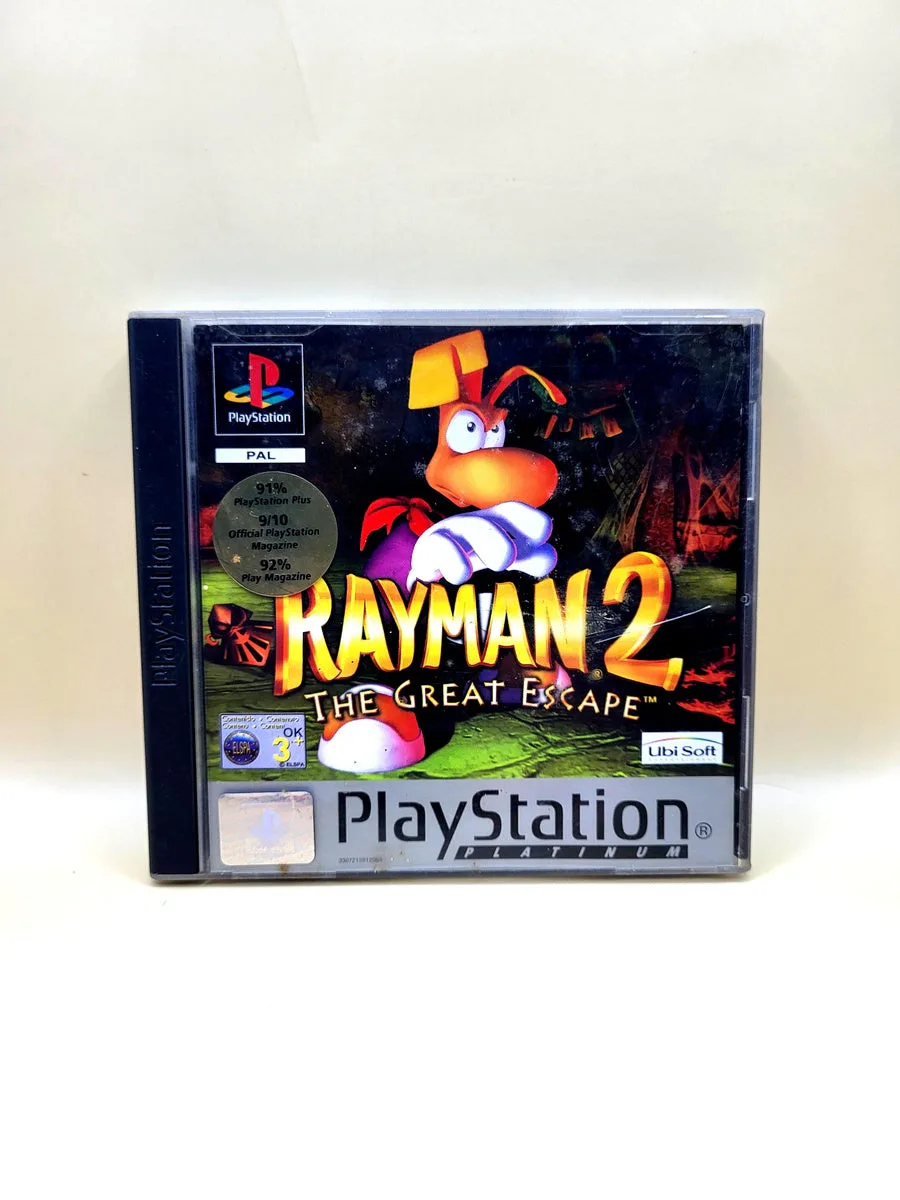
Rayman 2: The Great Escape for PlayStation 1
Rayman 2: The Great Escape for PlayStation 1 is a three-dimensional platform adventure in which robot pirates occupy Rayman's world. Admiral Razorbeard imprisons its inhabitants and has disrupted the world's balance. With help from Globox and the fairy Ly, you escape and search for four magical masks to awaken Polokus. You travel through forests, swamps, caves and pirate installations. Between jumps, you break open cages and search for Yellow Lums scattered along the routes.
Rayman shoots magical projectiles from his hands and uses his helicopter hair to stay airborne longer. You climb nets, swim underwater and hang from ledges to advance. Sometimes the pace changes with a fast chase or a ride on a living shell. The PlayStation 1 version has eight hundred Yellow Lums and its own adaptation of the areas. You therefore do not get exactly the same level layouts as in the Nintendo 64 or computer version of this adventure.
This is a single-player game using one controller. You can move Rayman with the directional pad or an analogue stick; an analogue controller is not required. The shoulder buttons rotate the camera to give you a better view of a jump. To preserve progress, you need a PlayStation Memory Card in slot one. You save in the Hall of Doors after completing a world. Without a Memory Card you can play, but cannot keep a save file; there is no password system as an alternative.
Region and language
Our PlayStation 1 games are PAL editions and come with a Dutch or English box, unless stated otherwise. By default, you receive the version for the European market. We note it in the product details if the region is different or the box is in another language. In almost all cases, the game is playable at least in English, and often in the other five common European languages too.
Manual
Rayman 2: The Great Escape for PlayStation 1 includes the manual unless the product title states otherwise. If the booklet is missing, the title says “No Manual”. This lets you see before ordering whether the game comes with a manual.
The manuals included with our games usually contain at least English and often around six European languages. The exact languages vary by edition, so Dutch is not always included. The booklet explains the controls and the main rules. You can use it to check how to control the game, which actions are available and how its different features work.
The history of Rayman 2: The Great Escape
After the drawn Rayman of 1995, Ubisoft created a sequel in three dimensions. Rayman 2: The Great Escape first appeared for Nintendo 64 and computers in 1999. During development, Michel Ancel and producer Pauline Jacquey described an adventure with a clear pace: players should remain at the heart of the action, even when environments offered freer exploration. The camera and gradual introduction of movements therefore received considerable attention. The pirate occupation gave the new world a threat running throughout its story.
Ubisoft Shanghai worked on the PlayStation adaptation released in 2000. It was not an identical conversion of every existing area. Levels were altered or combined, and the total number of Yellow Lums became eight hundred rather than the thousand in the earlier main versions. Cutscenes received fully voiced dialogue. This gives the release its own pace and presentation, even if you know the adventure from another console. Familiar characters and the search for four masks remained its connecting thread.
The transition also shows how Rayman's movements developed with the series. His separate hands could now fire projectiles through three-dimensional space, while helicopter hair helped with landings on narrow platforms. Further adaptations followed, including Rayman Revolution for PlayStation 2, with areas changed again and a different connecting world. This disc for PlayStation 1 contains the PlayStation 1 adaptation. It is therefore not the expanded Revolution release, nor a later handheld version or modern rerelease allowing saving anywhere at any time.
Similar games for PlayStation 1
Rayman for PlayStation 1 lets the same hero jump, hang from ledges and glide with his hair, but builds its challenges in a side view. Rayman 2 adds depth and a rotating camera, requiring you to judge landings from different angles. In the first game, fists break open hidden Electoon cages; in the sequel, you use magical projectiles and collect Lums. Both let you revisit previous areas to find missed secrets.
Spyro the Dragon on PlayStation 1 shares colourful three-dimensional settings, prisoners and collecting routes with Rayman 2. Spyro uses fire and a charge, while Rayman shoots from a distance and climbs nets. Spyro's areas more often invite searching in different directions for gems. Rayman 2 more noticeably alternates exploration with chases and passages requiring swift progress. Both heroes' gliding movements consistently require a carefully chosen starting point.
Crash Bandicoot for PlayStation 1 combines three-dimensional characters with precise jumps and dangerous obstacles, like Rayman 2. Crash usually follows a clearly confined path, with the camera defining the route. Rayman has more room to look around and can rotate the camera himself. Crates give Crash an additional reason to replay a level; Rayman searches for Lums and cages. The main distinction is between a tightly structured obstacle course and larger, connected adventure areas.
Gex: Deep Cover Gecko on PlayStation 1 shares three-dimensional jumping, collecting and manual camera adjustment with Rayman 2. Gex earns remote controls by completing individual objectives in television parodies. Rayman follows a more connected story about robot pirates and four masks. Gex uses his tail and climbs marked surfaces; Rayman shoots and glides with his hair. Both combine searching for small rewards with sections where timing matters more than extensive exploration.
Oddworld: Abe's Oddysee for PlayStation 1 also begins with a hero escaping captivity and trying to save others. Abe remains side-on and uses speech, stealth and possession of enemies to open routes. Rayman 2 lets you shoot, jump and swim directly through a three-dimensional world. Both hide prisoners away from the main path. Abe places greater emphasis on understanding a dangerous situation, while Rayman usually performs the jump or attack himself.