This product is like new. At NexWave Games, like new means:
Additionally, all discs at NexWave Games are carefully inspected and assessed for quality. When discs arrive, we do not accept any that are so badly damaged that they are unlikely to work. We only accept discs with light scratches at most. Discs with scratches are then treated in our professional disc repair machine. By warming the disc and polishing it with soft brushes, these machines can remove a very thin layer from the disc. This removes the layer containing surface scratches and improves the disc’s readability. This ensures the disc works properly, even on consoles with ageing lasers that have difficulty reading games! Great news for the player.
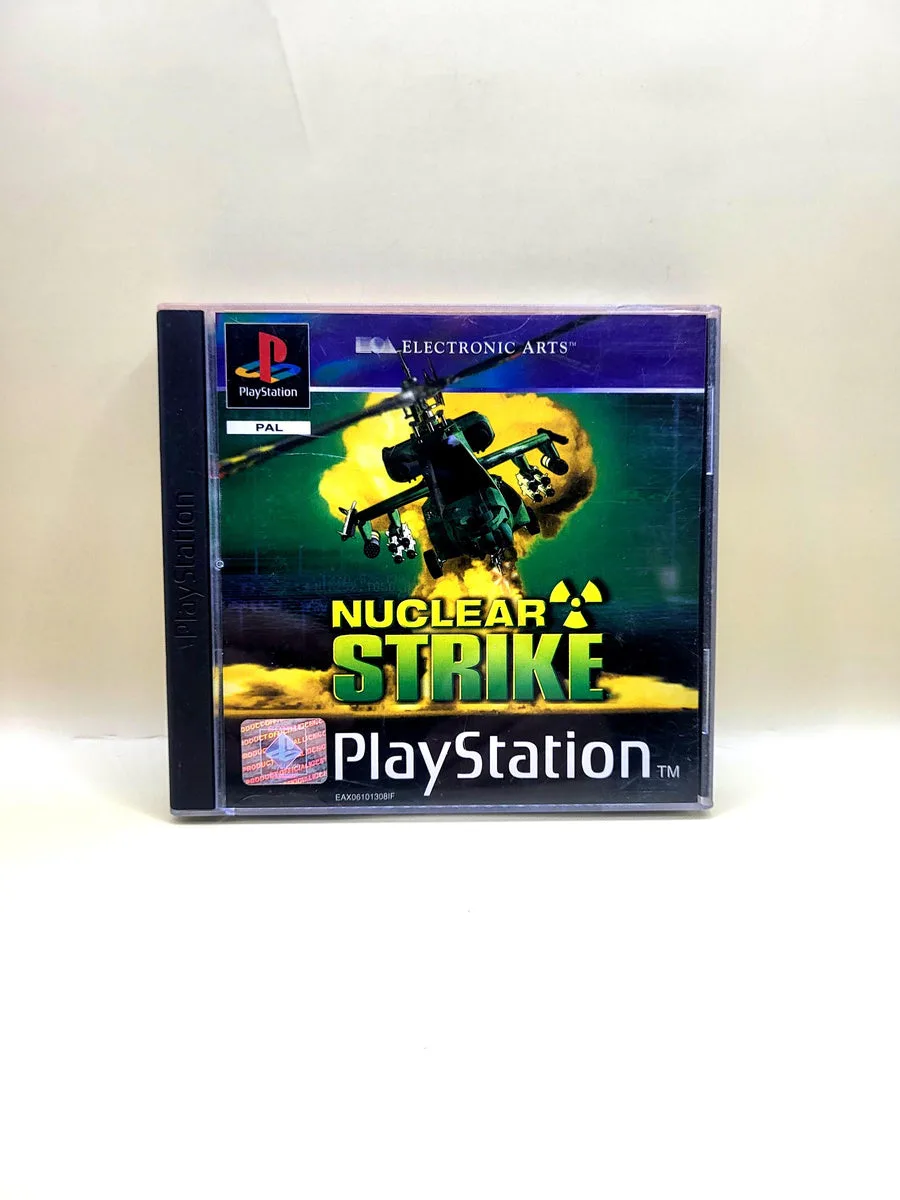
Nuclear Strike for PlayStation 1
In Nuclear Strike for PlayStation 1, you join the STRIKE unit in pursuing a terrorist who has a nuclear weapon. You begin in a Super Apache and fight vehicles, installations and anti-aircraft defences in Asian operational areas. The action also involves rescue work: hovering above people or supplies lets you winch them aboard. You choose between guns, missiles and other weapons while fuel, ammunition and armour demand constant attention.
At designated landing zones, you transfer to other vehicles, including tanks and hovercrafts. This changes how you move and which weapons you use. The map and briefing messages explain which objectives remain; a compass pointer helps you find the next task. In later campaigns, you also issue orders to ground troops through the map. This takes place within the game: the name STRIKE.net refers to your unit's fictional information system, not to a required internet connection.
This is a single-player game using a standard PlayStation controller. You steer with the directional buttons and can choose between several button layouts and two difficulty levels. You save manually to a PlayStation memory card in card slot 1, only after completing a whole campaign. The game also provides a password to unlock the next campaign. Individual objectives within a campaign do not provide intermediate save points, so keep that in mind when planning a longer session.
Region and language
Our PlayStation 1 games are PAL editions and come with a Dutch or English box, unless stated otherwise. By default, you receive the version for the European market. We note it in the product details if the region is different or the box is in another language. In almost all cases, the game is playable at least in English, and often in the other five common European languages too.
Manual
Nuclear Strike for PlayStation 1 includes the manual unless the product title states otherwise. If the booklet is missing, the title says “No Manual”. This lets you see before ordering whether the game comes with a manual.
The manuals included with our games usually contain at least English and often around six European languages. The exact languages vary by edition, so Dutch is not always included. The booklet explains the controls and the main rules. You can use it to check how to control the game, which actions are available and how its different features work.
The history of Nuclear Strike
Electronic Arts released Nuclear Strike for PlayStation in 1997. It followed Soviet Strike, which had brought three-dimensional terrain and more extensive film briefings to the helicopter series a year earlier. The original manual lists John Manley as game director and Michael Becker as creative director. R.J. Berg worked as game designer. The sequel thus developed the existing combination of direct shooting, gathering information and managing supplies during military operations.
The main addition meant that the Super Apache was no longer the only vehicle you controlled. Transfer points connected the helicopter to vehicles on land and water. The original EA sales catalogue also emphasised enemies and allies reacting to actions, new explosion effects and more elaborate terrain. The compass with its objective pointer and the small radar display made important information visible during play without requiring you to open the large map for every change of direction.
Nuclear Strike retained its predecessor's cinematic presentation. Flint Dille again contributed to the screenplay, and the credits list actors playing returning STRIKE staff and their opponents. The campaign moved the action to Asia and linked its objectives to a fictional nuclear threat. On the first PlayStation, it remained a single-player action game with a map as a supporting tool. You sometimes order ground troops around, but you also keep flying, driving and shooting yourself within the same operational area.
Similar games for PlayStation 1
Soviet Strike for PlayStation 1 is the direct foundation: helicopter combat, picking up people and finding fuel within a campaign. Nuclear Strike retains those tasks but also lets you control other vehicles at fixed transfer points. A tank, for example, moves and fires differently from the Super Apache. Soviet Strike keeps the whole flight focused on the same helicopter. Nuclear Strike therefore adds the decision of when to change vehicles to continue carrying out an objective.
Firestorm: Thunderhawk 2 for PlayStation 1 has you carry out military missions with an armed helicopter and different camera views. Nuclear Strike also begins in a combat helicopter, but adds land vehicles and orders for ground troops. Thunderhawk focuses your attention on flying, choosing altitude and attacking from a cockpit or external view. Nuclear Strike also spreads an operational area across rescue zones, supplies and transfer points, making route planning potentially just as important as hitting a target.
Agile Warrior F-111X for PlayStation 1 combines aerial combat with attacks on ground targets and missions where radar and different weapons matter. There you remain the pilot of a multirole combat aircraft. Nuclear Strike lets you transfer from the Super Apache to tanks or hovercrafts. Both therefore give you several ways to attack a target, but Nuclear Strike links that choice to different vehicles and rescue work in the field, rather than just an aircraft's weapons.
G-Police for PlayStation 1 gives you an armed flying police craft and a story connecting its missions. Like Nuclear Strike, it has you switch between air and ground targets and read your surroundings before attacking. However, G-Police's city domes form a densely built-up setting with traffic and buildings. Nuclear Strike uses military operational areas, transfer points and supplies, and you actually control a ground vehicle rather than shooting at road traffic from the air.
Independence Day for PlayStation 1 links flying action with ground targets and briefing information for a new objective. There you fly aircraft against alien attackers and must finish missions within a time limit. Nuclear Strike lets you explore a military campaign with a helicopter and other vehicles, while your own fuel supply limits the route. The difference therefore extends beyond the enemy: a race against the clock above cities versus rescue work and resupplying on a battlefield.