This product is like new. At NexWave Games, like new means:
Additionally, all discs at NexWave Games are carefully inspected and assessed for quality. When discs arrive, we do not accept any that are so badly damaged that they are unlikely to work. We only accept discs with light scratches at most. Discs with scratches are then treated in our professional disc repair machine. By warming the disc and polishing it with soft brushes, these machines can remove a very thin layer from the disc. This removes the layer containing surface scratches and improves the disc’s readability. This ensures the disc works properly, even on consoles with ageing lasers that have difficulty reading games! Great news for the player.
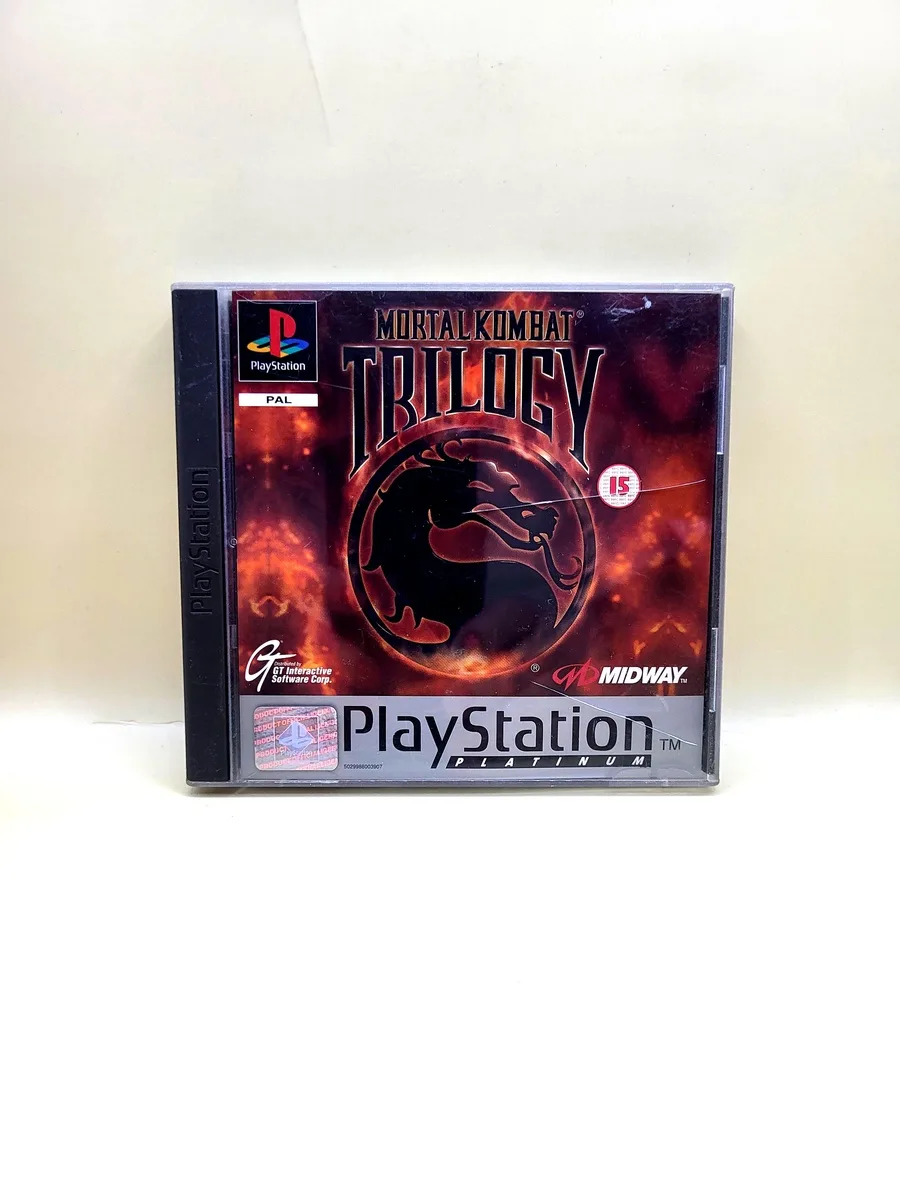
Mortal Kombat Trilogy for PlayStation 1
Mortal Kombat Trilogy for PlayStation 1 gathers fighters and arenas from the series' early years into a newly assembled fighting game. You choose returning names such as Liu Kang, Scorpion, Kitana and Sub-Zero and battle Shao Kahn's warriors. The digitised characters fight in two-dimensional arenas. The broad selection also includes classic versions of certain warriors, so a familiar face may have different attacks from those you initially expect when selecting it.
The foundation comes from Mortal Kombat 3: you run forwards, block with a dedicated button and chain punches and kicks together. Trilogy adds the Aggressor meter, which provides a temporary speed and attack-power advantage when full. Distance, sound defence and recognising combos remain important, even with so many different fighters. Fatalities and Brutalities end victories with explicit violence; the less lethal Friendships and Babalities are also present.
You play alone or face a second player on the same television, using two standard PlayStation controllers. The two-on-two option lets each player field two fighters who enter in succession. The eight-participant tournament likewise consists of successive duels, not eight characters controlled simultaneously. For solo play, you choose an opponent column. Trilogy is one assembled game with shared rules, not a collection in which you launch the first three original games separately.
Region and language
Our PlayStation 1 games are PAL editions and come with a Dutch or English box, unless stated otherwise. By default, you receive the version for the European market. We note it in the product details if the region is different or the box is in another language. In almost all cases, the game is playable at least in English, and often in the other five common European languages too.
Manual
Mortal Kombat Trilogy for PlayStation 1 includes the manual unless the product title states otherwise. If the booklet is missing, the title says “No Manual”. This lets you see before ordering whether the game comes with a manual.
The manuals included with our games usually contain at least English and often around six European languages. The exact languages vary by edition, so Dutch is not always included. The booklet explains the controls and the main rules. You can use it to check how to control the game, which actions are available and how its different features work.
The history of Mortal Kombat Trilogy
Mortal Kombat Trilogy appeared on PlayStation in 1996, after Mortal Kombat 3 and the expanded revision Ultimate Mortal Kombat 3 had renewed the fighting system. Midway and the Avalanche Software team credited in the manual built on that foundation. The premise was a broad meeting of warriors from the first three instalments. Old characters and arenas returned within the faster running-and-combo framework, rather than their original games being included unchanged.
The name Trilogy also refers to the story of Shao Kahn's attempts to conquer Earth. The first tournament, the struggle in Outworld and the invasion together form the background to this confrontation. The game uses that connection to place characters from different moments alongside one another. Classic versions of Kano and Jax, among others, strengthen that retrospective feel. The assembled roster therefore takes more prominence than an entirely new chapter featuring only new warriors.
The PlayStation release differs in some respects from the Nintendo 64 version. This disc includes classic versions of Kano, Kung Lao, Jax and Raiden, as well as the secret fighter Chameleon. The options for Shang Tsung's transformations show how the game handles CD loading: you can limit his selection to avoid loading interruptions. Trilogy thus brings the digitised early period together, before Mortal Kombat 4 introduced polygonal fighters.
Similar games for PlayStation 1
Mortal Kombat 3 offers the original 1995 selection on PlayStation 1, with new fighters such as Sektor, Cyrax and Kabal. Trilogy keeps the Run button and many of those techniques, but adds returning characters, classic versions and the Aggressor meter. The third instalment asks you to learn a smaller set of attack patterns. Trilogy places greater emphasis on choosing between different generations of fighters, all facing one another under the same match rules.
Mortal Kombat 4 gives the series polygonal characters and weapons used during fights on PlayStation 1. Running and recognisable special attacks maintain the connection with Trilogy. Trilogy instead concentrates on bringing together the digitised fighters and backdrops of the early years. When choosing between them, the main change is the type of duel you study: broad knowledge of classic characters versus a later fighting system with different attacking possibilities.
Street Fighter Alpha 3 likewise brings many familiar fighters together on PlayStation 1 and lets you explore their different styles. You also choose a fighting system with its own super attacks and rules there, while Trilogy unites its selection under one shared foundation. Drawn sprites and directional blocking differ from Trilogy's actors and block button. Both require substantial character knowledge, but defence and building towards a powerful attack work differently.
Tekken 3 builds its PlayStation 1 duels around three-dimensional characters, four limb-based attack buttons and the ability to sidestep. Trilogy keeps you on a two-dimensional fighting line and uses a separate block button. In both games, practised sequences can severely punish an opponent's mistake. Tekken 3 demands more attention to lateral positioning, while Trilogy tests your knowledge of projectiles, running attacks and the many classic techniques.
Street Fighter EX Plus Alpha uses polygonal characters on PlayStation 1 while keeping combat on a two-dimensional line. That makes its distance game recognisable alongside Trilogy, but the six punch-and-kick buttons and Super Combo meter create different decisions. Expert lets you practise specific technique and combo challenges. Trilogy instead places a large collection of Mortal Kombat characters side by side and uses the Aggressor meter to give duels a temporary burst of speed.