This product is like new. At NexWave Games, like new means:
Additionally, all discs at NexWave Games are carefully inspected and assessed for quality. When discs arrive, we do not accept any that are so badly damaged that they are unlikely to work. We only accept discs with light scratches at most. Discs with scratches are then treated in our professional disc repair machine. By warming the disc and polishing it with soft brushes, these machines can remove a very thin layer from the disc. This removes the layer containing surface scratches and improves the disc’s readability. This ensures the disc works properly, even on consoles with ageing lasers that have difficulty reading games! Great news for the player.
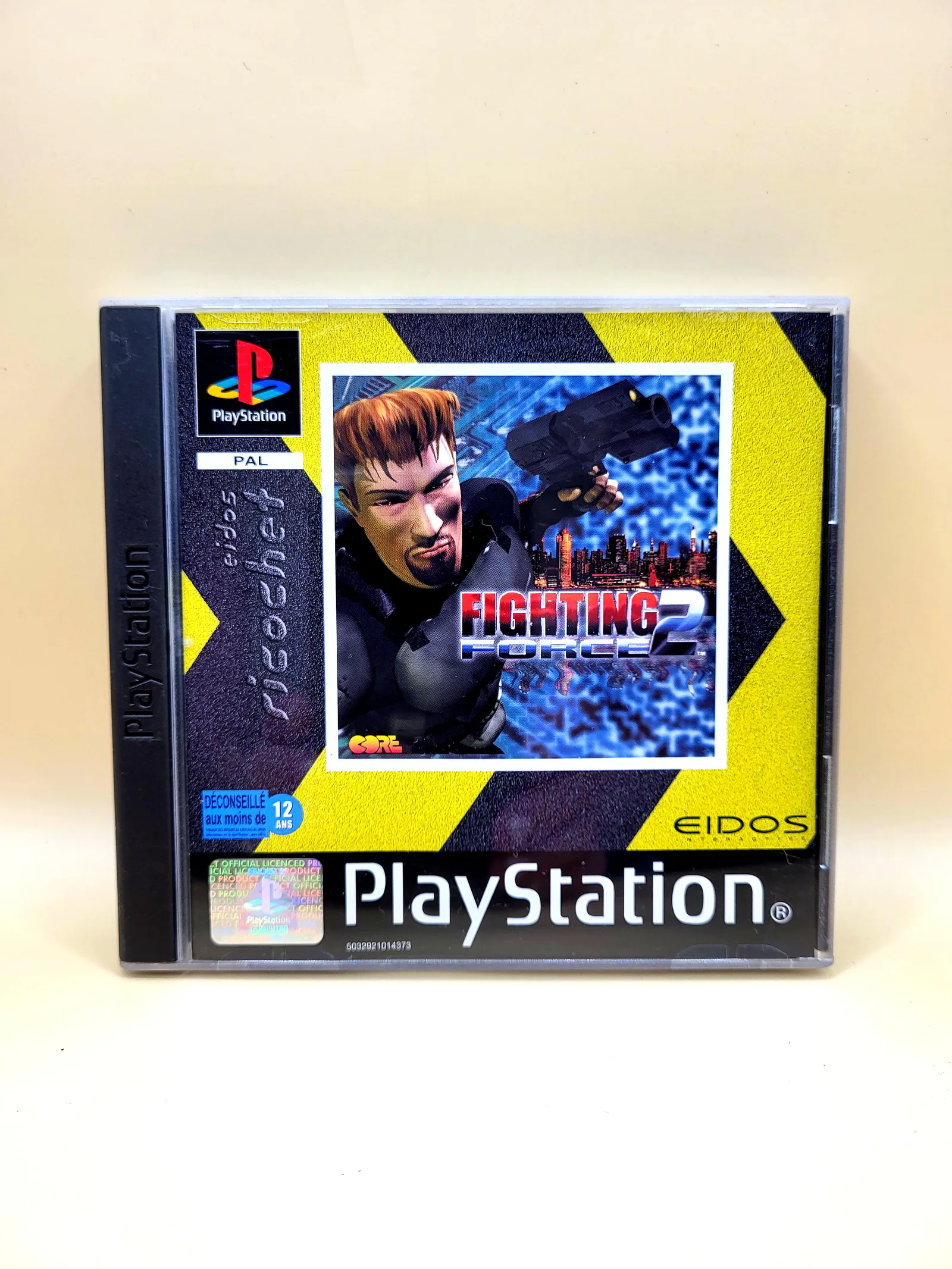
Fighting Force 2 for PlayStation 1
Fighting Force 2 for PlayStation 1 follows Hawk Manson on a secret operation against a company conducting illegal cloning experiments. This action game alternates fist fights with shooting and searching three-dimensional buildings. You enter research rooms and guarded complexes, look for the next passage and clear guards out of the way. The camera follows Hawk from behind, so exploring corridors and approaching enemies works differently from the street fights in the first game.
You can punch and kick opponents, but also pick up a firearm you find or throw an object at them. Cupboards and other parts of the environment can reveal weapons or useful items when destroyed. Searching a room therefore becomes part of your preparation for the next fight. You alternate close combat with keeping your distance and watch what you still have available. Missions take you deeper through the complex rather than along a series of short street arenas.
This sequel is a single-player game; the two-player cooperation from Fighting Force is absent. A standard PlayStation controller works, while a DualShock additionally supports analog control and vibration. You save progress at the saving points offered by the game, using a PlayStation memory card. You therefore cannot save at any arbitrary location. The offered Eidos Ricochet edition is a rerelease of this PlayStation game, not a collection including the first instalment or a version with modern extras.
Region and language
Our PlayStation 1 games are PAL editions and come with a Dutch or English box, unless stated otherwise. By default, you receive the version for the European market. We note it in the product details if the region is different or the box is in another language. In almost all cases, the game is playable at least in English, and often in the other five common European languages too.
Manual
Fighting Force 2 for PlayStation 1 includes the manual unless the product title states otherwise. If the booklet is missing, the title says “No Manual”. This lets you see before ordering whether the game comes with a manual.
The manuals included with our games usually contain at least English and often around six European languages. The exact languages vary by edition, so Dutch is not always included. The booklet explains the controls and the main rules. You can use it to check how to control the game, which actions are available and how its different features work.
The history of Fighting Force 2
Fighting Force 2 appeared in 1999 and again came from Core Design, with Eidos Interactive as publisher. The first game, released in 1997, had been built around four fighters and cooperative street combat. For the sequel the studio radically changed the setup. Hawk Manson remained as the playable lead and received a secret-agent story. The action moved into guarded corporate complexes, where you had to search further for passages, objectives and useful resources to handle the next opposition.
The story reflects interest in biotechnology and cloning around the turn of the millennium. An international intelligence agency sends Hawk on an officially unacknowledged assignment. Playing alone therefore fits the role of an agent who must solve his own problems. The original manual describes both fist attacks and managing and discarding weapons. The greater emphasis on armaments and moving through buildings made the experience different from simply adding levels to the first Fighting Force.
Alongside PlayStation, Dreamcast also received a version, but this description concerns the original PlayStation 1 game. The Eidos Ricochet packaging does not turn the game's foundations into a new sequel. The later Fighting Force Collection is also a separate release: rewind and the ability to record any game state belong to that edition. On the original disc, the built-in saving points, controls and Hawk's solo mission remain decisive. The difference from the first game therefore lies mainly in the structure of the action.
Similar games for PlayStation 1
Fighting Force for PlayStation 1 shares Hawk, physical attacks and the use of loose objects with this sequel. However, the first game lets you choose from four characters and play the campaign with two people simultaneously. Fighting Force 2 leaves you alone with Hawk and sends you through larger guarded complexes. The transition changes the pace: you spend longer finding the next passage and decide when to use a weapon you have found against the next guard.
Syphon Filter for PlayStation 1 likewise places you behind an agent conducting a dangerous operation in three-dimensional locations. Aimed shooting, stealth and individual mission objectives carry more weight there. Fighting Force 2 retains more of the brawler: you destroy many objects and regularly switch back to punching and kicking. Both require attention to positioning and weapons, but a room in Fighting Force 2 is also a storeroom full of potential weapons and breakable objects.
Metal Gear Solid for PlayStation 1 also revolves around a lone infiltrator and a secret military threat. Guards, sight lines and alarms have a much more central role, and conversations tell the story in greater detail. Fighting Force 2 more often lets you use direct violence and destroy furnishings. Similar themes therefore lead to two different rhythms: carefully reading a patrol pattern, or investigating a room, gathering items and entering a confrontation with Hawk.
Apocalypse for PlayStation 1 combines a solo character, three-dimensional environments and a large arsenal. You can control shooting and movement directions separately, while jumps and fast enemy waves demand considerable attention. Fighting Force 2 approaches the action more slowly from behind Hawk and gives fist fights and investigating objects more room. Both use spectacular destruction, but one feels like a moving shooting arena and the other like a series of dangerous infiltration rooms.
Tomb Raider II for PlayStation 1 also alternates fighting with exploring buildings and likewise comes from Core Design. Lara's adventure much more often asks you to judge jumps, find switches and solve spatial puzzles. Fighting Force 2 concentrates on guards, weapons and furnishings to smash. In both games you investigate the environment, but Lara mainly uses that information to find a route, while Hawk often uses it to prepare for the next confrontation.