This product is like new. At NexWave Games, like new means:
Additionally, all discs at NexWave Games are carefully inspected and assessed for quality. When discs arrive, we do not accept any that are so badly damaged that they are unlikely to work. We only accept discs with light scratches at most. Discs with scratches are then treated in our professional disc repair machine. By warming the disc and polishing it with soft brushes, these machines can remove a very thin layer from the disc. This removes the layer containing surface scratches and improves the disc’s readability. This ensures the disc works properly, even on consoles with ageing lasers that have difficulty reading games! Great news for the player.
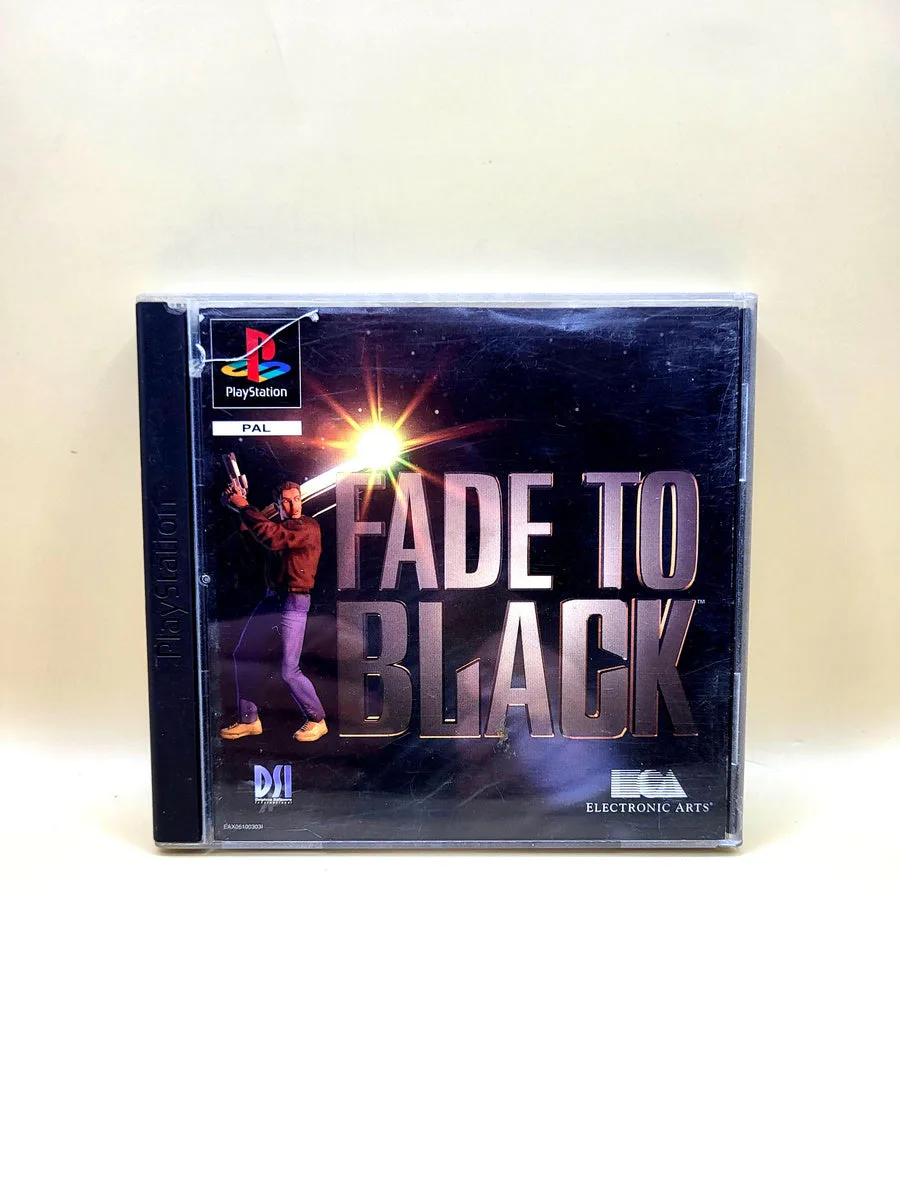
Fade to Black for PlayStation 1
In Fade to Black for PlayStation 1, you escape a Morph prison with Conrad B. Hart. After a long cryogenic sleep, the hero from Flashback discovers that his old enemies remain a threat. The camera follows behind Conrad as you investigate corridors, technical rooms and alien bases. A pistol and communicator help you get started, but locked doors and dangerous installations also require keys, switches and useful items.
You move carefully around corners, sidestep, crouch and jump past traps. Drawing your weapon prepares you for encounters differently from simply surveying your surroundings. Different controller settings change which actions are immediately available; the more advanced layouts give you greater control over movement and looking. The inventory screen helps you select collected items. Health and ammunition deserve attention, because an unprepared confrontation or a wrong step onto a dangerous floor can quickly cause damage.
This is a single-player adventure played with a standard PlayStation controller. Saving has two stages: first you create a temporary save, then copy it to a PlayStation memory card using Save in the Resume menu. Using only the temporary save does not preserve your journey after switching off the console. Level passwords offer another option, but start you at the beginning of a level with minimal equipment. Restarting with a code therefore differs from continuing with your own saved state.
Region and language
Our PlayStation 1 games are PAL editions and come with a Dutch or English box, unless stated otherwise. By default, you receive the version for the European market. We note it in the product details if the region is different or the box is in another language. In almost all cases, the game is playable at least in English, and often in the other five common European languages too.
Manual
Fade to Black for PlayStation 1 includes the manual unless the product title states otherwise. If the booklet is missing, the title says “No Manual”. This lets you see before ordering whether the game comes with a manual.
The manuals included with our games usually contain at least English and often around six European languages. The exact languages vary by edition, so Dutch is not always included. The booklet explains the controls and the main rules. You can use it to check how to control the game, which actions are available and how its different features work.
The history of Fade to Black
Delphine Software developed Fade to Black as a sequel to Flashback, again featuring Conrad B. Hart and the alien Morphs. Electronic Arts first released it for PC in 1995; the PlayStation version followed in 1996. The change in presentation was substantial. Flashback showed its action from the side, with illustrated backgrounds and carefully animated figures. Fade to Black placed Conrad in a three-dimensional world and had the camera move behind him during exploration and combat.
That also changed how you read a space. Instead of mainly looking for the next raised platform on a single screen, you now had to judge distance, viewing direction and cover in depth. Delphine retained the combination of science fiction, item use and dangerous encounters. The PlayStation game provided different controller layouts and its own memory-card procedure alongside level passwords. Those console choices belong to this release; keyboard controls and PC saving instructions do not automatically describe the same behaviour on PlayStation.
Fade to Black appeared early in the period when developers were still trying different approaches to action with a following camera. Tomb Raider also arrived on PlayStation later in 1996, placing greater emphasis on acrobatic movement. Conrad stayed closer to his predecessor’s science-fiction thriller, with prisons, guards and technical puzzles. The game therefore represents a separate step in Delphine’s history rather than a three-dimensional reissue of Flashback: it tells a sequel and asks for a different way of moving, looking and planning.
Similar games for PlayStation 1
Tomb Raider likewise shows a character from behind as you explore a three-dimensional world with traps and switches. Lara’s long jumps, ledge grabs and swimming routes put greater emphasis on traversal. Fade to Black more often builds encounters around corridors, guards and technical installations. Both ask you to prepare a movement, but Conrad more often uses his inventory and weapon stance where Lara seeks a route through changes in elevation and ancient structures.
Like Fade to Black, Resident Evil 2 combines combat, searching for items and careful ammunition management. Capcom, however, uses fixed camera angles and pre-rendered backgrounds in a city full of zombies. Fade to Black lets you move Conrad through a fully three-dimensional science-fiction environment with a camera that follows him. Both require you to understand doors and resources, but you view an unfamiliar corner in a different way in each game.
MDK also places its hero Kurt visibly in a 3D world, alternating shooting with reaching the next location. His suit has a sniper sight and a parachute for long glides. Fade to Black gives Conrad a more cautious route past guards, traps and items used to operate doors or machinery. MDK more quickly turns movement and aiming into a large action set-piece; Conrad spends more time investigating smaller passages and installations.
Duke Nukem: Time to Kill likewise uses a camera behind its protagonist on PlayStation, combining shooting with jumping and exploration. Duke’s journey through different time periods relies more heavily on a large arsenal and over-the-top action. Fade to Black keeps its story focused on Conrad and the struggle against the Morphs. Turning, aiming and judging 3D space form the recognisable similarity; the tone and the importance of technical puzzles are clearly different.
Metal Gear Solid shares the tension of a guarded base where you look before going around a corner. Snake uses stealth, hiding and distractions to prevent an alarm from making the situation worse. Fade to Black also uses its corridors for direct gunfights, traps and inventory puzzles surrounding Conrad’s escape. Both reward observation, but Metal Gear Solid builds its spaces more around guards’ sightlines, while Fade to Black more often brings survival and technical progress together.