This product is like new. At NexWave Games, like new means:
Additionally, all discs at NexWave Games are carefully inspected and assessed for quality. When discs arrive, we do not accept any that are so badly damaged that they are unlikely to work. We only accept discs with light scratches at most. Discs with scratches are then treated in our professional disc repair machine. By warming the disc and polishing it with soft brushes, these machines can remove a very thin layer from the disc. This removes the layer containing surface scratches and improves the disc’s readability. This ensures the disc works properly, even on consoles with ageing lasers that have difficulty reading games! Great news for the player.
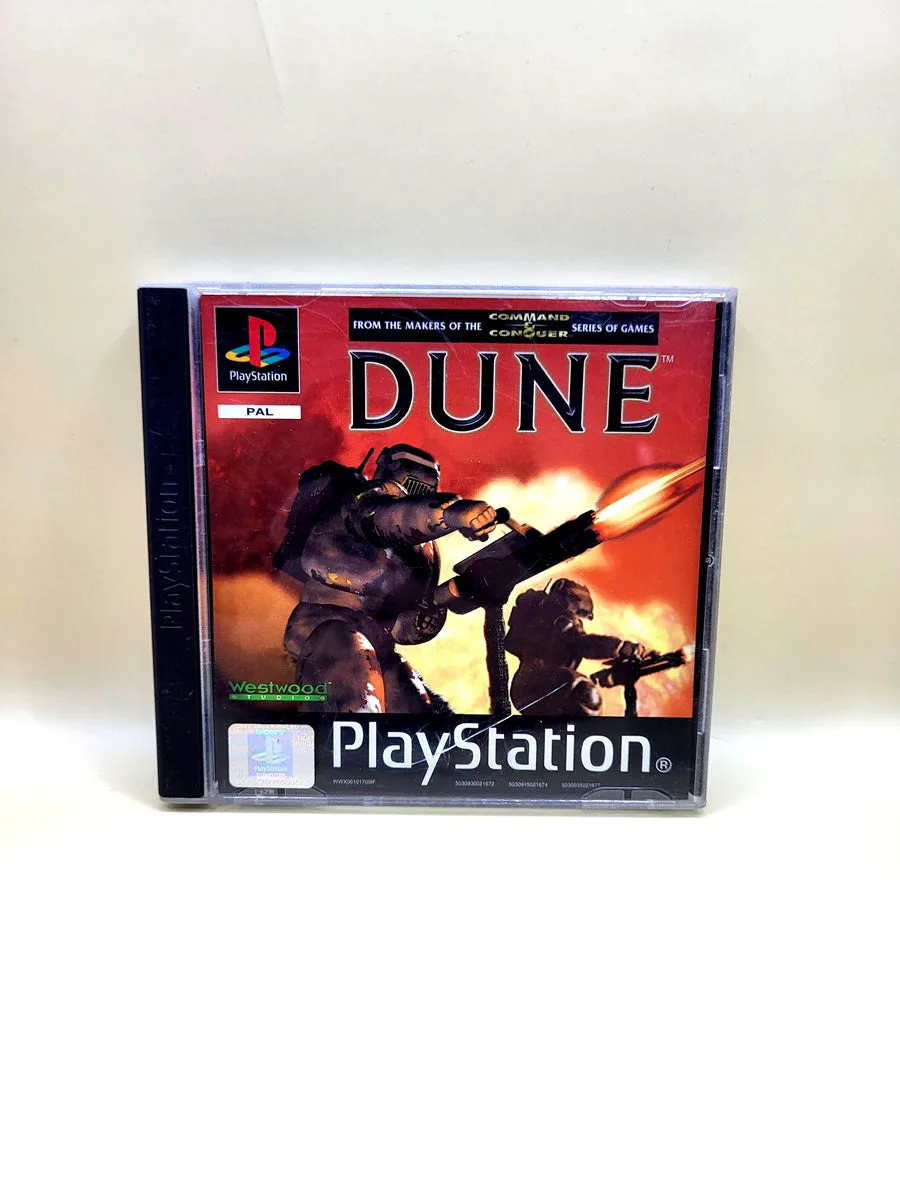
Dune 2000 for PlayStation 1
Dune 2000 for PlayStation 1 is a real-time strategy game on the desert planet Arrakis. You choose House Atreides, Harkonnen or Ordos and try to defeat the other powers. Harvesters collect spice, the valuable resource used to pay for buildings and troops. You build on rocky ground, maintain your power supply and send units into unexplored territory. Sandworms make harvesting dangerous, so an unprotected supply line can disrupt your entire military build-up.
Each house has its own weapons and strengths. Atreides can deploy Sonic Tanks among other units, Harkonnen has the heavy Devastator and Ordos uses the Deviator. You combine infantry with vehicles and look for weak points in enemy bases. The PlayStation version displays terrain, units and buildings in three dimensions. Filmed scenes accompany the campaigns. For a standalone battle, you can start Practice and choose your own settings for a fight against computer-controlled armies.
You control everything with a standard PlayStation controller or an optional PlayStation Mouse. The game menu lets you save progress on a PlayStation memory card in slot 1. A duel between two people requires two consoles with Serial I/O ports, two televisions, a Link Cable, controls for each player and two copies of Dune 2000. A second controller on one console therefore does not enable a two-player battle. This description concerns the strategy game Dune 2000, even when the product title only says Dune.
Region and language
Our PlayStation 1 games are PAL editions and come with a Dutch or English box, unless stated otherwise. By default, you receive the version for the European market. We note it in the product details if the region is different or the box is in another language. In almost all cases, the game is playable at least in English, and often in the other five common European languages too.
Manual
Dune 2000 for PlayStation 1 includes the manual unless the product title states otherwise. If the booklet is missing, the title says “No Manual”. This lets you see before ordering whether the game comes with a manual.
The manuals included with our games usually contain at least English and often around six European languages. The exact languages vary by edition, so Dutch is not always included. The booklet explains the controls and the main rules. You can use it to check how to control the game, which actions are available and how its different features work.
The history of Dune 2000
Dune 2000 returned to the struggle between three houses on Arrakis that Westwood had previously explored in Dune II. The new computer game appeared in 1998; the PlayStation release followed in 1999. The struggle for spice remained central, with an economy that constantly fuels a growing army. The three houses received different strengths and special weapons. The choice made at the start of a campaign thus continued to determine which units you could use to attack later on.
Between Dune II and Dune 2000, Westwood had gained considerable experience with Command & Conquer and Red Alert. Filmed story scenes and commanding groups reflected that development of real-time strategy. However, the desert continued to impose its own conditions: sand is not building ground and sandworms threaten the economy. That combination of a familiar construction structure and a hostile planet made Arrakis more than simply a different backdrop for the same military battles.
The PlayStation adaptation received three-dimensional terrain with matching units and buildings. Controller and separate PlayStation Mouse support brought pointing and selection to the console. The game also supported battles through the Link Cable and saving on a memory card. This distinguishes the release from older PlayStation strategy games that used mission passwords. The original version and the Classics reissue remain the same Dune 2000 for PlayStation 1 here; the shortened shop name does not change the campaign, houses and desert war being described.
Similar games for PlayStation 1
Command & Conquer also has you protect harvesters, build a refinery and turn income into an army. GDI and Nod gather Tiberium there; Dune 2000 uses spice and three houses. Sandworms and limited building space on rocky ground make the landscape of Arrakis important to your economy. On PlayStation, the first Command & Conquer uses two-dimensional images and mission passwords. Dune 2000 adds three-dimensional units, memory-card saving and battles between linked consoles.
Like Dune 2000, Command & Conquer: Red Alert combines base construction with groups of infantry and vehicles that you command directly. It has the Allies and Soviets fight with ore and gemstones as their source of income. Dune 2000 features three houses and spice harvesting on a planet roamed by sandworms. Red Alert also uses ships and submarines, making waterways a battlefield. In Dune, the distribution of sand, spice fields and buildable rocky ground mainly determines your initial layout.
Warzone 2100 also calls for a protected economy, working factories and an army that you continue to reinforce during battles. It lets you design vehicles with a chosen body, propulsion system and weapon, with research unlocking new components. Dune 2000 gives each house a fixed range of units and a few special weapons. The composition of an attack matters in both, but Warzone lets you adapt the equipment while Dune has you work with your house’s characteristics.
Warcraft II: The Dark Saga shares base construction and the protection of a resource economy with Dune 2000. It splits gathering between gold, lumber and oil and adds humans, orcs, magic and warships. On Arrakis, spice provides income and the war centres on three houses with military vehicles. In Warcraft, forests can be both a supply and an obstacle; in Dune, sandworms and rocky plateaus demand attention when you expand.
Like Dune 2000, KKnD: Krossfire has three factions with their own armies fight in real time over territory and resources. Survivors, Evolved and Series 9 robots give the war a world after nuclear disaster, with a different mixture of vehicles and fighters. Dune ties its houses to spice harvesting on Arrakis. You build a production system behind the front line in both, but sandworms and construction on rocky ground give Dune its own economic restrictions.