This product is like new. At NexWave Games, like new means:
Additionally, all discs at NexWave Games are carefully inspected and assessed for quality. When discs arrive, we do not accept any that are so badly damaged that they are unlikely to work. We only accept discs with light scratches at most. Discs with scratches are then treated in our professional disc repair machine. By warming the disc and polishing it with soft brushes, these machines can remove a very thin layer from the disc. This removes the layer containing surface scratches and improves the disc’s readability. This ensures the disc works properly, even on consoles with ageing lasers that have difficulty reading games! Great news for the player.
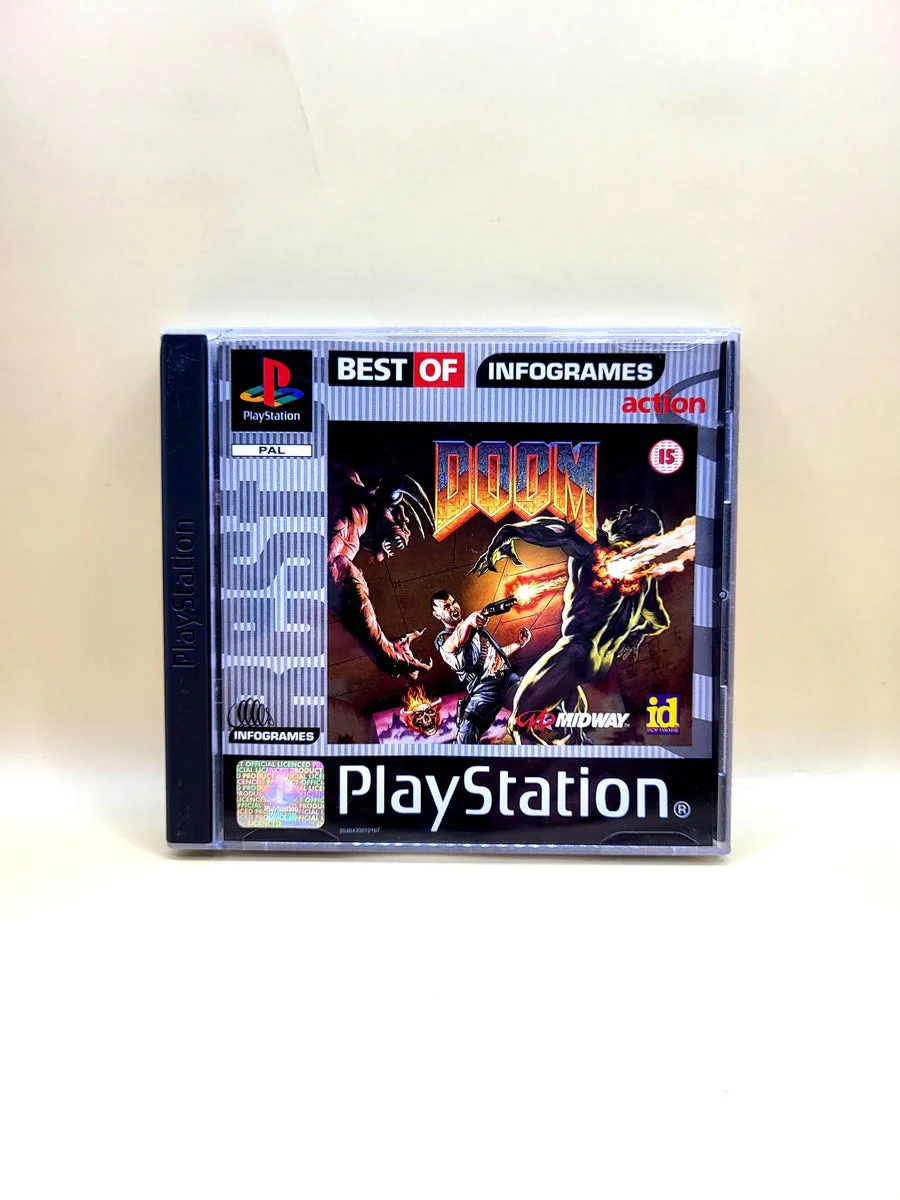
Doom for PlayStation 1
In Doom for PlayStation 1, you explore bases full of demons through the eyes of a marine. You find access cards, operate switches and fight your way to each level's exit. Corridors open into larger rooms where enemies attack from several directions. A shotgun, chainsaw or rocket launcher changes how you deal with threats, while your health, armour and ammunition supply remain important at every next door.
This PlayStation release combines adapted levels from Doom and Doom II with areas of its own. The automap helps you retrace earlier corridors, but does not show which enemy is approaching meanwhile. Hidden doors can reveal weapons or supplies. You turn and walk with the directional buttons and use the shoulder buttons to strafe. Coloured lighting and low, ominous sounds give familiar locations a different atmosphere from the original PC releases.
You play alone or with two people through a PlayStation Link Cable. This requires two original PlayStation consoles with serial ports, two copies of the game, two screens and a controller for each player; there is no split screen on a single console. Fight demons together or choose a competitive Death Match duel. Progress uses passwords after completing a level, not a memory card. A valid password resumes at the next level with the weapons, ammunition, health and armour carried over.
Region and language
Our PlayStation 1 games are PAL editions and come with a Dutch or English box, unless stated otherwise. By default, you receive the version for the European market. We note it in the product details if the region is different or the box is in another language. In almost all cases, the game is playable at least in English, and often in the other five common European languages too.
Manual
Doom for PlayStation 1 includes the manual unless the product title states otherwise. If the booklet is missing, the title says “No Manual”. This lets you see before ordering whether the game comes with a manual.
The manuals included with our games usually contain at least English and often around six European languages. The exact languages vary by edition, so Dutch is not always included. The booklet explains the controls and the main rules. You can use it to check how to control the game, which actions are available and how its different features work.
The history of Doom
id Software released Doom for PC in 1993. Its combination of fast movement, three-dimensional-looking corridors and enemies attacking from several directions made it an important early first-person shooter. Doom II then added other enemies and weapons. Williams Entertainment made the PlayStation version in 1995. The team combined material from both games and changed levels for the console, rather than simply transferring all the original PC campaigns unchanged.
The soundscape became a distinctive part of this adaptation. Composer Aubrey Hodges used low tones, distorted sounds and reverb to make rooms feel more threatening. In interviews he described how limited audio memory forced him to use small samples in different ways. The music consequently sounds less like a constant rock track and more like something within the environment itself. Coloured light reinforces that impression, with corridors and doors glowing red, green or blue.
Playing together at home also took a different technical form from a PC network. The PlayStation Link Cable connected two consoles, giving each player a full screen of their own. Passwords replaced saving at any chosen moment. Final Doom later appeared as a separate PlayStation game with different levels. This Doom remains the earlier release: a selection from Doom and Doom II with its own console adaptations, without the campaigns or modern features of later reissues.
Similar games for PlayStation 1
Final Doom for PlayStation 1 uses the same foundation of moving forward, dodging sideways and finding an exit behind coloured doors. However, it contains a different selection of levels, based on Master Levels, TNT and The Plutonia Experiment. Doom combines earlier material from Doom and Doom II with its own console areas. You recognise weapons and many enemies, but cannot rely on the same route knowledge. Both PlayStation games are separate releases; the Doom disc does not contain Final Doom.
Duke Nukem: Time to Kill for PlayStation 1 also combines alien enemies, heavy weapons and secret passages. Its camera follows Duke from behind, however, while jumping, swimming and climbing form part of the route. Doom keeps you in the character's viewpoint and mainly involves moving through corridors, finding switches and dodging projectiles. Time to Kill also has competitive battles on a split screen; playing Doom with two people requires two consoles connected by Link Cable.
Disruptor for PlayStation 1 also takes you through futuristic complexes while firing from the shooter's viewpoint. Alongside firearms, it gives you psionic powers that consume their own energy supply. Doom instead uses an arsenal including a shotgun, rockets and plasma, without a separate system of mental powers. Both demand attention to the resources available. Disruptor presents its assignments as military science fiction; Doom mixes industrial bases with demons and hellish spaces.
Apocalypse for PlayStation 1 shares the pressure of groups of enemies and the need to keep moving while shooting. You see Trey Kincaid through an external camera and control movement and firing direction independently. Jumps across gaps add platforming. Doom uses a first-person view and asks you to read corridors, doors and changes in height within a level. Both have futuristic weapons, but Apocalypse emphasises constant changes of direction, while Doom also revolves around route knowledge and hidden supplies.
Tomb Raider for PlayStation 1 shares the search for switches, hidden rooms and a route through three-dimensional locations. Lara is visible on screen and must jump, climb and swim precisely to advance. Doom leaves out jumping puzzles and centres on fast combat and opening passages. Both can require returning to a room. Lara explores tombs for the Scion; in Doom you search for weapons, keys and an exit among the demons.