This product is like new. At NexWave Games, like new means:
Additionally, all discs at NexWave Games are carefully inspected and assessed for quality. When discs arrive, we do not accept any that are so badly damaged that they are unlikely to work. We only accept discs with light scratches at most. Discs with scratches are then treated in our professional disc repair machine. By warming the disc and polishing it with soft brushes, these machines can remove a very thin layer from the disc. This removes the layer containing surface scratches and improves the disc’s readability. This ensures the disc works properly, even on consoles with ageing lasers that have difficulty reading games! Great news for the player.
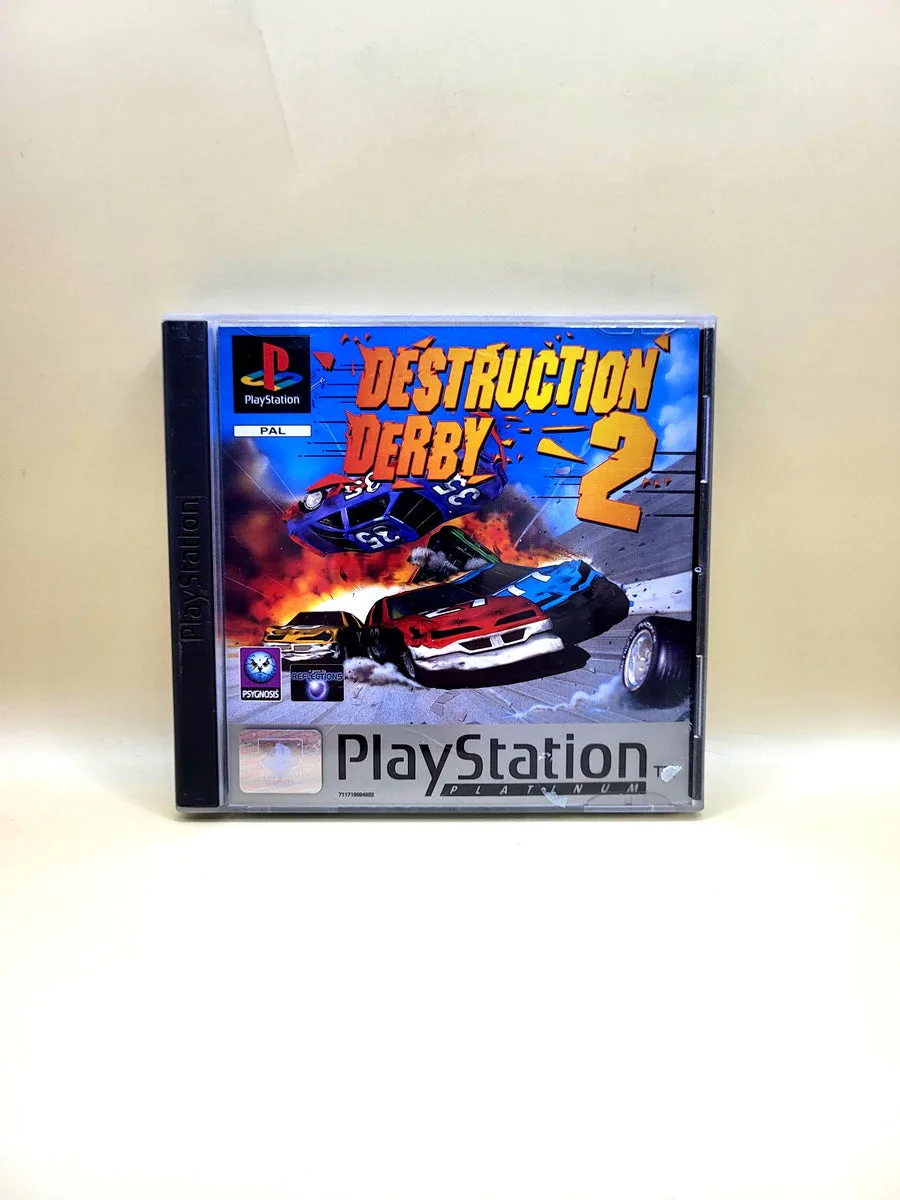
Destruction Derby 2 for PlayStation 1
Destruction Derby 2 for PlayStation 1 makes a collision a deliberate racing choice. In Wreckin' Racing you try to spin opponents and destroy their cars while completing the laps. A well-timed impact can earn more than a clean overtaking move, but your own car must survive the attack. If you choose Stock Car Racing, your finishing position determines the result instead. The same busy circuits therefore take on a different meaning when you change the competition rules.
The tracks contain jumps, crossings and fast sections where a mistake can trigger a chain reaction. Your car can roll over and lose parts; damage means its handling does not automatically stay the same. Pit stops give you a chance to have the car repaired. In the separate Destruction Derby arenas, you seek collisions without a normal lap time as the main objective. Different cars place different emphases on speed, acceleration and grip, so you must adapt your driving style to both the chosen car and your opponents.
You drive championships, practice races and time trials with a standard PlayStation controller. The multiplayer competition takes place in turns: each participant drives separately, after which the game compares the results. It is therefore not a split-screen battle with several human drivers simultaneously. A PlayStation memory card stores your game data, allowing you to load a saved competition later. You can alternate between a quick round of destruction and developing a season in which points, position and your car's condition remain interconnected.
Region and language
Our PlayStation 1 games are PAL editions and come with a Dutch or English box, unless stated otherwise. By default, you receive the version for the European market. We note it in the product details if the region is different or the box is in another language. In almost all cases, the game is playable at least in English, and often in the other five common European languages too.
Manual
Destruction Derby 2 for PlayStation 1 includes the manual unless the product title states otherwise. If the booklet is missing, the title says “No Manual”. This lets you see before ordering whether the game comes with a manual.
The manuals included with our games usually contain at least English and often around six European languages. The exact languages vary by edition, so Dutch is not always included. The booklet explains the controls and the main rules. You can use it to check how to control the game, which actions are available and how its different features work.
The history of Destruction Derby 2
Reflections developed Destruction Derby 2 as a sequel to 1995's Destruction Derby. Psygnosis published the second game during 1996–1997, with release timing varying by region. The first PlayStation had already shown that three-dimensional cars could do more than follow a circuit neatly: they could visibly deform and react to one another. Reflections built on that with broader circuits, jumps and cars that could overturn. The sequel consequently treated damage as more than a visual effect.
The original manual clearly divides racing into Wreckin' Racing, Stock Car Racing and Destruction Derby. That three-way division allowed the same vehicle technology to serve different goals: collecting damage points, finishing first or surviving an arena full of collisions. Pit stops added repairs during circuit races. The presentation also adopted a pronounced American stock-car atmosphere, with loud commentary and heavy music. The races did not recreate an official competition, but combined motorsport and demolition events with recognisable computer-controlled rivals.
Within the series, this is the second main PlayStation game. Destruction Derby Raw later appeared on the same console, developed by Studio 33, while Reflections became further known for Driver. The distinction matters: Destruction Derby 2's alternating competition is not the same as Raw's simultaneous multiplayer battles. This original PS1 release emphasises collision physics, points and surviving chaotic races, still without the weapons that played a leading role in other vehicular combat games of the period.
Similar games for PlayStation 1
The first Destruction Derby already introduces the combination of damage points, circuit races and demolition arenas. Those goals remain recognisable in Destruction Derby 2, but jumps, greater elevation changes and overturning cars make the races more dynamic. Pit stops also change how you deal with a damaged car. The original shows the foundation of the formula; the second game mainly expands what can happen to those colliding cars both on and above the asphalt.
Raw retains collisions for points and arena events, but comes from Studio 33 and builds a different progression and multiplayer structure around that idea. It has direct battles involving several human drivers; three or four simultaneous players require a PlayStation Multitap. Destruction Derby 2 has participants drive separately in its local competition and compares their results afterwards. That is a significant difference when you want to play together on the same sofa.
Demolition Racer likewise lets you ram through other cars and links destruction to points. Your race result plays a particularly explicit part in determining your score there. Destruction Derby 2 draws a clearer distinction between Stock Car Racing, where finishing position counts, and Wreckin' Racing with damage points. Both ask you to weigh an aggressive attack against your own car's condition, but organise those risks differently.
Twisted Metal 2: World Tour also pits vehicles against one another in enclosed combat areas, but lets rockets, mines and other weapons do the work. Destruction Derby 2 instead uses bodywork, speed and impact angle as its means of attack. You look for an opening to spin another car without immediately sacrificing your own. Circuit racing and pit stops also keep it closer to motorsport than Twisted Metal's armed confrontations.
TOCA Touring Car Championship also features contact, visible damage and cars whose behaviour changes after a collision. Its objective remains a strong touring car circuit race, where an impact mainly threatens your result. Destruction Derby 2 can instead reward you for causing that impact. The shared attention to damage therefore leads to different decisions: in TOCA you generally protect your racing line, while here you may deliberately make room for a targeted attack.