This product is like new. At NexWave Games, like new means:
Additionally, all discs at NexWave Games are carefully inspected and assessed for quality. When discs arrive, we do not accept any that are so badly damaged that they are unlikely to work. We only accept discs with light scratches at most. Discs with scratches are then treated in our professional disc repair machine. By warming the disc and polishing it with soft brushes, these machines can remove a very thin layer from the disc. This removes the layer containing surface scratches and improves the disc’s readability. This ensures the disc works properly, even on consoles with ageing lasers that have difficulty reading games! Great news for the player.
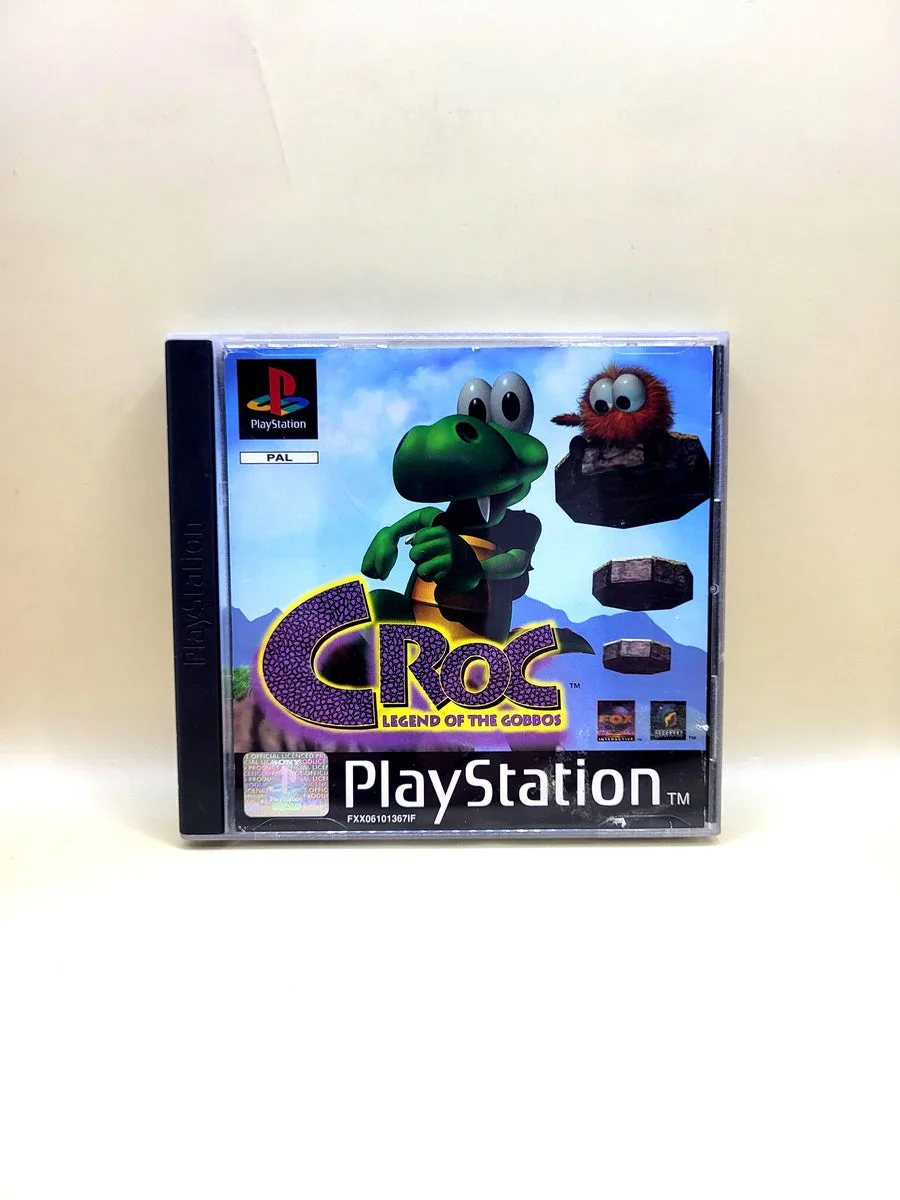
Croc: Legend of the Gobbos for PlayStation 1
Croc: Legend of the Gobbos for PlayStation 1 is a 3D platform game in which a small crocodile rescues the Gobbos from Baron Dante. These furry inhabitants raised Croc and are now imprisoned across the islands. You jump over chasms, climb walls and search among crates and behind doors for missing friends. At the end of a regular level, you strike a gong to travel onwards. If you only look for the exit, you often leave some rescuing undone.
Croc keeps enemies away with a spin of his tail. A ground stomp breaks certain crates, while keys open doors and cages. Ordinary crystals protect you from a hit, but you lose them when an enemy strikes. Five coloured crystals open a special door to an extra challenge. In regular levels, you search for six Gobbos; a complete set can also unlock secret levels. Balloons, overhead bars and underwater sections change how you navigate a route.
You play alone with one standard PlayStation controller. Left and right turn Croc, while up moves him forwards; the shoulder buttons let you sidestep or adjust the camera. You save to a PlayStation memory card through the world map. A password is also available as an alternative, but it does not retain settings or the number of Gobbos rescued in each level. Use the memory card for that more complete saved progress. You can replay previously visited levels to find friends and secrets left behind.
Region and language
Our PlayStation 1 games are PAL editions and come with a Dutch or English box, unless stated otherwise. By default, you receive the version for the European market. We note it in the product details if the region is different or the box is in another language. In almost all cases, the game is playable at least in English, and often in the other five common European languages too.
Manual
Croc: Legend of the Gobbos for PlayStation 1 includes the manual unless the product title states otherwise. If the booklet is missing, the title says “No Manual”. This lets you see before ordering whether the game comes with a manual.
The manuals included with our games usually contain at least English and often around six European languages. The exact languages vary by edition, so Dutch is not always included. The booklet explains the controls and the main rules. You can use it to check how to control the game, which actions are available and how its different features work.
The history of Croc: Legend of the Gobbos
Argonaut Software developed Croc: Legend of the Gobbos, which Fox Interactive released for PlayStation in 1997. The British studio had previously worked with Nintendo on three-dimensional technology and Star Fox. According to founder Jez San, this led to a proposal for a 3D platform game starring Yoshi. Nintendo did not accept the proposal. Argonaut then continued with its own characters and a new world. Croc therefore became an independent adventure, not a released game with a replaced Nintendo character.
The crocodile's appearance changed during development. An early design by Marcus Morgan was reworked; Simon Keating gave Croc and the other characters the form recognisable in the finished game. Animator Jason Smith worked on their movements. At the same time, the team had to discover how jumping, turning and judging distances could work comfortably in three-dimensional spaces. They not only built levels but also developed tools to bring the drawn characters into a moving game world.
The release arrived at a time when platform heroes were exploring new three-dimensional worlds. Croc used separate levels, collectibles and secret passages to shape that transition. Croc 2 followed, also appearing on PlayStation and sending the crocodile on another adventure. Much later, the original game was reworked for more modern systems. This PlayStation 1 version retains the original controls and presentation; the updated visuals, extra documentation and other changes of that later release are not included here.
Similar games for PlayStation 1
Spyro the Dragon for PlayStation 1, like Croc, lets you travel through colourful three-dimensional areas, collect treasure and free prisoners. Spyro can glide long distances and explores broader landscapes. Croc moves through smaller sections with doors and a clear finishing gong. His tail takes the place of Spyro's fire and horns. Croc often revolves around thoroughly searching a room; Spyro more often asks you to recognise a route through the landscape from a high point.
Spyro: Year of the Dragon on PlayStation 1 also combines platforming, hidden collectibles and rescuing other creatures. Five playable friends help the dragon, so the game regularly switches to jumping, flying or shooting with another character. Croc sticks to one crocodile with a fixed set of moves. Its coloured crystals and six Gobbos per regular level provide a clearly defined checklist, unlike the varied egg tasks within Spyro's larger areas.
Crash Bandicoot 2: Cortex Strikes Back for PlayStation 1 also uses crates, secret routes and levels you revisit for missing finds. Crash usually follows a tighter path and uses his spin to hit enemies and crates. Croc gives you more room to wander and sends you through doors to different sections of a level. In both, a missed collectible can require another attempt, but Croc puts more emphasis on searching tucked-away corners and rooms.
Rayman 2: The Great Escape on PlayStation 1 shares Croc's search for prisoners and its mix of jumping, climbing and special movement. Rayman fires magical projectiles and can extend a jump using his hair. Croc uses his tail and a ground stomp and first turns to face the direction he wants to move. Both teach you to read a three-dimensional route, but Rayman more often carries its story along a continuous sequence of events and encounters.
Toy Story 2: Buzz Lightyear to the Rescue! for PlayStation 1, like Croc, puts collecting alongside platforming. Buzz explores large environments and earns Pizza Planet tokens through different tasks, including finding lost objects. Croc mainly searches for Gobbos and coloured crystals within shorter levels. Buzz uses a laser and a wing spin, while Croc attacks at close range with his tail. Both reward checking edges, high places and passages that are easy to overlook on a first visit.