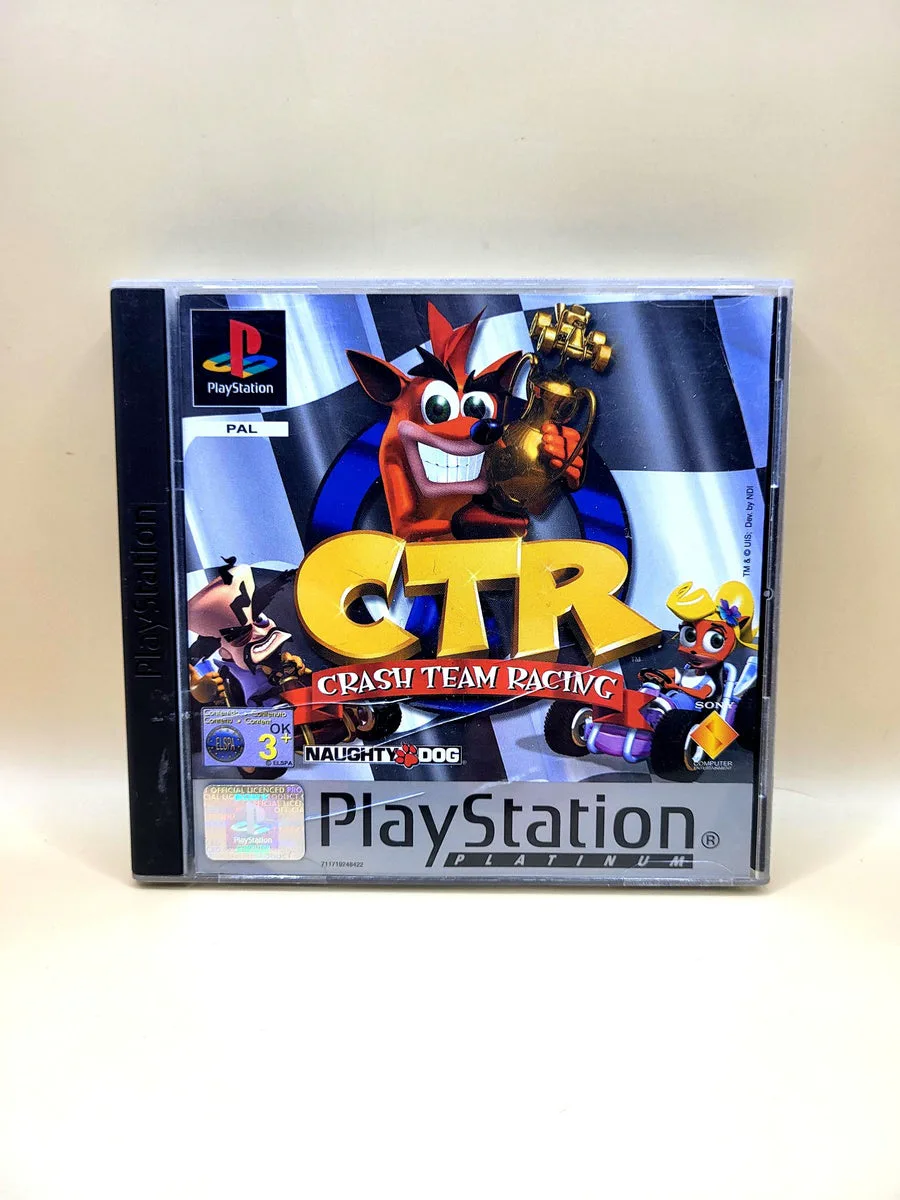
This product is in good condition. At NexWave Games, good means:
Additionally, all discs at NexWave Games are carefully inspected and assessed for quality. When discs arrive, we do not accept any that are so badly damaged that they are unlikely to work. We only accept discs with light scratches at most. Discs with scratches are then treated in our professional disc repair machine. By warming the disc and polishing it with soft brushes, these machines can remove a very thin layer from the disc. This removes the layer containing surface scratches and improves the disc’s readability. This ensures the disc works properly, even on consoles with ageing lasers that have difficulty reading games! Great news for the player.
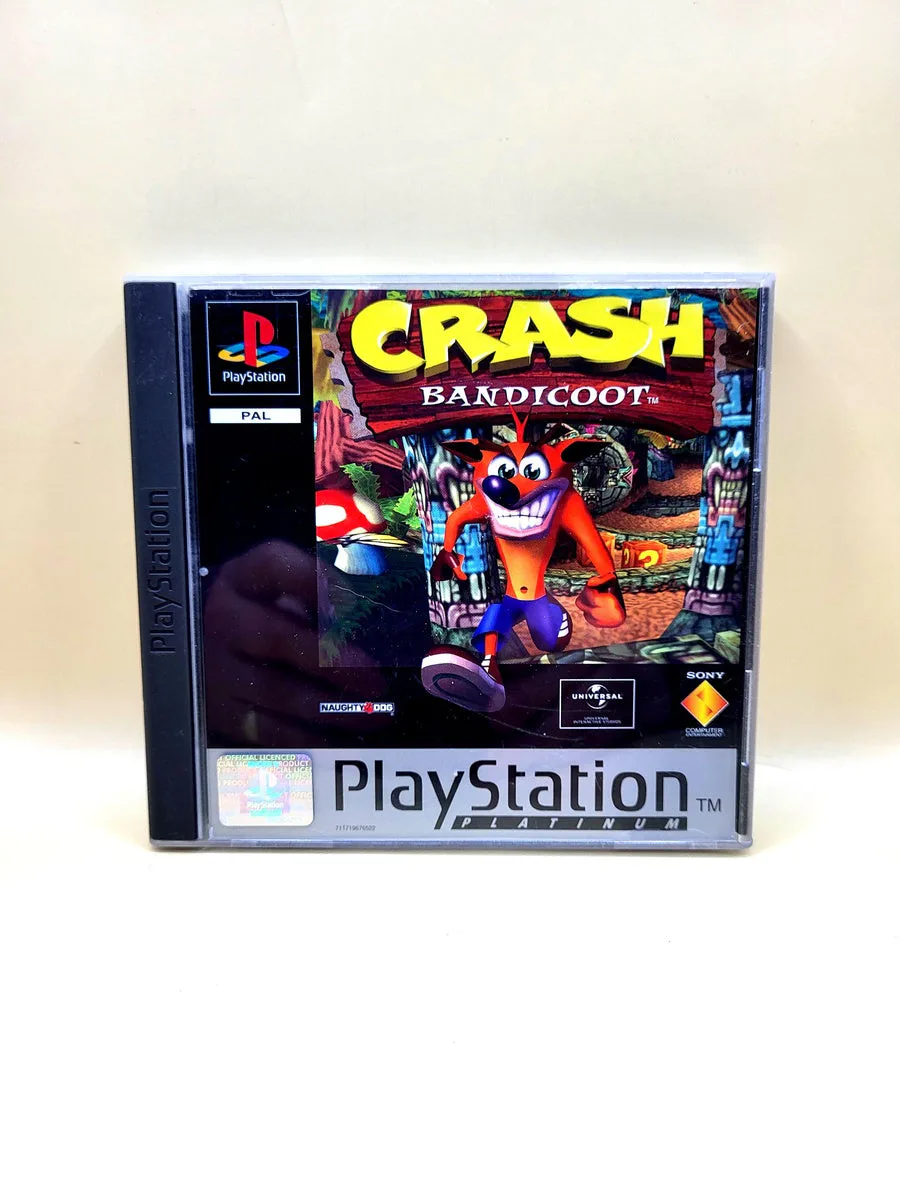
Crash Bandicoot for PlayStation 1
Crash Bandicoot for PlayStation 1 is a 3D platform game in which you pursue Dr. Neo Cortex and try to rescue Tawna. The route crosses three islands, with jungle paths, ancient temples, rope bridges and factories. You usually see Crash from behind, but sometimes the course appears from the side or you flee straight towards the camera ahead of a rolling boulder. Each change of viewpoint requires you to judge distances and approaching dangers again.
Jumping and spinning are the basics. A jump lets you land on many enemies and break crates; a spin knocks opponents aside, but can also send fruit flying. Wumpa fruit earns extra lives and Aku Aku masks absorb hits. TNT crates require a different approach from ordinary wooden boxes. To earn a gem in the original version, you must break every crate in a level without losing a life along the way.
You play alone with one standard PlayStation controller. Checkpoint crates help during the same attempt, but do not save progress for after you switch off. You record progress on a PlayStation memory card at designated points, particularly after completing a Tawna bonus round. Gems and keys have their own recording opportunities. The game also offers passwords. Reaching an actual save opportunity is therefore part of the challenge; this is not the automatic saving system of N. Sane Trilogy.
Region and language
Our PlayStation 1 games are PAL editions and come with a Dutch or English box, unless stated otherwise. By default, you receive the version for the European market. We note it in the product details if the region is different or the box is in another language. In almost all cases, the game is playable at least in English, and often in the other five common European languages too.
Manual
Crash Bandicoot for PlayStation 1 includes the manual unless the product title states otherwise. If the booklet is missing, the title says “No Manual”. This lets you see before ordering whether the game comes with a manual.
The manuals included with our games usually contain at least English and often around six European languages. The exact languages vary by edition, so Dutch is not always included. The booklet explains the controls and the main rules. You can use it to check how to control the game, which actions are available and how its different features work.
The history of Crash Bandicoot
Naughty Dog released Crash Bandicoot in 1996 for the original PlayStation, with Universal Interactive as its partner and Sony as publisher. Andy Gavin and Jason Rubin began developing the concept while moving to California in 1994. They wanted to bring character-platforming action into three-dimensional environments. Choosing PlayStation reflected its technical capabilities and the opportunity for a new recognizable character alongside the established Mario and Sonic.
The camera determined how the team built that world. Rather than a completely freely controlled camera, the developers chose predetermined routes beside, behind and in front of Crash. This let them calculate which parts of an environment would be visible and fit considerable detail into that view. The cartoon-style animation also received considerable attention. Exaggerated movements and expressions needed to keep Crash readable among the colourful trees, walls and machines.
The game began Naughty Dog's original Crash series. Cortex Strikes Back followed in 1997 and Warped in 1998, bringing new moves and different ways to select levels. This first instalment still has the island map, straightforward jump-and-spin attacks and stricter rules for gems and saving. The later N. Sane Trilogy rebuild changed several of those rules. The PlayStation 1 disc contains the original adventure, not that modern collection.
Similar games for PlayStation 1
Crash Bandicoot 2: Cortex Strikes Back for PlayStation 1 shares the narrow 3D courses, crates and spin attacks. The sequel adds sliding and a downward body slam, giving Crash more ways to pass obstacles. You select levels from Warp Rooms and can save there on a memory card. The first Crash Bandicoot uses an island route and separate saving opportunities. You therefore notice the difference both during a jump and when you want to finish a play session.
Crash Bandicoot 3: Warped on PlayStation 1 builds on the same familiar platforming, but alternates it with motorcycling, underwater areas and Coco riding a tiger or jet ski. Time trials with relics give completed levels an additional objective. Crash Bandicoot limits its collecting to gems and keys and has no comparable relic system. The first instalment concentrates more strongly on carefully negotiating its island courses with a small set of basic moves.
Spyro the Dragon for PlayStation 1 likewise combines colourful 3D worlds with collectibles and an animal protagonist. Spyro uses fire, charges and gliding jumps to explore larger areas. You find your own line between high ledges and hidden places. Crash Bandicoot more often guides you through a clearly bounded course. The challenge here is therefore less about spotting a distant destination and more about correctly making the next jump along the fixed route.
Rayman on PlayStation 1, like Crash Bandicoot, has a cartoon world where precise jumps and hidden collecting objectives matter. Its action remains two-dimensional, however: you judge distances from the side and gradually learn abilities such as punching and gliding with his hair. Crash starts with his small fixed set of moves and alternates depth-based courses with side views. Both reward revisiting areas, but consequently demand a different sense of the space on screen.
Croc: Legend of the Gobbos for PlayStation 1 also sends an animal hero through three-dimensional platforming areas to rescue others. Croc explores rooms and paths in search of Gobbo friends and can look around before continuing. Crash Bandicoot fixes the direction of travel more firmly with its moving camera. Whereas Croc more often asks you to find where to go, Crash mainly requires you to remember crates, enemies and safe landing spots along a chosen route.