This product is like new. At NexWave Games, like new means:
Additionally, all discs at NexWave Games are carefully inspected and assessed for quality. When discs arrive, we do not accept any that are so badly damaged that they are unlikely to work. We only accept discs with light scratches at most. Discs with scratches are then treated in our professional disc repair machine. By warming the disc and polishing it with soft brushes, these machines can remove a very thin layer from the disc. This removes the layer containing surface scratches and improves the disc’s readability. This ensures the disc works properly, even on consoles with ageing lasers that have difficulty reading games! Great news for the player.
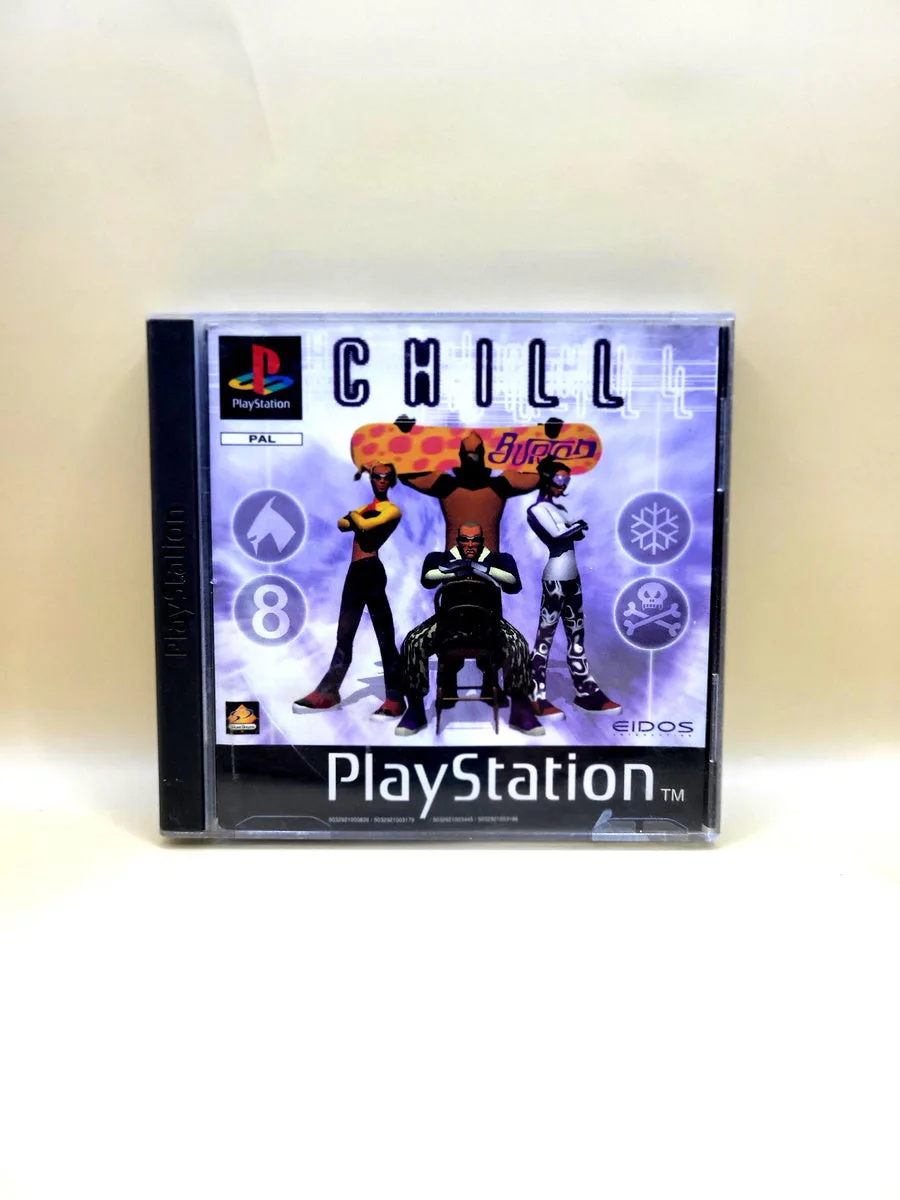
Chill for PlayStation 1
Chill for PlayStation 1 is a snowboarding game that combines speed and tricks on snowy mountainsides. You view your snowboarder from behind and look for a line past trees, rocks and changes in elevation. Five mountains provide downhill terrain where a fast time and a successful jump both require attention. The slope sets you moving; turns and a good riding position determine how you get between the obstacles.
You choose a snowboarder and a board, then try to make increasingly good use of your surroundings. A rock or tree stump can become the starting point for a trick, while an awkward landing interrupts your run. Grabs and spins earn points when you complete them properly. Along the way, you look for side routes and hidden runs. Practising is therefore not just about steering faster, but also recognising where there is room for a jump and where it is better to stay on the snow.
You can ride alone or race another player simultaneously in split screen. Connect two standard PlayStation controllers for this; no Multitap is needed. The game also supports analogue controls. A PlayStation memory card lets you save game data. While riding, you switch between gathering speed, turning sharply and jumping. Trying a course again lets you choose another line and practise a trick you missed earlier.
Region and language
Our PlayStation 1 games are PAL editions and come with a Dutch or English box, unless stated otherwise. By default, you receive the version for the European market. We note it in the product details if the region is different or the box is in another language. In almost all cases, the game is playable at least in English, and often in the other five common European languages too.
Manual
Chill for PlayStation 1 includes the manual unless the product title states otherwise. If the booklet is missing, the title says “No Manual”. This lets you see before ordering whether the game comes with a manual.
The manuals included with our games usually contain at least English and often around six European languages. The exact languages vary by edition, so Dutch is not always included. The booklet explains the controls and the main rules. You can use it to check how to control the game, which actions are available and how its different features work.
The history of Chill
Silicon Dreams developed Chill, and Eidos Interactive released the snowboarding game for PlayStation in 1998. The British studio had started in 1994 as US Gold’s in-house development department. On its own company website, Silicon Dreams later looked back at sports games such as Fever Pitch, Olympic Soccer and World League Soccer ’98. Chill added a winter sport to that background: the action shifted from teams on a playing field to an individual snowboarder on a mountainside.
On the same website, the developer confirmed that Burton Boards of America endorsed Chill. That connection with a snowboarding brand fits the emphasis on boards, clothing and recognisable moves. The original publisher description focused mainly on speed, freedom and tricks. It mentioned five mountains, hidden runs and jumps that make use of objects in the surroundings. Eidos thus presented the game as a combination of a fast descent and looking for opportunities to earn extra points along the way.
Chill appeared in the same PlayStation era as several Cool Boarders games, but came from a different development team and was not part of that series. A Saturn version was also worked on; the edition offered here is the PlayStation game that actually reached release. Its following camera, snowy routes and direct two-player competition place it within the wave of three-dimensional extreme sports games of the late 1990s. It remains a standalone title, unrelated to later snowboarding series such as SSX.
Similar games for PlayStation 1
Cool Boarders also has you descend a mountain, avoid obstacles and earn points with jumps. The first game splits its assessment between time, tricks and a combined performance, giving the same slope different goals. Chill additionally emphasises hidden routes and direct two-player competition in split screen. Both require a safe landing, but the basic structure of Cool Boarders focuses more on improving individual records.
Like Chill, Cool Boarders 2 combines snowboarding tricks with a fast descent and expands the riding with a competition structure and extra equipment to unlock. Chill presents five mountains as terrain for exploring runs and hidden passages. In Cool Boarders 2, the progression of the competition provides a clearer framework for alternating jumps and races. Repetition helps you find a good line in both games; their emphasis on progression differs.
Cool Boarders 3 shares Chill’s snowy three-dimensional courses and the choice of a board that matches your riding style. The third game in Sony’s series offers different events and also lets you punch opponents during races. Chill revolves around reading the slope, performing tricks at natural obstacles and finding hidden runs. Both bring speed and stunt work into conflict, but physical confrontation gives Cool Boarders 3 another way to obstruct a direct rival.
Like Chill, Tony Hawk’s Pro Skater 2 asks you to recognise jumps and finish tricks safely. The skateboarding game lets you ride freely through plazas, school grounds and skateparks, with objectives and cash rewards in the career. Chill uses the mountainside to guide your direction. Tony Hawk adds manuals to connect tricks across flat sections; in Chill, you mainly look for a line through the snow and a useful take-off point in the surroundings.
Street Sk8er shares Chill’s combination of speed and stunts, but moves the riding to streets and skating facilities. In the Street Tour, you pass checkpoints to earn time as you head for the finish. Chill takes a downhill mountain run and natural obstacles as its starting point. Both have a route you learn through repetition, while Street Sk8er explicitly ties the pressure of the clock to reaching the next checkpoint.