This product is like new. At NexWave Games, like new means:
Additionally, all discs at NexWave Games are carefully inspected and assessed for quality. When discs arrive, we do not accept any that are so badly damaged that they are unlikely to work. We only accept discs with light scratches at most. Discs with scratches are then treated in our professional disc repair machine. By warming the disc and polishing it with soft brushes, these machines can remove a very thin layer from the disc. This removes the layer containing surface scratches and improves the disc’s readability. This ensures the disc works properly, even on consoles with ageing lasers that have difficulty reading games! Great news for the player.
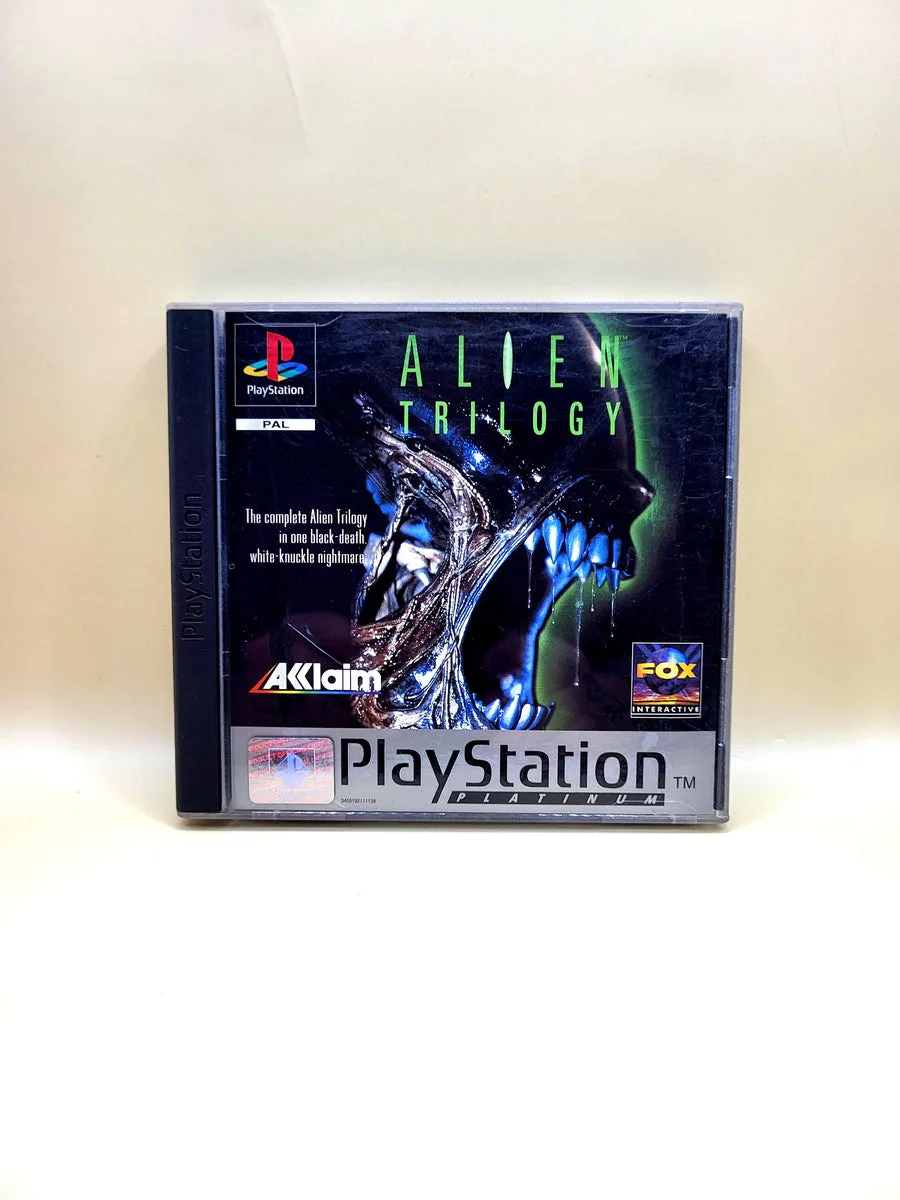
Alien Trilogy for PlayStation 1
Alien Trilogy for PlayStation 1 is a first-person shooter in which you play Ellen Ripley through settings from the first three Alien films. The abandoned colony, prison and alien ship form three sections of the same campaign. You walk through dark corridors, check doors and find the route to your next objective. The motion tracker helps you spot approaching danger, even when you cannot yet see anything around a corner.
You fight adult aliens, facehuggers and armed guards, among other enemies. A pistol, shotgun, pulse rifle and flamethrower offer different answers to those threats. Ammunition, medical supplies and protective equipment are scattered throughout the levels. Read the briefing carefully: reaching the exit does not complete every assignment. Sometimes you first need to activate machinery, find items or destroy a specified target. Hidden passages and extra supplies reward searching a room once the immediate danger has passed.
You play this adventure alone with a standard PlayStation controller. Four preset button layouts let you choose your controls. The map helps you track visited rooms and possible routes. After a level, you can save progress on a PlayStation memory card or write down the password. This resumes play at a level boundary, not in the middle of a firefight. The three difficulty settings change how much room you have to recover from mistakes and lost supplies.
Region and language
Our PlayStation 1 games are PAL editions and come with a Dutch or English box, unless stated otherwise. By default, you receive the version for the European market. We note it in the product details if the region is different or the box is in another language. In almost all cases, the game is playable at least in English, and often in the other five common European languages too.
Manual
Alien Trilogy for PlayStation 1 includes the manual unless the product title states otherwise. If the booklet is missing, the title says “No Manual”. This lets you see before ordering whether the game comes with a manual.
The manuals included with our games usually contain at least English and often around six European languages. The exact languages vary by edition, so Dutch is not always included. The booklet explains the controls and the main rules. You can use it to check how to control the game, which actions are available and how its different features work.
The history of Alien Trilogy
Probe Entertainment developed Alien Trilogy, and Acclaim released it for PlayStation in 1996. The project grew from the idea of combining the films' recognisable weapons and menace with a shooter seen through the player's eyes. An early Mega-CD concept was set aside before the PlayStation version took shape. The console of the time made room for three-dimensional corridors, extensive sound presentation and a campaign linking different film settings together.
The story is not a literal retelling in which you play every film scene in sequence. Probe used the colony from Aliens, the prison from Alien 3 and the alien ship from Alien as starting points for its own missions. Ripley consequently faced an ongoing struggle against aliens and the Company's interests. Briefings explain each level's objectives. This gave the designers room to turn familiar locations into networks of corridors with switches, items to collect and enemies blocking your progress.
During development, Probe worked with Acclaim's American motion-capture team. Movements were recorded, applied to digital models and processed into images for the game's characters. In the finished game, enemies appear as sprites within the three-dimensional environment, not as the fully polygonal figures of later shooters. That combination places Alien Trilogy firmly in the early PlayStation years. The later Alien Resurrection used a different film and different technology on the same console; this Platinum release retains the original Trilogy campaign.
Similar games for PlayStation 1
Doom for PlayStation 1, like Alien Trilogy, combines exploring corridors with shooting, finding ammunition and opening doors. You learn a level by retracing your steps and connecting new routes. Alien Trilogy uses its motion tracker and recognisable film weapons to signal danger, however. Briefings also set concrete objectives within the environment. Doom builds its world around demons and infernal bases; Trilogy ties similar exploration and shooting decisions to Ripley and the alien threat.
Alien Resurrection for PlayStation 1 again has you fight aliens from a first-person perspective, but is based on the fourth film. You explore the Auriga and control different characters during the story. Its controls support separate movement and looking with two analogue sticks. Alien Trilogy uses the earlier three films and an older digital button layout. Both play with dark rooms and limited supplies, but they do not share the same campaign, character changes or aiming technology.
Duke Nukem: Total Meltdown for PlayStation 1 also revolves around shooting, discovering hidden places and finding the right passage. Urban settings, jokes and its outspoken hero give that game a different tone, however. Alien Trilogy builds tension through dark corridors, sounds and motion tracker alerts. Both alternate combat with searching a room, but Ripley's campaign relies on film horror rather than Duke's mocking commentary.
Disruptor for PlayStation 1 combines a first-person shooter with separate missions and a science-fiction story. Alongside guns, the LightStormer uses psionic powers, for example to drain energy or heal himself. Alien Trilogy makes you rely on physical weapons, medical supplies and protective equipment. In both, you must decide which resources to use in a difficult room. Disruptor adds a separate energy supply for mental powers; Trilogy keeps the focus on Ripley's equipment and signals of approaching aliens.
Die Hard Trilogy for PlayStation 1, like Alien Trilogy, takes three films as its starting point, but divides them into three different types of game. You control McClane from an external viewpoint, shoot in an automatically progressing section and drive through the city during the third film. Alien Trilogy keeps its entire campaign within the same first-person framework. Both rearrange film ideas into game objectives. Moving to the next section reveals the difference: different rules and controls in Die Hard, one continuous shooting campaign in Alien Trilogy.