This product is like new. At NexWave Games, like new means:
Additionally, all discs at NexWave Games are carefully inspected and assessed for quality. When discs arrive, we do not accept any that are so badly damaged that they are unlikely to work. We only accept discs with light scratches at most. Discs with scratches are then treated in our professional disc repair machine. By warming the disc and polishing it with soft brushes, these machines can remove a very thin layer from the disc. This removes the layer containing surface scratches and improves the disc’s readability. This ensures the disc works properly, even on consoles with ageing lasers that have difficulty reading games! Great news for the player.
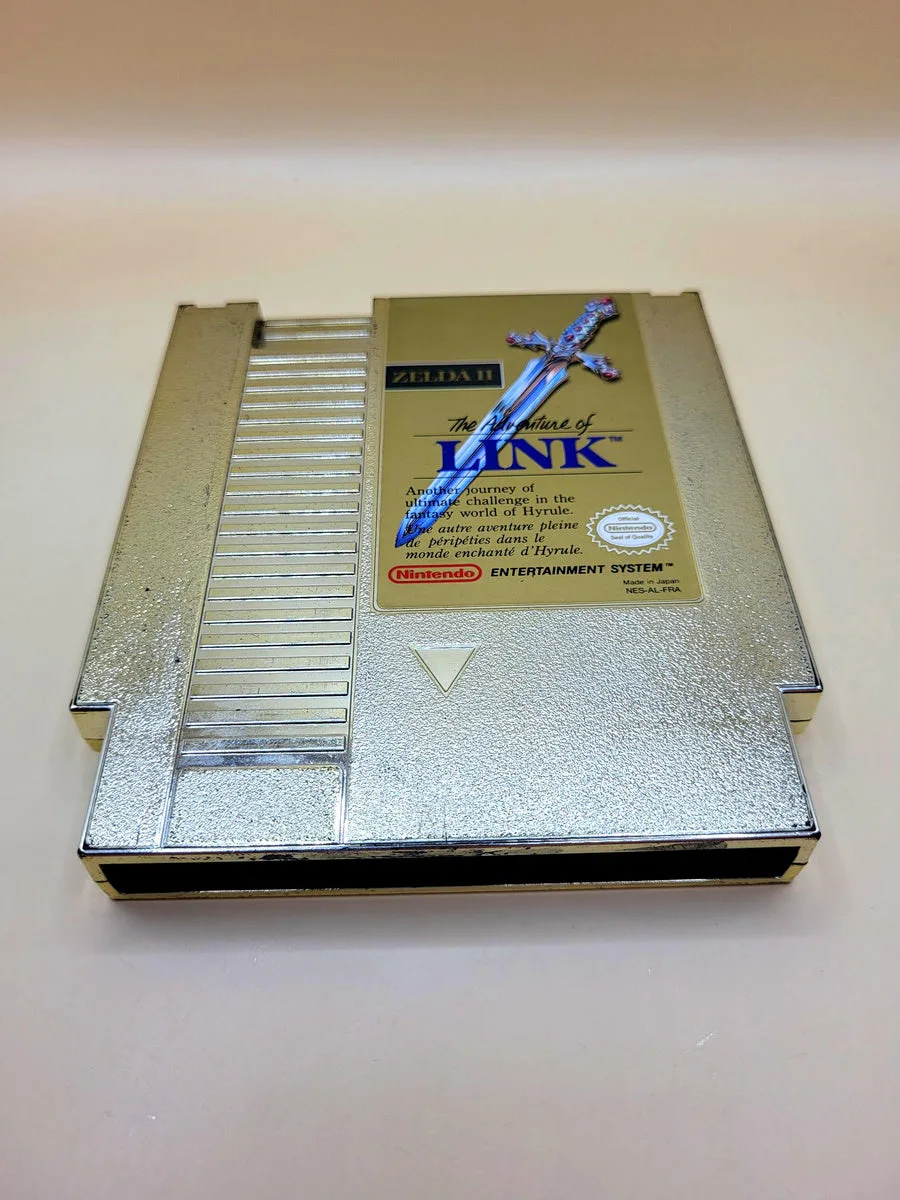
Zelda II: The Adventure of Link for Nintendo NES
Zelda II: The Adventure of Link for Nintendo NES combines an action adventure with role-playing elements. Link seeks the Triforce of Courage to awaken a sleeping Princess Zelda. To do so, you must visit six palaces, defeat their guardians and place crystals in statues. You travel across a world map with towns, forests, caves and deserts. When you enter a location or touch an enemy on the map, the view switches to side-scrolling action.
In these battles, you jump, thrust with your sword and hold your shield high or low. Opponents respond to the height of your attack, so blindly striking again and again achieves little. Inhabitants offer clues, teach you spells and help you progress through small tasks. Experience points improve attack, magic and life energy separately. New items, such as a hammer or raft, also open routes on the world map.
You play alone with one standard controller. The original cartridge has battery-backed saving, not passwords. Save preserves items and attained ability levels; any unspent experience points are lost. After Game Over, you normally restart at North Castle, with an exception for the final palace. A second controller is needed only if you want to open the save menu during play: open the inventory screen and press Up and A together on that controller.
Region and language
Our Nintendo NES games are PAL editions, unless stated otherwise. This product contains a loose cartridge for the European market. A box is only included if explicitly stated in the product details. We note any different region in the product details. In almost all cases, the game is playable at least in English, and often in the other five common European languages too.
Manual
With Zelda II: The Adventure of Link for Nintendo NES, you receive a loose cartridge. A box and manual are not included unless we explicitly state otherwise in the product details. This is the standard way we supply this copy.
The history of Zelda II: The Adventure of Link
Nintendo released Zelda II: The Adventure of Link in Japan for the Famicom Disk System in January 1987. The European NES cartridge followed in September 1988. The sequel retained Link, Hyrule and the Triforce but changed combat substantially. Towns, caves and palaces received a side view, while the world map remained visible from above. The combination of jumps, sword thrusts and experience levels gave this second adventure a different structure from the first Zelda.
Director Tadashi Sugiyama later explained that the project began with a request from Shigeru Miyamoto: make a side-scrolling action game in which attacks and defence use different heights. The team experimented with sword and shield rather than continually following the first game's system. The story and Link's age of sixteen were added later to release the adventure as the second Zelda. According to Sugiyama, around ten people worked on the project, exchanging their design documents on paper.
Sugiyama also linked the difficulty to the way that small team worked. The creators tested their own game so often that their benchmark for challenging battles kept rising. At the same time, they added experience levels to give repeated battles meaning. Town names later returned in the series as character names, including Saria, Ruto and Rauru. Connections with later Zelda adventures can therefore also be found beyond the unusual combat.
Similar games for Nintendo NES
Like Zelda II, The Legend of Zelda for Nintendo NES has you explore Hyrule, find hidden items and search dungeons. During combat, however, the first game retains the overhead view. You do not gain experience levels but instead seek better weapons and heart containers. Zelda II divides the journey between a world map and side-view scenes, giving jumping and high or low defence much more influence over a duel.
Faxanadu on Nintendo NES is close to Zelda II through its side-view sword fighting, spells and visits to towns. You explore a huge World Tree, buy equipment and collect experience to earn a higher rank. Zelda II lets you raise attack, magic and life energy separately and uses a distinct overworld map. In Faxanadu, routes through the world itself remain part of the side-view exploration, so travel and combat flow into one another differently.
The Battle of Olympus for Nintendo NES also revolves around sword fighting and finding useful items in side-view areas. Orpheus seeks help from Greek gods to free Helene from Hades. Zelda II instead uses an overworld map between towns and palaces and lets Link grow through experience points. Both ask you to remember clues, but their mythical worlds and systems for strengthening the hero differ.
Metroid for Nintendo NES shares the side-view action and returning to blocked routes after finding new equipment. Samus fires her arm cannon and moves through a connected network of passages on Zebes. Link also travels across a separate world map and speaks to townspeople to learn spells. Metroid has no comparable experience-point system; new weapons and movement abilities determine which parts of the maze you can explore.
Kid Icarus on Nintendo NES also mixes jumping and combat with strengthening its hero. Pit uses a bow, buys helpful items and explores fortresses, alongside routes that scroll vertically or horizontally. Zelda II gives you a sword and shield for close-range battles and a freely explorable world map between important locations. Pit follows a more clearly ordered sequence of areas, whereas Link returns more often to seek information or a missing item.