This product is like new. At NexWave Games, like new means:
Additionally, all discs at NexWave Games are carefully inspected and assessed for quality. When discs arrive, we do not accept any that are so badly damaged that they are unlikely to work. We only accept discs with light scratches at most. Discs with scratches are then treated in our professional disc repair machine. By warming the disc and polishing it with soft brushes, these machines can remove a very thin layer from the disc. This removes the layer containing surface scratches and improves the disc’s readability. This ensures the disc works properly, even on consoles with ageing lasers that have difficulty reading games! Great news for the player.
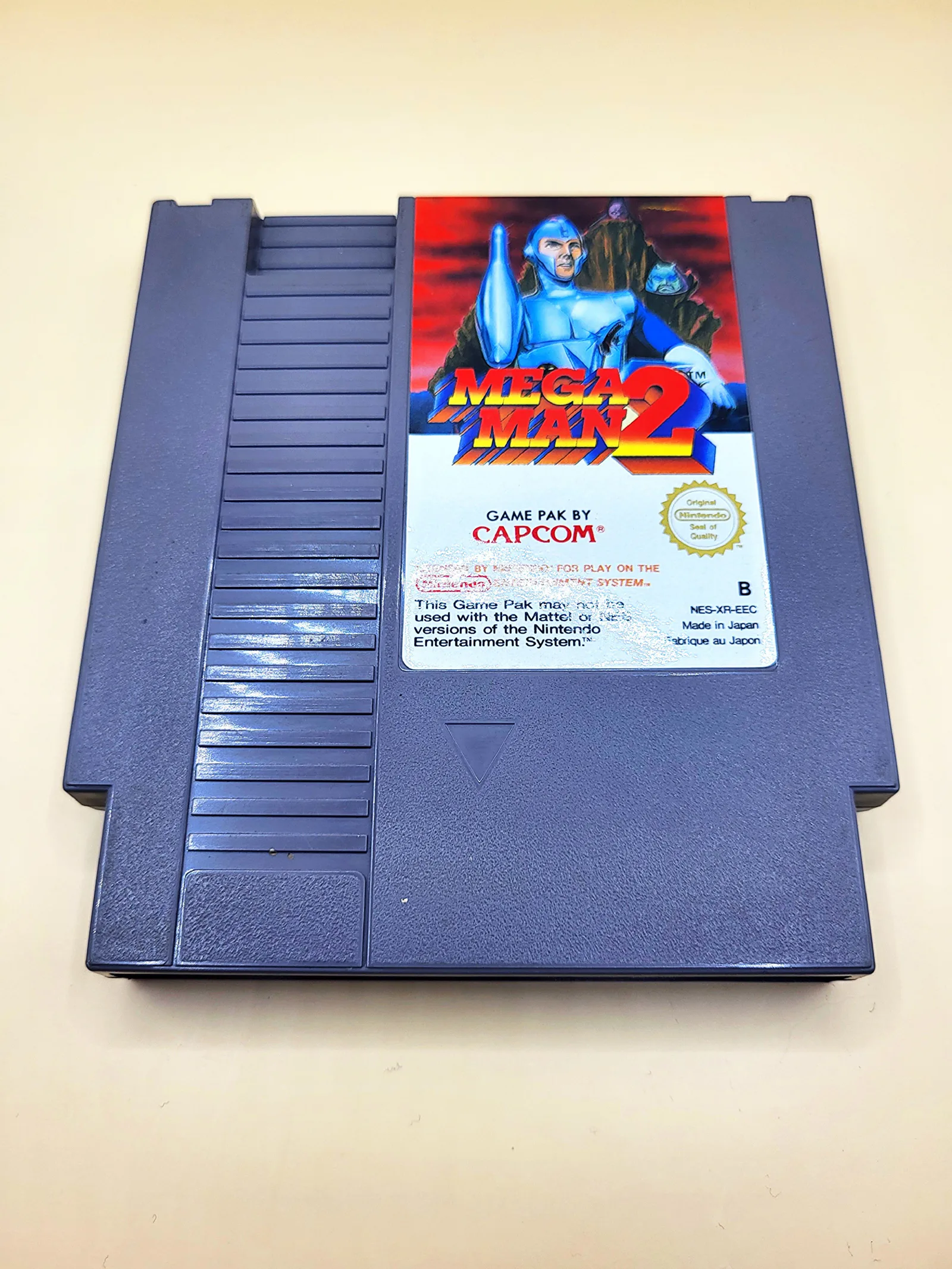
Mega Man 2 for Nintendo NES
Mega Man 2 for Nintendo NES is an action platformer in which you stop Dr. Wily and his eight new Robot Masters. You choose which robot area to try first. Each route has its own setting and obstacles, from Air Man's clouds to Wood Man's forest and Quick Man's deadly beams. Jumping, climbing ladders and shooting form the foundation, but the order of your victories determines which extra tools you can use later.
After defeating a Robot Master, you receive his weapon. Metal Blade fires in several directions, Leaf Shield temporarily protects you and Time Stopper freezes many enemies. Each special weapon has its own energy supply; your normal shots remain available without such a meter. Bosses respond differently to your attacks, making experimentation worthwhile. Dr. Light also provides three transport tools, including floating platforms and a flying device for crossing difficult gaps.
You play alone with one standard controller. The European NES version offers Normal and Difficult, with Normal providing a gentler challenge. Energy Tanks completely restore your health when used. A password made of dots records which Robot Masters you have defeated and how many Energy Tanks you own, but not your exact position in Wily's fortress. Write down the code yourself: the original cartridge does not save your progress with a battery.
Region and language
Our Nintendo NES games are PAL editions, unless stated otherwise. This product contains a loose cartridge for the European market. A box is only included if explicitly stated in the product details. We note any different region in the product details. In almost all cases, the game is playable at least in English, and often in the other five common European languages too.
Manual
With Mega Man 2 for Nintendo NES, you receive a loose cartridge. A box and manual are not included unless we explicitly state otherwise in the product details. This is the standard way we supply this copy.
The history of Mega Man 2
Mega Man 2 appeared in Japan as Rockman 2 in late 1988, following Capcom's first Mega Man from 1987. The sequel retained the choice of robot areas and weapon acquisition, but increased the number of Robot Masters from six to eight. Energy Tanks and passwords changed how you could organise a long attempt. The European and American releases also gained a choice between Normal and Difficult, with Difficult matching the original Japanese challenge.
Designer Akira Kitamura later explained that, for this sequel, the team first decided how weapons would move and work, then matched them to the Robot Masters. A boss's behaviour and a weapon's operation could therefore provide clues to a weakness. He also described a short development period with little room for extensive testing. The relationships between enemies, terrain and weapons thus took shape under a tight schedule.
The move to Wily's fortress puts your collected equipment to use again after you complete the eight separate areas. This builds on the first game's structure, while extra transport tools provide more ways to overcome obstacles. Later entries further expanded Mega Man's movements, including sliding and robot dog Rush in Mega Man 3. Mega Man 2 remains the earlier version: no slide, no Rush and no charged standard shot as found in later sequels.
Similar games for Nintendo NES
Mega Man for Nintendo NES uses the same premise: choose a robot area, defeat its boss and acquire his weapon. The first game has six Robot Masters and uses the Magnet Beam to create platforms. Mega Man 2 offers eight bosses, three transport tools, Energy Tanks and passwords. This gives you more ways to tackle a stalled attempt in the sequel, and means you need not repeat every earlier victory after switching off.
Mega Man 3 on Nintendo NES retains Mega Man 2's eight Robot Masters, weapon selection and passwords. It adds a slide and lets robot dog Rush help with movement, allowing you to pass under obstacles and perform different kinds of jumps. Mega Man 2 uses the regular jump and three numbered tools. Both link action to discovering weaknesses, but the extra movements change the distances at which you fight.
Metroid for Nintendo NES also combines shooting, jumping and collecting new tools. Samus, however, explores a connected world in which upgrades make old passages reachable. Mega Man 2 initially divides its adventure into separate robot areas chosen from a selection screen. In Metroid, you try to remember where to return later; in Mega Man, knowledge of boss weapons and their interactions is particularly helpful when choosing an effective order.
Like Mega Man 2, Castlevania on Nintendo NES requires precise jumps and recognition of attack patterns. Simon Belmont uses a whip and one found secondary weapon at a time, with hearts as ammunition. Mega Man keeps several earned robot weapons in his selection menu and switches during his journey. Castlevania follows a fixed route through Dracula's castle, while Mega Man 2 lets you arrange the first part of your route yourself.
Bionic Commando for Nintendo NES shares Capcom's combination of shooting action, new equipment and choices between areas. The soldier, however, uses an extending arm to swing and reach platforms instead of a normal jump. You also move by helicopter across a map and choose equipment for a mission. Mega Man 2 lets you choose a Robot Master directly and keeps jumping central, even when transport tools simplify a difficult passage.