This product is like new. At NexWave Games, like new means:
Additionally, all discs at NexWave Games are carefully inspected and assessed for quality. When discs arrive, we do not accept any that are so badly damaged that they are unlikely to work. We only accept discs with light scratches at most. Discs with scratches are then treated in our professional disc repair machine. By warming the disc and polishing it with soft brushes, these machines can remove a very thin layer from the disc. This removes the layer containing surface scratches and improves the disc’s readability. This ensures the disc works properly, even on consoles with ageing lasers that have difficulty reading games! Great news for the player.
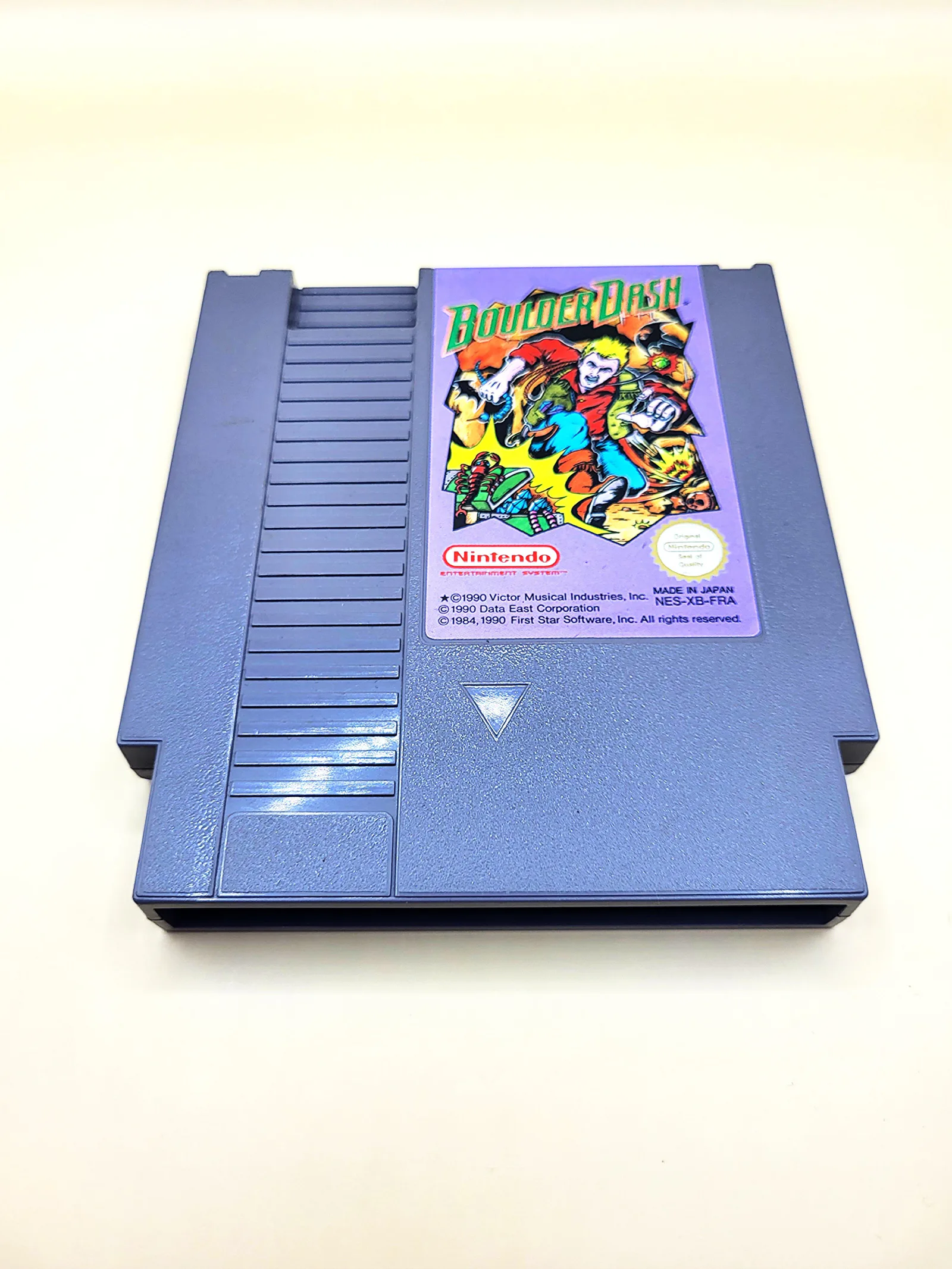
Boulder Dash for Nintendo NES
Boulder Dash for Nintendo NES is an action puzzle game in which you guide Rockford through underground mazes to collect diamonds. His father Stoneford leaves him a map leading to the treasures of six worlds. Each world consists of four separate towns. You choose where to begin within the world and collect the required number of diamonds there. Once you have enough, the exit appears. Meanwhile, the clock keeps running and strange creatures move along the tunnel walls.
Digging away dirt creates new passages, but also removes the support beneath rocks and diamonds. Anything that falls can crush Rockford. A carefully released rock can instead destroy an enemy, whose explosion can then open a passage through a wall. Some opponents turn into diamonds when destroyed. A growing amoeba and temporarily active magic walls introduce extra rules to the caves. You can also dig or pick up an adjacent object without moving into that square yourself.
You begin with four lives and earn an extra chance for every two thousand points. If you become trapped, you can give up a life and restart from the world's entrance. You play alone or with two players taking turns, not simultaneously together; the controls use the standard controller. After a game ends, a password appears that lets you return to the same world later. It does not remember individually completed towns: when resuming, you must complete all four towns in that world again.
Region and language
Our Nintendo NES games are PAL editions, unless stated otherwise. This product contains a loose cartridge for the European market. A box is only included if explicitly stated in the product details. We note any different region in the product details. In almost all cases, the game is playable at least in English, and often in the other five common European languages too.
Manual
With Boulder Dash for Nintendo NES, you receive a loose cartridge. A box and manual are not included unless we explicitly state otherwise in the product details. This is the standard way we supply this copy.
The history of Boulder Dash
Boulder Dash began on Atari home computers in 1984, published by First Star Software. Peter Liepa developed the original game with Chris Gray as an early collaborator. Liepa expanded a simple digging idea into a world where rocks, dirt and diamonds affect one another according to fixed rules. A brief movement could therefore trigger a whole chain of falling objects. The game subsequently reached systems including the Commodore 64 and Apple II, long before this NES adaptation appeared.
Rockford only gradually gained his recognisable appearance during development. Liepa later explained that the character was initially little more than a simple symbol. At the publisher's request, he enlarged the figures and objects and gave the protagonist more personality. The existing caves consequently no longer fitted entirely on one screen, so scrolling was introduced. Rockford's name followed around publication. In this way, the technical changes and visual identity grew together from the original experiment with falling rocks.
The NES release followed in 1990. JVC obtained a licence and released this version in North America; Nintendo handled the European release through a sublicence. Data East published the NES version in Japan. This cartridge organises Rockford's journey into six worlds, each with four towns and a password for the world. Its structure therefore differs from the first computer release. Digging, using falling rocks and collecting diamonds retain the link to Liepa's original design, but the route and resuming system are tailored to this NES edition.
Similar games for Nintendo NES
Solomon's Key for Nintendo NES combines route planning with immediate hazards in an enclosed play area, like Boulder Dash. Dana creates stones to reach higher places and removes them to open passages. Rockford digs away dirt and must account for the rocks that consequently fall. Both reward thinking ahead, but in Solomon's Key you build platforms yourself; in Boulder Dash you work with the existing ground and gravity.
Adventures of Lolo on Nintendo NES also has you move objects to find a route to the exit. Lolo pushes blocks and collects hearts while enemies guard or attack in particular directions. Rockford gathers diamonds among falling rocks and digs his own passages. The shared puzzle element centres on the consequences of a move, but the shifting ground and running clock make Boulder Dash more dependent on quick execution.
Tetris for Nintendo NES also uses gravity to make every placement important. New shapes fall from above, and you try to build complete horizontal lines. In Boulder Dash you instead release objects already in the ground by removing the dirt beneath them. One wrong decision can cost you space in either game. Rockford also faces enemies, a diamond quota and an exit, whereas Tetris centres on managing the stack.
Dig Dug II on Nintendo NES shares the idea of defeating enemies by changing the environment with Boulder Dash. Taizo creates cracks in islands and sends sections of land into the sea; he also uses his pump against monsters. Rockford digs tunnels and drops loose rocks. In both games you must judge which parts of the terrain will remain safe, but Dig Dug II focuses on eliminating enemies and Boulder Dash on reaching enough diamonds.
Lode Runner for Nintendo NES also links collecting to opening up the environment and avoiding pursuers. You dig temporary holes in floors to trap guards and gather all the gold to escape. Rockford's digging removes dirt among falling rocks and can permanently change a route. Lode Runner spreads movement across ladders and platforms; Boulder Dash has you work through a grid of underground squares.