This product is like new. At NexWave Games, like new means:
Additionally, all discs at NexWave Games are carefully inspected and assessed for quality. When discs arrive, we do not accept any that are so badly damaged that they are unlikely to work. We only accept discs with light scratches at most. Discs with scratches are then treated in our professional disc repair machine. By warming the disc and polishing it with soft brushes, these machines can remove a very thin layer from the disc. This removes the layer containing surface scratches and improves the disc’s readability. This ensures the disc works properly, even on consoles with ageing lasers that have difficulty reading games! Great news for the player.
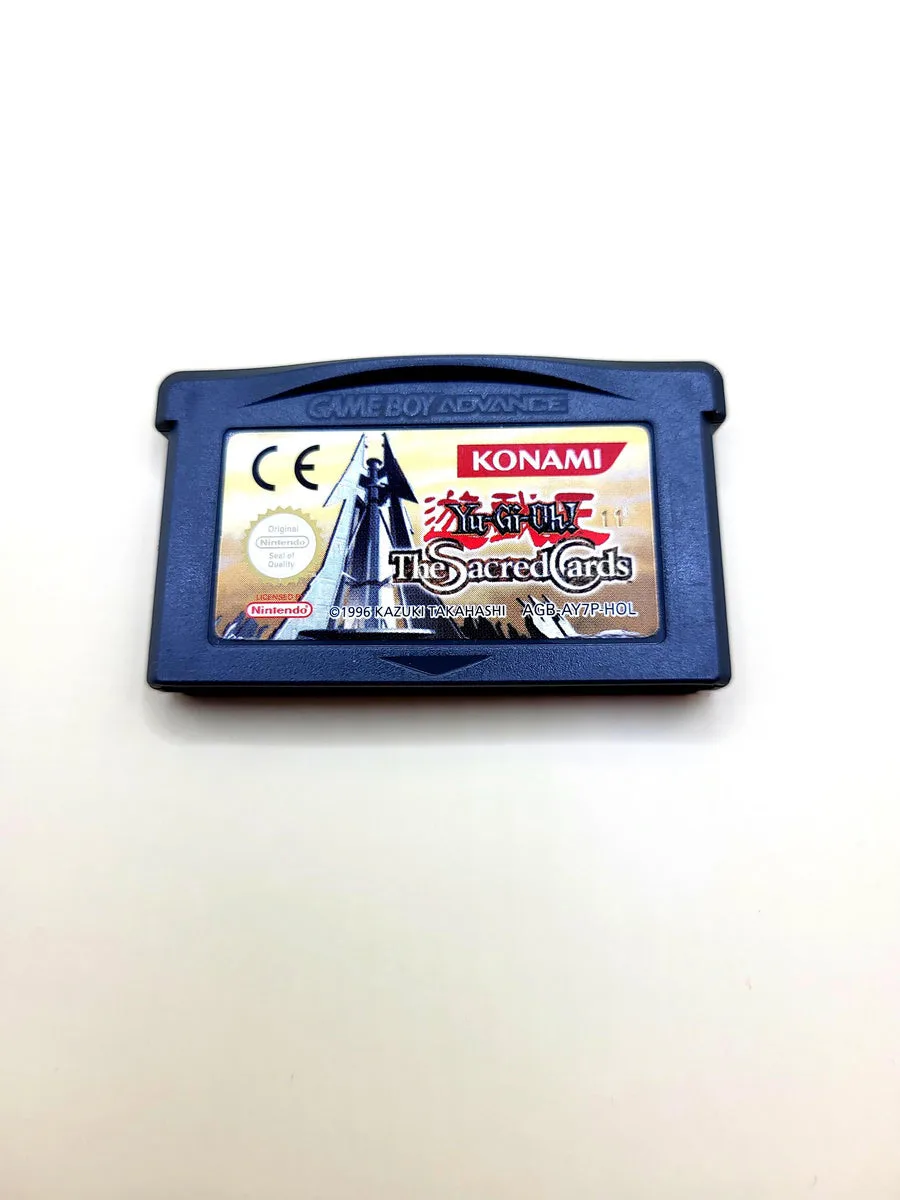
Yu-Gi-Oh! The Sacred Cards for Game Boy Advance
Yu-Gi-Oh! The Sacred Cards for Game Boy Advance combines card duels with a role-playing game set in Battle City. You name your own young duelist and join Yugi and Joey in Kaiba Corporation’s tournament. Between matches you walk through the city, talk to residents and look for opponents. The Locator Cards you win bring you closer to the finals. The Egyptian God Cards and opponents from the animated series play an important part in the story.
You build a deck of forty cards and try to deplete your opponent’s Life Points. Not every card you find fits immediately: your Duelist Level and Deck Capacity limit what you can use. Victories help you develop further and earn you money and cards. You can expand your collection in the shop. Attack and defence matter, but the strengths and weaknesses of different monster attributes can also decide a duel.
You play the campaign alone. You save your progress at the computer in your character’s room; the game does not save automatically. The cartridge holds one saved adventure. Duels use their own simplified rules, so knowledge of the current physical card game does not apply directly in every situation. A monster with lower attack power can still win because of its attribute. You therefore need to learn both your cards and the rules of this particular release.
Region and language
Our Game Boy Advance games are European editions, unless stated otherwise. This product contains a loose cartridge for the European market. A box is only included if explicitly stated in the product details. We note any different region in the product details. In almost all cases, the game is playable at least in English, and often in the other five common European languages too.
Manual
With Yu-Gi-Oh! The Sacred Cards for Game Boy Advance, you receive a loose cartridge. A box and manual are not included unless we explicitly state otherwise in the product details. This is the standard way we supply this copy.
The history of Yu-Gi-Oh! The Sacred Cards
Konami developed and published Yu-Gi-Oh! The Sacred Cards for Game Boy Advance. The game appeared in Japan in 2002, North America in 2003 and Europe in 2004. The Japanese title refers to Duel Monsters 7 and Duel City. The Western release emphasises the special cards sought during the tournament. The story uses Battle City as its foundation, but adds your own duelist to the familiar friends and rivals.
The series took different forms on Game Boy Advance. Some releases focused mainly on matches and deck building, while The Sacred Cards also used a walkable city and conversations. A won duel therefore connects to the next encounter or a new location in the story. Your Deck Capacity grows with your achievements. Stronger cards are consequently not just a matter of collecting them: your character must also be able to use them within the limits of their deck.
The later Reshef of Destruction built on the combination of card duels and role-playing, but told a different adventure. Konami subsequently included both games in Early Days Collection alongside other early Yu-Gi-Oh! releases. That compilation added its own tools for modern systems. This original GBA cartridge saves the adventure through the bedroom computer. The city, tournament progression and distinctive card rules show how Konami turned the animated series into a playable journey centred on one duelist at the time.
Similar games for Game Boy Advance
Yu-Gi-Oh! Reshef of Destruction is the closest match to The Sacred Cards on Game Boy Advance: you walk around, speak to characters and let your deck grow alongside your duelist. It tells a new story about missing Millennium Items and Reshef, however. The Sacred Cards centres on entering Battle City and collecting Locator Cards. The familiar city and cards give both a similar foundation, but the reason for your quest and its sequence differ.
Yu-Gi-Oh! The Eternal Duelist Soul on Game Boy Advance also centres on collecting cards and building a deck. Its emphasis is on directly selected duels and rules closer to the physical card game. The Sacred Cards adds a walking character, conversations and story-driven encounters. You therefore work not only towards better cards, but also towards your place in a tournament unfolding throughout the city.
Yu-Gi-Oh! Worldwide Edition: Stairway to the Destined Duel on Game Boy Advance also uses Battle City and familiar duelists as its backdrop. Its focus is on tournaments and card duels following the card game’s rules. The Sacred Cards lets you walk through local areas as your own character and uses a system of Duelist Level and Deck Capacity. Shared names therefore do not mean that the same card always produces the same outcome in both games.
Yu-Gi-Oh! World Championship Tournament 2004 on Game Boy Advance likewise offers plenty of scope to turn a collection into a deck. It concentrates on successive opponents and learning to use card combinations, without The Sacred Cards’ walks through Battle City. In The Sacred Cards, the storyline also determines whom you meet. You must additionally account for its own attributes and capacity limits rather than just familiar card game rules.
Yu-Gi-Oh! Dungeon Dice Monsters takes the same familiar world in a different direction on Game Boy Advance. You use dice and move monsters across a playing field, so space and available actions shape the duel. The Sacred Cards sticks to cards, a deck and Life Points, with city conversations between matches. Both build on ideas from the animated series, but preparing for a card battle clearly differs from unfolding and using a dice dungeon.