This product is like new. At NexWave Games, like new means:
Additionally, all discs at NexWave Games are carefully inspected and assessed for quality. When discs arrive, we do not accept any that are so badly damaged that they are unlikely to work. We only accept discs with light scratches at most. Discs with scratches are then treated in our professional disc repair machine. By warming the disc and polishing it with soft brushes, these machines can remove a very thin layer from the disc. This removes the layer containing surface scratches and improves the disc’s readability. This ensures the disc works properly, even on consoles with ageing lasers that have difficulty reading games! Great news for the player.
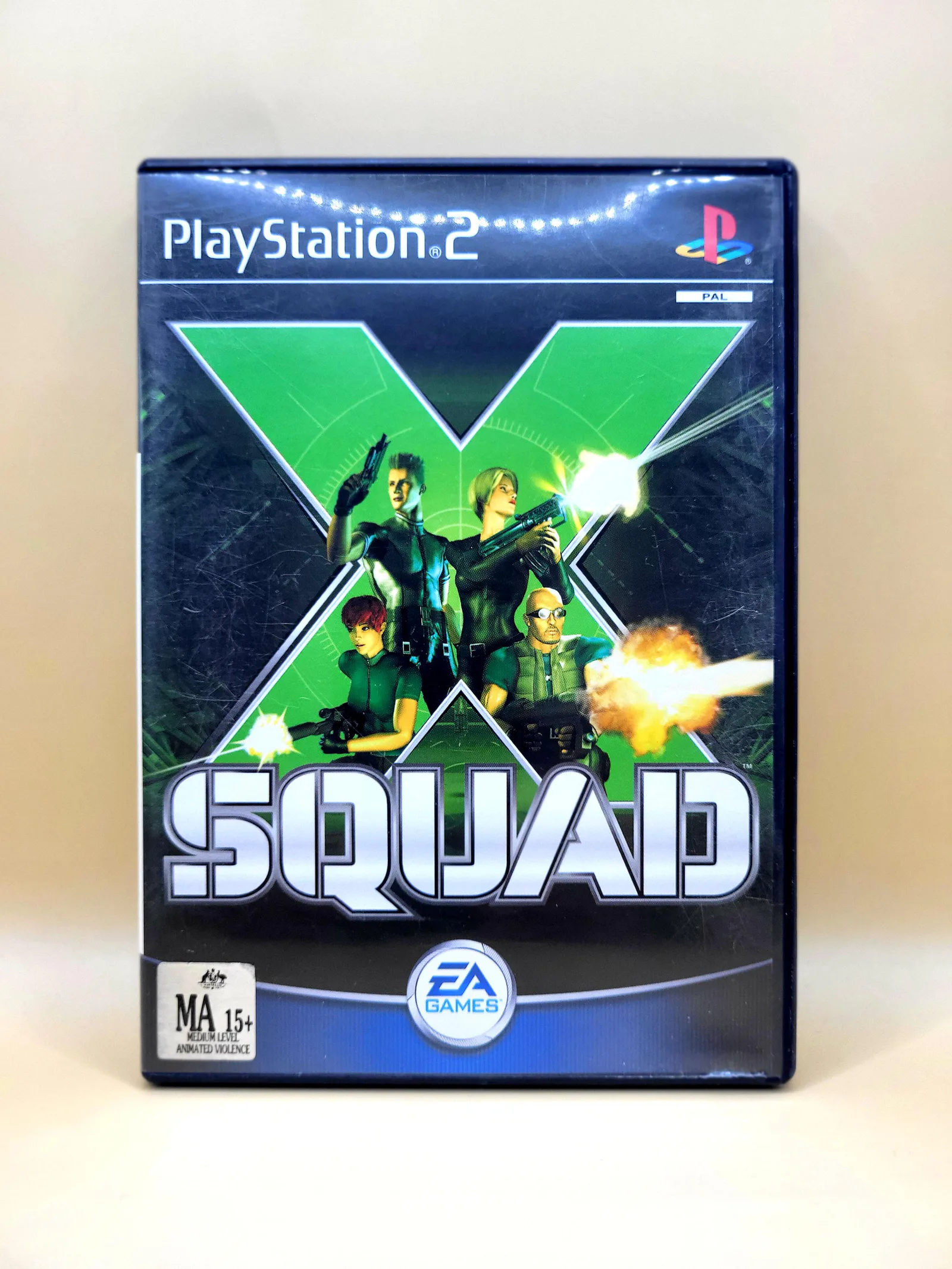
X-Squad for PlayStation 2
X-Squad for PlayStation 2 is a science-fiction shooter in which, as team leader Ash, you guide an armed unit through a military crisis. In the year 2037, researcher Bianca Noble has been kidnapped and Project Medusa has fallen into the wrong hands. Together with Maya, Melinda and Judd, you search for those responsible. You directly control Ash from a third-person perspective, while his three companions are computer-controlled and provide support as you advance.
Orders let you direct the team when a room demands a different approach. You move through corridors, around corners and past obstacles, aim at enemies and seek a position where you are not being hit from several sides. Ash can crouch and roll to escape gunfire. Besides armed soldiers, you encounter automated defences and larger opponents. Switches and closed passages interrupt the shooting, so you also need to examine the layout of an area.
The game combines that direct action with preparation and growth. Earned points improve your squad's capabilities and give access to more powerful equipment. What matters is therefore not just how you resolve a confrontation, but also what you take into subsequent assignments. Radio messages between team members keep you informed during missions. Despite the four visible soldiers, X-Squad is strictly a single-player game: you play with one controller and cannot hand the other team members over to local companions.
Region and language
Our PlayStation 2 games are PAL editions and come with a Dutch or English box, unless stated otherwise. By default, you receive the version for the European market. We note it in the product details if the region is different or the box is in another language. In almost all cases, the game is playable at least in English, and often in the other five common European languages too.
This edition of X-Squad has a PAL case with an Australian MA15+ age rating on the front. You therefore receive the photographed packaging, which differs from our standard packaging for the European market.
Manual
X-Squad for PlayStation 2 includes the manual unless the product title states otherwise. If the booklet is missing, the title says “No Manual”. This lets you see before ordering whether the game comes with a manual.
The manuals included with our games usually contain at least English and often around six European languages. The exact languages vary by edition, so Dutch is not always included. The booklet explains the controls and the main rules. You can use it to check how to control the game, which actions are available and how its different features work.
The history of X-Squad
Electronic Arts Square developed X-Squad for the first wave of PlayStation 2 games. It appeared in Japan in August 2000 as X-Fire, pronounced Cross Fire; the Western version followed later that year as X-Squad. Electronic Arts released it in Europe under the EA Games label. It was the Japanese studio's first original PS2 production, following work adapting and publishing foreign games for the Japanese market. A squad of player-controlled and computer-controlled soldiers formed its core.
The original presentation emphasised cooperation, radio communications and motion-captured movements. The new console's power was meant to be visible in multiple characters appearing together, facial animation and environmental lighting. Behind that technical story lay a concrete game idea: the player fires their own weapon but also accounts for three allies. Points and upgrades added ongoing development, so performance in individual assignments affected the squad's capabilities.
For the American localisation, EA employee Mike Jeffress discussed changes to voices, story and artificial-intelligence balancing. He also explained that multiplayer plans had been dropped; the finished game retained one human player. The name X-Squad should therefore not be read as a promise of four-player co-op. As an early PS2 title, it chiefly shows how developers combined third-person shooting, dual analogue controls and squad orders. Later tactical shooters would each develop similar subjects in their own way.
Similar games for PlayStation 2
Freedom Fighters shares X-Squad's control of one shooter who gives orders to other fighters. There, you recruit increasing numbers of resistance members during an occupation and send them to positions or targets. X-Squad sticks to Ash and his fixed team within a futuristic military operation. The similarity lies in shooting while simultaneously leading; the difference lies in a growing resistance group and freer urban assaults versus the successive missions of an established special unit.
SOCOM: U.S. Navy SEALs likewise uses a small unit acting on the player's instructions. Quiet approaches, equipment choices and coordinated takedowns carry considerable weight in its contemporary military assignments. X-Squad deploys its team in a science-fiction story, emphasising direct firefights and improving capabilities through points. Both demand attention to allies, but SOCOM builds more extensively around a tactical mission approach, whereas Ash himself often remains at the centre of the action.
Conflict: Desert Storm divides military duties among four specialists and lets you switch the soldier you control. Their different roles matter when dealing with vehicles or distant targets, for example. X-Squad also shows four soldiers, but you control only Ash and give orders to the others. This makes the difference between the two squads immediately concrete: in Conflict you take on a different role yourself, while in X-Squad you organise support from one position.
WinBack: Covert Operations shares X-Squad's third-person view, guarded installations and cautious approaches to armed opponents. Its action revolves more strongly around cover, corners and aimed shots during an anti-terrorist operation. Ash must additionally account for his squad and a system of points and upgrades. Their similarities are clearest in a corridor full of enemies; the difference appears as soon as you must direct assistance or develop equipment for later use.
Like X-Squad, Oni places an armed protagonist in a technological future and shows combat from a third-person perspective. Konoko, however, alternates shooting with extensive throws, kicks and other fighting techniques, and largely operates alone. Ash focuses on firearms and directing his squad. Those who mainly know Oni's physical action therefore receive a different division of tasks here: less emphasis on an individual's fighting repertoire and more on support from computer-controlled allies.