This product is like new. At NexWave Games, like new means:
Additionally, all discs at NexWave Games are carefully inspected and assessed for quality. When discs arrive, we do not accept any that are so badly damaged that they are unlikely to work. We only accept discs with light scratches at most. Discs with scratches are then treated in our professional disc repair machine. By warming the disc and polishing it with soft brushes, these machines can remove a very thin layer from the disc. This removes the layer containing surface scratches and improves the disc’s readability. This ensures the disc works properly, even on consoles with ageing lasers that have difficulty reading games! Great news for the player.
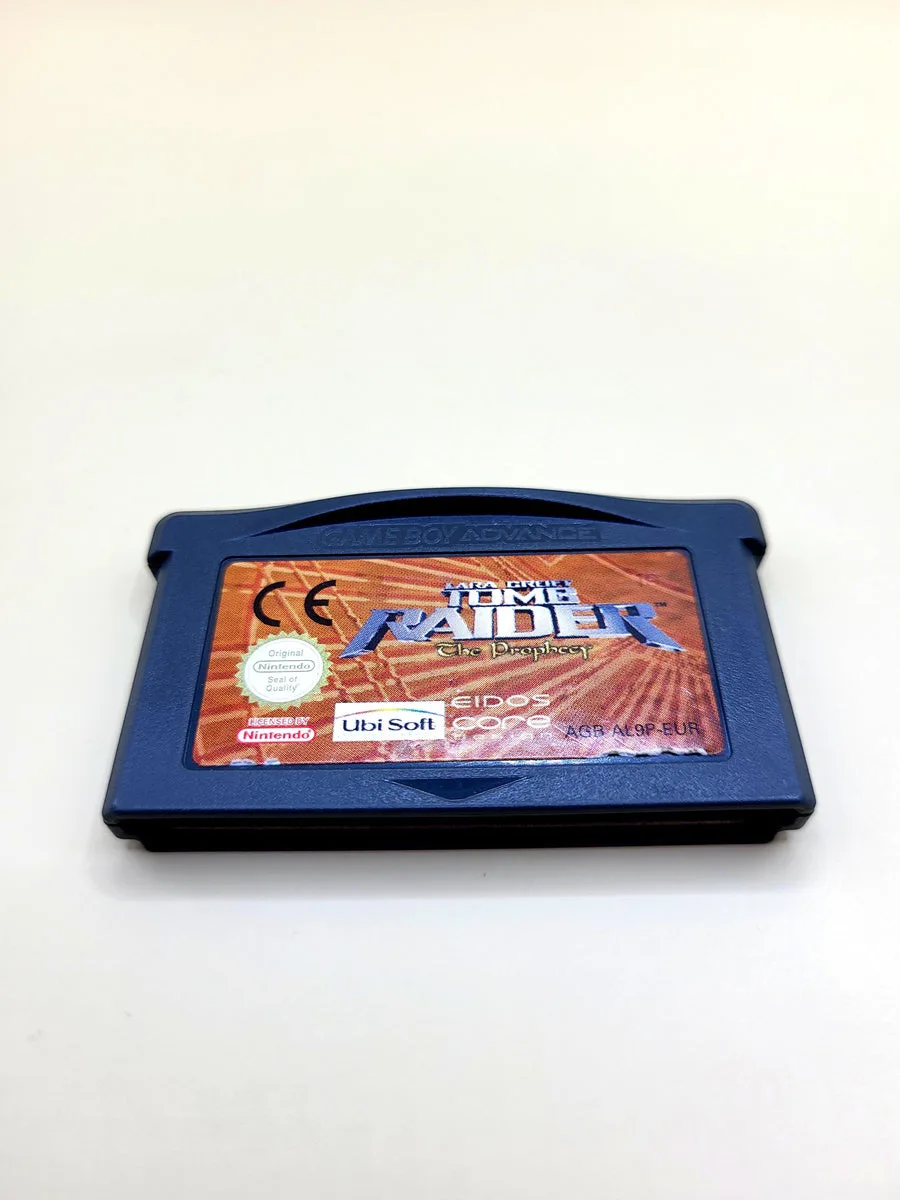
Tomb Raider: The Prophecy for Game Boy Advance
Tomb Raider: The Prophecy for Game Boy Advance follows Lara Croft as she searches for magical stones mentioned in the Tome of Ezekiel. Her investigation begins in the Swedish mountains and leads to ancient temples filled with enemies, locked passages and traps. You see the rooms from an angled overhead view, making changes in height and side paths part of every route. Lara runs, jumps and hangs from ledges to reach places that seem impossible to access from the floor. Finding a key or lever can make an earlier room important again.
Exploration alternates with battles in which Lara uses her twin pistols. These have unlimited ammunition; you must find ammunition for more powerful weapons. Medipacks restore lost health, but do not remove the need to dodge attacks. You put your weapons away when climbing. Sprinting helps you cover ground quickly for as long as her energy bar allows. Sometimes you therefore need to create some distance, choose a new position and only then shoot or continue climbing.
You play this action adventure alone. You resume the adventure using passwords that you write down and later enter through Continue. Lara’s equipment is reset when you resume from a level. The fixed angled view mainly requires you to judge carefully where a ledge lies and which jumps are possible. The Prophecy is a standalone GBA adventure, not a scaled-down port of the first PlayStation game.
Region and language
Our Game Boy Advance games are European editions, unless stated otherwise. This product contains a loose cartridge for the European market. A box is only included if explicitly stated in the product details. We note any different region in the product details. In almost all cases, the game is playable at least in English, and often in the other five common European languages too.
Manual
With Tomb Raider: The Prophecy for Game Boy Advance, you receive a loose cartridge. A box and manual are not included unless we explicitly state otherwise in the product details. This is the standard way we supply this copy.
The history of Tomb Raider: The Prophecy
Tomb Raider: The Prophecy was released for Game Boy Advance in 2002. Ubisoft Milan developed the game and Ubisoft published it under licence from Eidos. Lara had previously received two side-view adventures on Game Boy Color. For her first GBA game, the team chose an angled overhead view with rooms built around depth. The story about the Tome of Ezekiel was created for this release rather than simply repeating her first quest on PC and PlayStation.
The collaboration was announced in May 2002, when Ubisoft obtained the development and publishing rights for this handheld instalment. It produced a distinct interpretation of the series: the familiar pistols, temples and acrobatics remained, but the camera did not follow behind Lara. Players read the environment from a fixed angle. Lighting and animation support that impression of depth, while movement and aiming use the GBA’s directional pad and buttons.
Continuing also took a form specific to this cartridge. Passwords return you to a reached section of the adventure with reset equipment. Remembering a route and writing down codes therefore matters. The Prophecy sits between the earlier two-dimensional Game Boy adventures and later handheld adaptations of Tomb Raider. It preserves a separate chapter in which Lara’s familiar movements were rearranged around fixed rooms, short sightlines and its own supernatural mystery.
Similar games for Game Boy Advance
The Legend of Zelda: The Minish Cap also has you investigate rooms, find keys and open new passages on Game Boy Advance. Link uses items and can shrink to see an environment differently. The Prophecy builds its routes more around Lara’s jumps and ledges. Both ask you to reconsider previously visited places, but Zelda connects those puzzles to a larger world of villages and conversations.
Banjo-Kazooie: Grunty’s Revenge likewise uses an angled overhead view for a new Game Boy Advance adventure from a familiar console series. Banjo explores areas, collects objects and learns moves. Lara mainly searches temples, seeking the right combination of jumps, switches and combat. Collecting and recurring characters receive more space in Banjo; The Prophecy places greater emphasis on dangerous rooms and a supernatural investigation.
Metroid: Zero Mission shares the alternation between armed action and finding a usable route on Game Boy Advance. Samus sees her surroundings from the side and opens up more of planet Zebes with new equipment. Lara moves through angled rooms using keys, levers and acrobatics. Progress in Metroid depends more on permanent upgrades, whereas The Prophecy more often revolves around local spatial puzzles.
Wario Land 4 also mixes platforming with searching rooms and spotting hidden passages on Game Boy Advance. Wario’s transformations help him overcome obstacles, and a switch starts an escape against the clock. Lara relies on climbing moves, weapons and found items. Both invite you to read an environment again, but Wario’s treasure hunt uses comic situations and a side-view perspective more prominently.
W.I.T.C.H. likewise offers action and environmental puzzles with a supernatural story on Game Boy Advance. You switch between heroines who use different elemental powers and fly through side-view levels. The Prophecy keeps you with Lara and her established equipment in angled temples. In W.I.T.C.H. you mainly choose the right character for an obstacle; with Lara, you decide how the same adventurer can cross the room safely.