This product is in good condition. At NexWave Games, good means:
Additionally, all discs at NexWave Games are carefully inspected and assessed for quality. When discs arrive, we do not accept any that are so badly damaged that they are unlikely to work. We only accept discs with light scratches at most. Discs with scratches are then treated in our professional disc repair machine. By warming the disc and polishing it with soft brushes, these machines can remove a very thin layer from the disc. This removes the layer containing surface scratches and improves the disc’s readability. This ensures the disc works properly, even on consoles with ageing lasers that have difficulty reading games! Great news for the player.
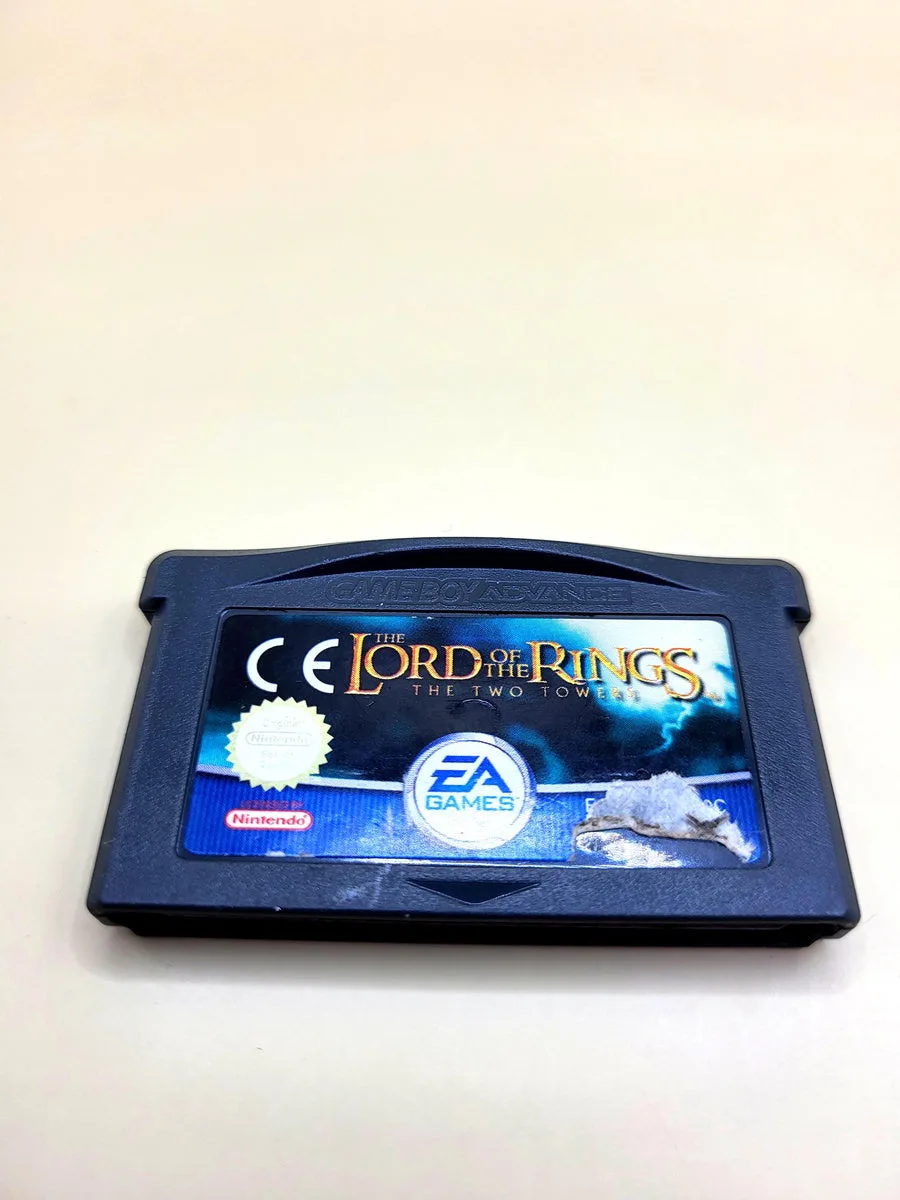
The Lord of the Rings: The Two Towers for Game Boy Advance
The Lord of the Rings: The Two Towers for Game Boy Advance is an isometric action role-playing game in which you fight, collect loot and steadily develop a hero. You choose between Frodo, Aragorn, Legolas, Gandalf and Éowyn, with different weapons and skills. Legolas can attack from a distance with his bow, for example, while Gandalf uses magic. You travel through areas from the first two films and encounter orcs, dangerous creatures and stronger leaders that provide extra loot and experience.
New equipment changes how much punishment you can take and how much damage you can inflict in battle. You examine weapons, armour and other finds in your limited backpack and decide what to keep or sell. When you gain an experience level, you allocate points to attributes such as strength, accuracy and defence. Active skills use spirit points; passive skills support you without needing to be activated repeatedly. Sauron’s attention is another risk. Frodo’s use of the Ring in particular can increase the threat, so invisibility is not without consequences.
You can play alone or cooperate locally with a maximum of two players and exchange items. For cooperative play, each person needs their own Game Boy Advance and their own copy of this game, plus a Game Boy Advance Game Link cable between the systems. Those additional requirements are not included as standard. This is Griptonite’s separate GBA role-playing game, not the three-dimensional console version with the same name.
Region and language
Our Game Boy Advance games are European editions, unless stated otherwise. This product contains a loose cartridge for the European market. A box is only included if explicitly stated in the product details. We note any different region in the product details. In almost all cases, the game is playable at least in English, and often in the other five common European languages too.
Manual
With The Lord of the Rings: The Two Towers for Game Boy Advance, you receive a loose cartridge. A box and manual are not included unless we explicitly state otherwise in the product details. This is the standard way we supply this copy.
The history of The Lord of the Rings: The Two Towers
Electronic Arts published The Lord of the Rings: The Two Towers for Game Boy Advance in 2002. Griptonite Games developed a separate handheld adaptation alongside the three-dimensional action game for home consoles. The film licence included recognisable events and characters from The Fellowship of the Ring and The Two Towers. The journey therefore does not begin only with the events of the second film. The GBA version uses an isometric world in which equipment, experience and your chosen hero determine how battles unfold.
An early demonstration at Electronic Arts already showed how differently Aragorn, Legolas and Gandalf were designed. Direct combat remained the foundation, but your choice also determined which weapons and skills you could use. The finished game combined that with a backpack, upgradeable attributes and a growing collection of finds. A new area therefore meant more than different enemies: it also offered the chance of equipment that could help your hero tackle the next confrontation differently. The film characters thus had room for individual development.
The local connection applied that collecting drive to cooperative play. Two players could travel through the adventure together and pass useful items to each other, each on their own screen. This was a different approach from fighting on one console. Griptonite later developed this handheld action direction further in The Return of the King. The Third Age on GBA then chose tactical turn-based battles. Two Towers therefore stands at the beginning of a particular handheld series, built around fast action and character development.
Similar games for Game Boy Advance
The Lord of the Rings: The Return of the King on Game Boy Advance builds on the isometric combat, loot collecting and hero development of Two Towers. The journey moves to the film trilogy’s conclusion, with different battles and environments. For those who chiefly recognise the expanding equipment and direct action, it is the closest sequel. Two Towers instead covers events from the first two films and has its own character routes.
The Lord of the Rings: The Third Age on Game Boy Advance uses the same film world but changes how you approach a battle. You move units across a battlefield and issue orders in turns. Two Towers has you continually move and attack directly with one hero while improving their equipment. The similarity lies in familiar fighters and developing abilities; the time available to consider your next move is very different.
Golden Sun on Game Boy Advance also combines equipment, character growth and a fantasy world full of opponents. There, you control a group and select attacks during turn-based battles; Psynergy also helps solve puzzles outside combat. Two Towers uses direct attacks and builds its collecting around one chosen hero. Both require attention to what a character can carry and learn, but Golden Sun gives party composition and magical puzzles a far larger role.
The Legend of Zelda: The Minish Cap on Game Boy Advance also has directly controlled battles and areas to search for secrets. Link acquires tools and can shrink to reach other passages. Two Towers places more emphasis on experience levels, random finds and allocating character points. In Zelda, a new item often determines the solution to a dungeon; here, better equipment chiefly determines how you fight the next enemy.
Harry Potter and the Chamber of Secrets on Game Boy Advance also uses an isometric view and direct magical action in a familiar film world. Harry learns spells to tackle battles and route puzzles, guided by lessons and tasks. Two Towers instead has you search for better weapons and skills for a chosen hero. Hogwarts involves more switches, conversations and sneaking; Middle-earth focuses more strongly on combat, loot and character development.