This product is like new. At NexWave Games, like new means:
Additionally, all discs at NexWave Games are carefully inspected and assessed for quality. When discs arrive, we do not accept any that are so badly damaged that they are unlikely to work. We only accept discs with light scratches at most. Discs with scratches are then treated in our professional disc repair machine. By warming the disc and polishing it with soft brushes, these machines can remove a very thin layer from the disc. This removes the layer containing surface scratches and improves the disc’s readability. This ensures the disc works properly, even on consoles with ageing lasers that have difficulty reading games! Great news for the player.
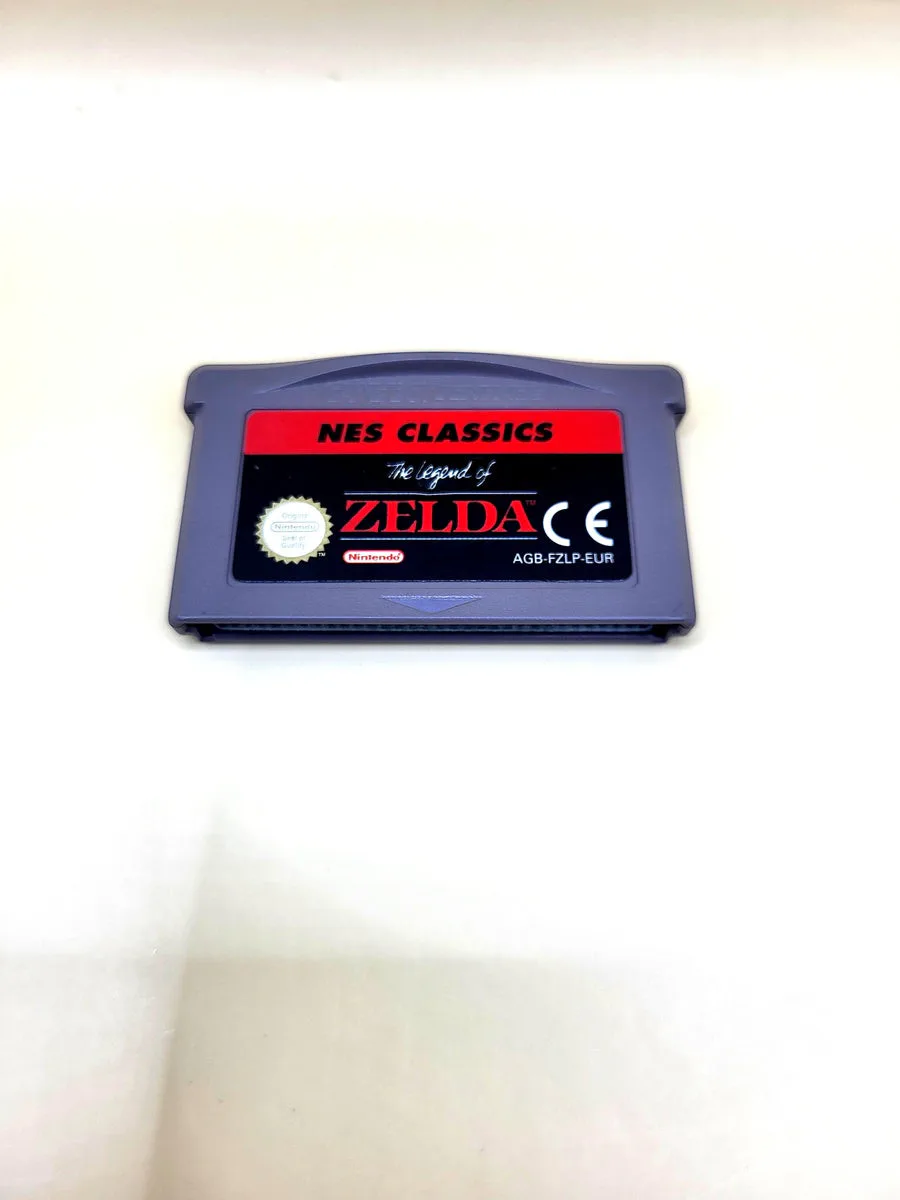
The Legend of Zelda (NES Classics) for Game Boy Advance
The Legend of Zelda from NES Classics for Game Boy Advance brings the first Zelda adventure to a portable cartridge. You play as Link and search for the eight pieces of the Triforce of Wisdom so you can defeat Ganon and rescue Princess Zelda. From the start, you can head in different directions. Forests, mountains, lakes and caves form a world in which you investigate for yourself where the next dungeon lies and which passage is still unusable.
You use a sword and collect equipment including bombs, a boomerang and a bow. These items help in combat but can also reveal hidden routes. In dungeons, you search for keys, a map and a compass while trying to get further with a limited number of hearts. Rupees serve as currency for shops and certain aids. An unremarkable wall or a solitary bush can hide a secret, making careful observation as important as drawing your sword quickly.
This is a single-player game; no link cable is needed. You can save your progress on the cartridge and continue later. The NES Classics edition retains the original two-dimensional form and is not a new version of A Link to the Past or The Minish Cap. After the first adventure, the Second Quest awaits, with dungeons and secrets placed differently and a need to find your way again.
Region and language
Our Game Boy Advance games are European editions, unless stated otherwise. This product contains a loose cartridge for the European market. A box is only included if explicitly stated in the product details. We note any different region in the product details. In almost all cases, the game is playable at least in English, and often in the other five common European languages too.
Manual
With The Legend of Zelda (NES Classics) for Game Boy Advance, you receive a loose cartridge. A box and manual are not included unless we explicitly state otherwise in the product details. This is the standard way we supply this copy.
The history of The Legend of Zelda (NES Classics)
Nintendo released The Legend of Zelda in Japan in 1986 for the Family Computer Disk System. Shigeru Miyamoto and Takashi Tezuka worked on an adventure with swords, magic and treasure, while Koji Kondo provided the music. The developers were also working on Super Mario Bros. during the same period. Whereas Mario mainly led you along a side-scrolling route, Zelda gave you more room to decide where to search and which clue to follow.
This approach made exchanging discoveries important. A newly found entrance, secret item or distinctive place could help someone else get started without explaining the whole adventure. The game built its progression around tools, hearts and conquering dungeons. Many elements that would remain associated with Zelda were already present: Link, Princess Zelda, Ganon, the Triforce and a landscape with a surprising amount hidden behind its simple visuals.
The European Game Boy Advance edition appeared on 9 July 2004 as part of NES Classics. In this series, Nintendo reissued individual NES games as handheld cartridges rather than completely redrawing them as modern sequels. This adventure therefore remained recognisable through its original screens, small characters and direct combat. After the first completion, the Second Quest gives the same world a different arrangement of dungeons and secrets, so existing knowledge of the routes no longer solves everything.
Similar games for Game Boy Advance
The Legend of Zelda: A Link to the Past & Four Swords on Game Boy Advance also gives you a kingdom full of hidden routes and dungeons. A Link to the Past uses more story scenes, more extensive equipment and two connected worlds. The first Zelda more often leaves you searching without a clear next clue. Both ask you to remember places, but NES Classics does not contain the separate shared adventure of Four Swords.
The Legend of Zelda: The Minish Cap shares sword fights, dungeon puzzles and new items with this NES Classics edition on Game Boy Advance. The Minish Cap builds many puzzles around shrinking and growing again, with a talking companion and more conversations. The first Zelda uses sparer clues and hides its secrets more strongly within the landscape. Exploration remains important in both, but you do not receive the same guidance during the journey.
Zelda II: The Adventure of Link from NES Classics is also on Game Boy Advance, but alternates a world map with side-view battles. Link earns experience points and improves his attributes there. The first Zelda keeps its top-down view during combat and links growth mainly to discovered hearts and equipment. They are two early adventures from the same series, with clearly different demands on your timing and route planning.
Metroid from NES Classics on Game Boy Advance shares the search for hidden passages and equipment that makes new places reachable. Samus travels sideways through an interconnected network of corridors, using shots, missiles and jumps. Link journeys from above through an overworld with separate dungeons. Both let you get lost and return with new knowledge, but the shape of the map and the way you approach enemies differ greatly.
Sword of Mana also offers direct combat in a fantasy world on Game Boy Advance. It gives characters, conversations, weapon types and magic much more space than the first Zelda. In NES Classics, the presentation remains compact and you more often have to connect a hint to a place on the map yourself. Mana also puts more emphasis on developing your character; Zelda on finding and using new tools.