This product is like new. At NexWave Games, like new means:
Additionally, all discs at NexWave Games are carefully inspected and assessed for quality. When discs arrive, we do not accept any that are so badly damaged that they are unlikely to work. We only accept discs with light scratches at most. Discs with scratches are then treated in our professional disc repair machine. By warming the disc and polishing it with soft brushes, these machines can remove a very thin layer from the disc. This removes the layer containing surface scratches and improves the disc’s readability. This ensures the disc works properly, even on consoles with ageing lasers that have difficulty reading games! Great news for the player.
Spyro: Season of Ice for Game Boy Advance
Spyro: Season of Ice for Game Boy Advance is an isometric platform adventure in which you free frozen fairies. The wizard Grendor has the Fairy Realms in his grip, interrupting Spyro’s holiday. You explore islands, villages and other areas viewed diagonally from above, collect gems and seek inhabitants who need help. Finding a fairy is not always enough: sometimes you must first complete a task or discover the route to a higher location. Your collection grows as you reach new areas.
Spyro uses his flame breath against enemies and ice blocks, while his horns smash breakable objects. After a jump you can glide and gain a little extra height just before landing. This calls for attention to shadows and platform positions, because an island may lie farther back than it first appears. The dragonfly Sparx follows you, his colour showing how much more damage you can withstand.
You play this adventure alone. Flying challenges and separate sections in which you control Sparx break up the exploring with Spyro. The atlas records how many gems and fairies you have found. A missing reward therefore gives you a reason to return, rather than simply heading for the next exit. This is an original handheld adventure, not a scaled-down version of one of the PlayStation games.
Region and language
Our Game Boy Advance games are European editions, unless stated otherwise. This product contains a loose cartridge for the European market. A box is only included if explicitly stated in the product details. We note any different region in the product details. In almost all cases, the game is playable at least in English, and often in the other five common European languages too.
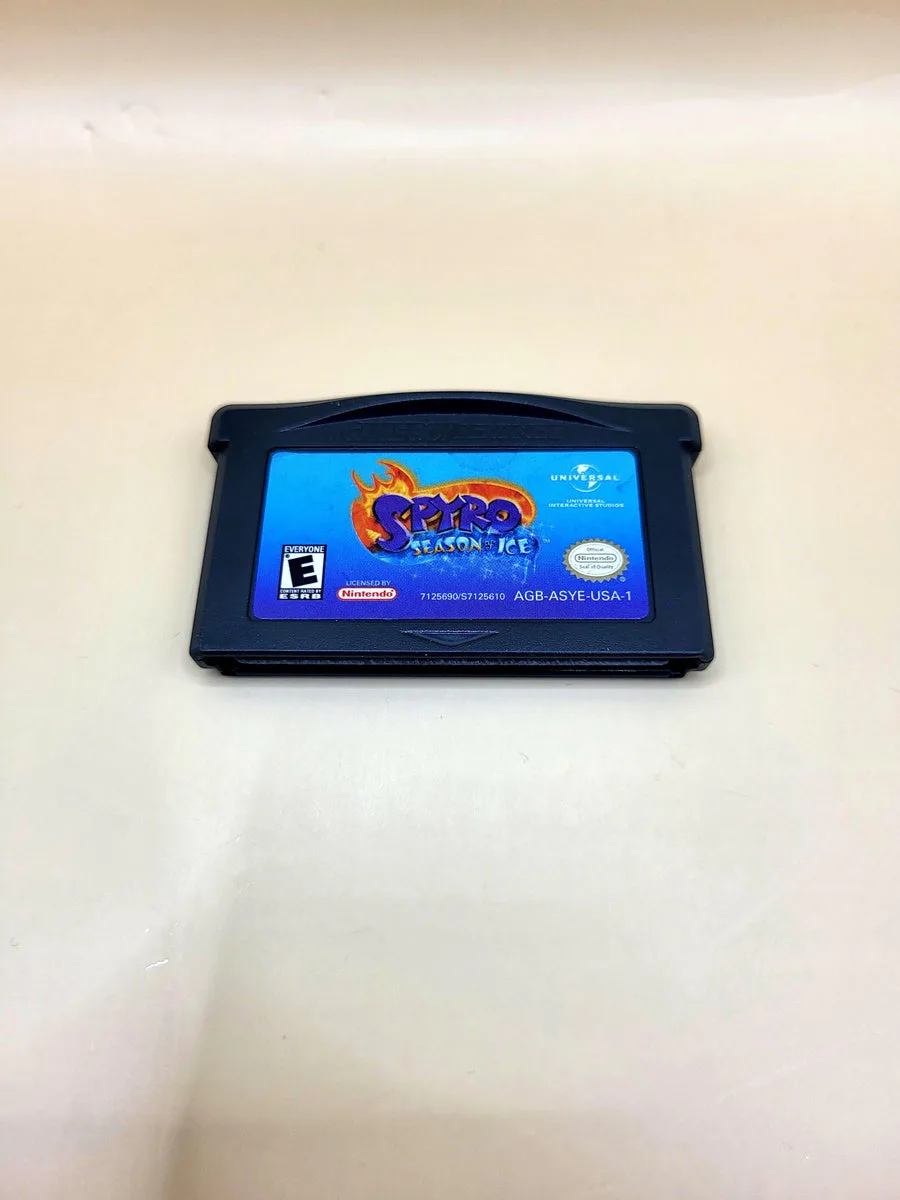
This copy of Spyro: Season of Ice is a North American release. The cartridge label bears AGB-ASYE-USA-1. The in-game text is English.
Manual
With Spyro: Season of Ice for Game Boy Advance, you receive a loose cartridge. A box and manual are not included unless we explicitly state otherwise in the product details. This is the standard way we supply this copy.
The history of Spyro: Season of Ice
Spyro: Season of Ice appeared on Game Boy Advance in 2001, developed by Digital Eclipse and published by Universal Interactive. It was Spyro’s first adventure on a Nintendo system following his earlier PlayStation games. Universal chose a new story rather than directly adapting an existing world. The diagonal view of the landscape allowed familiar actions such as gliding, breathing fire and collecting gems without adopting the freely moving camera of the earlier console adventures.
The story follows the defeated Sorceress: Grendor finds her spell book and creates his own problem by misreading a spell. He wants to use magical fairies’ wings as a cure. Freeing those fairies therefore has a specific place in Spyro’s journey. The different seasonal areas connect exploration with individual tasks, while flying rounds and the Sparx sections change the pace. The handheld adaptation thus seeks variety within a smaller screen.
Programmer Scott Schebek later described how his work at Digital Eclipse included menus, the atlas and a hidden arcade bonus. It was the team’s first GBA project, with new tools for text and game data emerging during development. That experience fed into the 2002 sequel Season of Flame. Season of Ice therefore remains the beginning of a separate line of GBA adventures: familiar Spyro actions, but original worlds and a different way of reading distances.
Similar games for Game Boy Advance
Spyro 2: Season of Flame continues the same isometric foundation on Game Boy Advance, but has you catch fireflies to recover the lost flame breath. Its map helps you remember visited routes. Season of Ice focuses on frozen fairies and contains separate Sparx sections. You recognise the gliding and collecting, while the purpose of your breath attack and the distribution of tasks change.
Rayman 3 on Game Boy Advance also combines rescue work with jumping and collecting light creatures. Rayman mainly moves from left to right, using his fist and helicopter hair to overcome obstacles. Spyro can walk in several directions through diagonally viewed landscapes. A difficult jump here therefore also involves reading depth, whereas Rayman lets you judge distance and height from a side view.
Rayman Advance shares drawn fantasy worlds and the search for hidden rewards on Game Boy Advance. Rayman follows side-scrolling routes and gains new powers while pursuing Mr. Dark. Season of Ice more often lets you walk around an island to find a task or fairy. Both use recognisable moves for precise landings, but Spyro’s glide through a diagonal landscape calls for a different spatial judgement from Rayman’s helicopter hair.
Super Mario World: Super Mario Advance 2 on Game Boy Advance likewise lets you return to finish uncovering secrets. Mario’s hidden exits change connections on the world map. With Spyro, returning is more about gems and fairies still missing from the atlas. Mario jumps through side-scrolling courses with Yoshi and temporary powers, whereas Spyro uses his established dragon moves to search a broader terrain viewed diagonally from above.
Kirby: Nightmare in Dream Land on Game Boy Advance also uses colourful areas in which you help a disrupted fantasy world. Kirby steals powers from enemies and can inflate himself to fly. Spyro keeps flame breath, a horn charge and gliding as his recognisable foundation. The similarity lies in investigating reachable corners and hidden passages; the difference is Kirby’s changing toolkit and side view versus Spyro’s established moves and isometric surroundings.