This product is like new. At NexWave Games, like new means:
Additionally, all discs at NexWave Games are carefully inspected and assessed for quality. When discs arrive, we do not accept any that are so badly damaged that they are unlikely to work. We only accept discs with light scratches at most. Discs with scratches are then treated in our professional disc repair machine. By warming the disc and polishing it with soft brushes, these machines can remove a very thin layer from the disc. This removes the layer containing surface scratches and improves the disc’s readability. This ensures the disc works properly, even on consoles with ageing lasers that have difficulty reading games! Great news for the player.
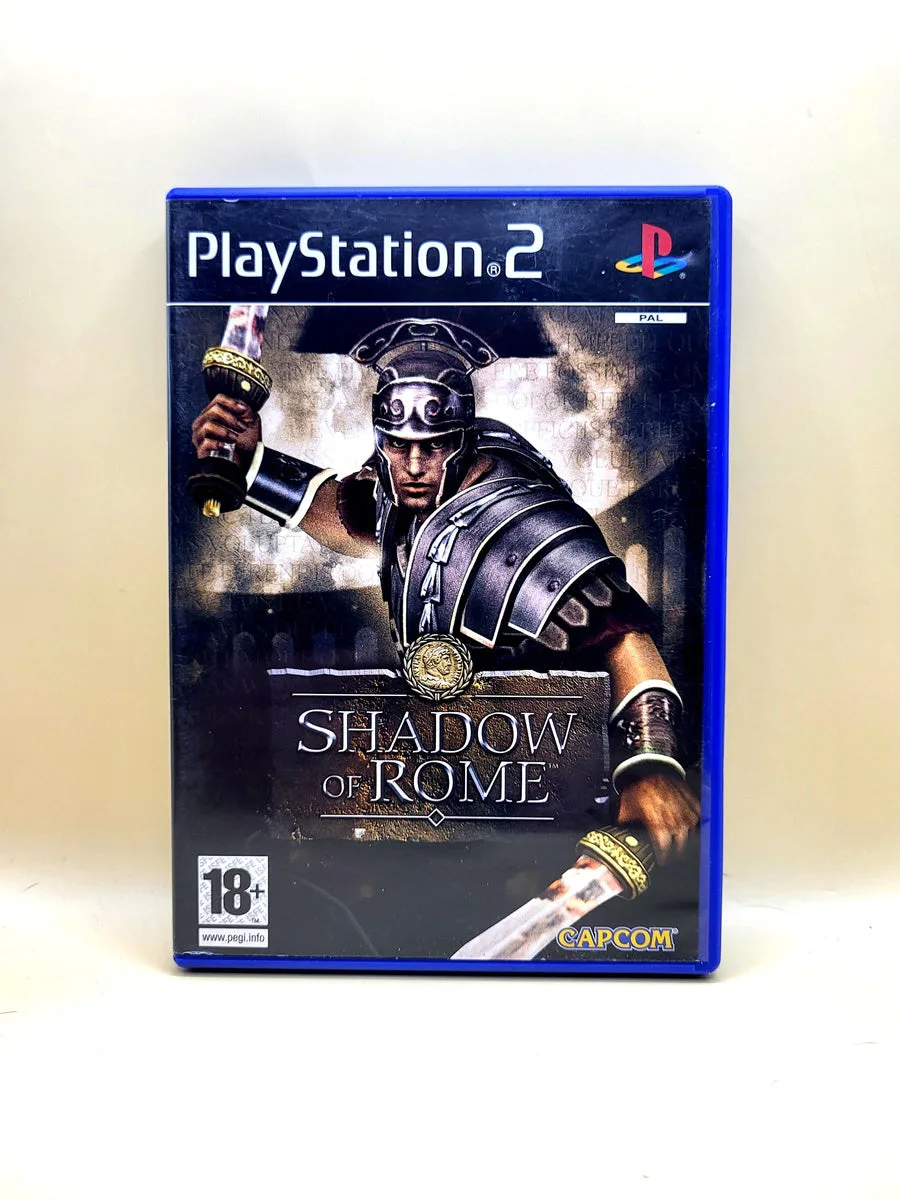
Shadow of Rome for PlayStation 2
Shadow of Rome for PlayStation 2 combines gladiatorial combat with stealth and a murder investigation in ancient Rome. After Julius Caesar's death, the father of soldier Agrippa is accused of the murder. Agrippa enters the arena to save him, while his friend Octavianus searches for evidence. The story lets you play as both men in turn. Their tasks call for very different actions: one must attract attention and win, while the other must stay out of the guards' hands.
As Agrippa, you fight with swords, axes and other weapons you find. They wear out through use, so combat also involves finding or taking replacements. You can throw weapons and defeat opponents in different ways. Impressive actions earn the crowd's appreciation; enthusiastic spectators help by throwing items into the arena. Chariot races appear alongside the fighting. The combat is explicitly bloody, and the presentation firmly treats the arena as a dangerous spectacle for a demanding audience.
Octavianus investigates buildings, eavesdrops on conversations and uses disguises to make progress. You study routes, hide unconscious guards and search for useful objects without starting an open fight. The chapters determine which protagonist you control and when; these are not two simultaneous players. You play this adventure alone with one DualShock 2 and do not need a Multitap. The same conspiracy thus alternates between the pressure of a public arena and the tension of a corridor where nobody must recognise you.
Region and language
Our PlayStation 2 games are PAL editions and come with a Dutch or English box, unless stated otherwise. By default, you receive the version for the European market. We note it in the product details if the region is different or the box is in another language. In almost all cases, the game is playable at least in English, and often in the other five common European languages too.
Manual
Shadow of Rome for PlayStation 2 includes the manual unless the product title states otherwise. If the booklet is missing, the title says “No Manual”. This lets you see before ordering whether the game comes with a manual.
The manuals included with our games usually contain at least English and often around six European languages. The exact languages vary by edition, so Dutch is not always included. The booklet explains the controls and the main rules. You can use it to check how to control the game, which actions are available and how its different features work.
The history of Shadow of Rome
Capcom developed and published Shadow of Rome in 2005 for PlayStation 2. The project built on the studio's experience with historical action adventures such as Onimusha, but shifted its attention to Rome. Keiji Inafune was involved. He explained that a holiday in Italy had given him the idea for the setting. The buildings and culture made an impression and provided a starting point for a game in which public power and hidden interests coexist.
The developers used Caesar's death as the starting point for their own story involving accusations, gladiators and investigation. The result is historical fiction, not a lesson reconstructing events exactly. The two protagonists also make that story playable in different ways. Agrippa uses violence to advance through the arena; Octavianus gathers information outside it. Capcom explained this combination of action and stealth as early as the 2004 announcement. The investigation is therefore part of the original design, not an extra chapter added later.
Inafune also emphasised that the audience should give the fights greater meaning. You do not simply defeat opponents: you also try to impress the people surrounding the arena. Their support connects the spectacle to the resources that help you survive. Weapon wear adds another practical consideration: a powerful find does not remain usable indefinitely. Capcom later looked back on the game as an adventure with two clearly defined styles of play. The offered PS2 version contains that original alternation within one continuous story.
Similar games for PlayStation 2
Spartan: Total Warrior shares the ancient setting and combat against many opponents, but places you alongside allies on large battlefields. Shadow of Rome turns Agrippa's fights into public contests where weapon wear and audience approval create important choices. Octavianus' investigation also interrupts the fighting with stealth. The variety here therefore comes not just from different enemies and weapons, but also from whether you want to be seen at that moment or need to remain unnoticed.
God of War likewise combines violent combat in a world drawing on antiquity with a fixed storyline. Kratos uses divine powers and his distinctive chained weapons, while Agrippa constantly has to account for found weapons that can break. Attention also shifts to Octavianus when the story calls for investigation. Where Kratos mainly advances through violence, climbing and mechanisms, a disguise can matter more here than the next powerful attack.
Onimusha 2: Samurai's Destiny shows how Capcom combines historical settings with a fictional action adventure. Jubei fights demons in Japan and builds relationships with allies through gifts. Shadow of Rome moves the story to Rome and divides progress between two fixed protagonists. Their different tasks determine the chapters. Constantly developing a favourite fighting style is therefore less useful; you also need to learn when a vulnerable investigator is better off waiting.
Prince of Persia: The Sands of Time alternates sword fighting with exploring a palace and solving route puzzles. The prince uses acrobatics and can reverse mistakes with his dagger. Shadow of Rome instead divides its variety between a gladiator and a stealth character, without a comparable time power. Especially for Octavianus, a safe route involves observing, distracting and hiding your identity, not a series of wall runs or rewinding a failed jump.
ICO and Shadow of Rome both show how vulnerability can change an action adventure's pace. Ico searches for a way out of a castle with Yorda and protects her from shadows. Octavianus mainly has to keep himself out of the guards' hands while gathering information. Shadow of Rome alternates that cautious work with Agrippa's explicitly violent performances. Here, the difference between acting and waiting comes from the chapters, not from continually escorting a companion through the same spaces.