This product is like new. At NexWave Games, like new means:
Additionally, all discs at NexWave Games are carefully inspected and assessed for quality. When discs arrive, we do not accept any that are so badly damaged that they are unlikely to work. We only accept discs with light scratches at most. Discs with scratches are then treated in our professional disc repair machine. By warming the disc and polishing it with soft brushes, these machines can remove a very thin layer from the disc. This removes the layer containing surface scratches and improves the disc’s readability. This ensures the disc works properly, even on consoles with ageing lasers that have difficulty reading games! Great news for the player.
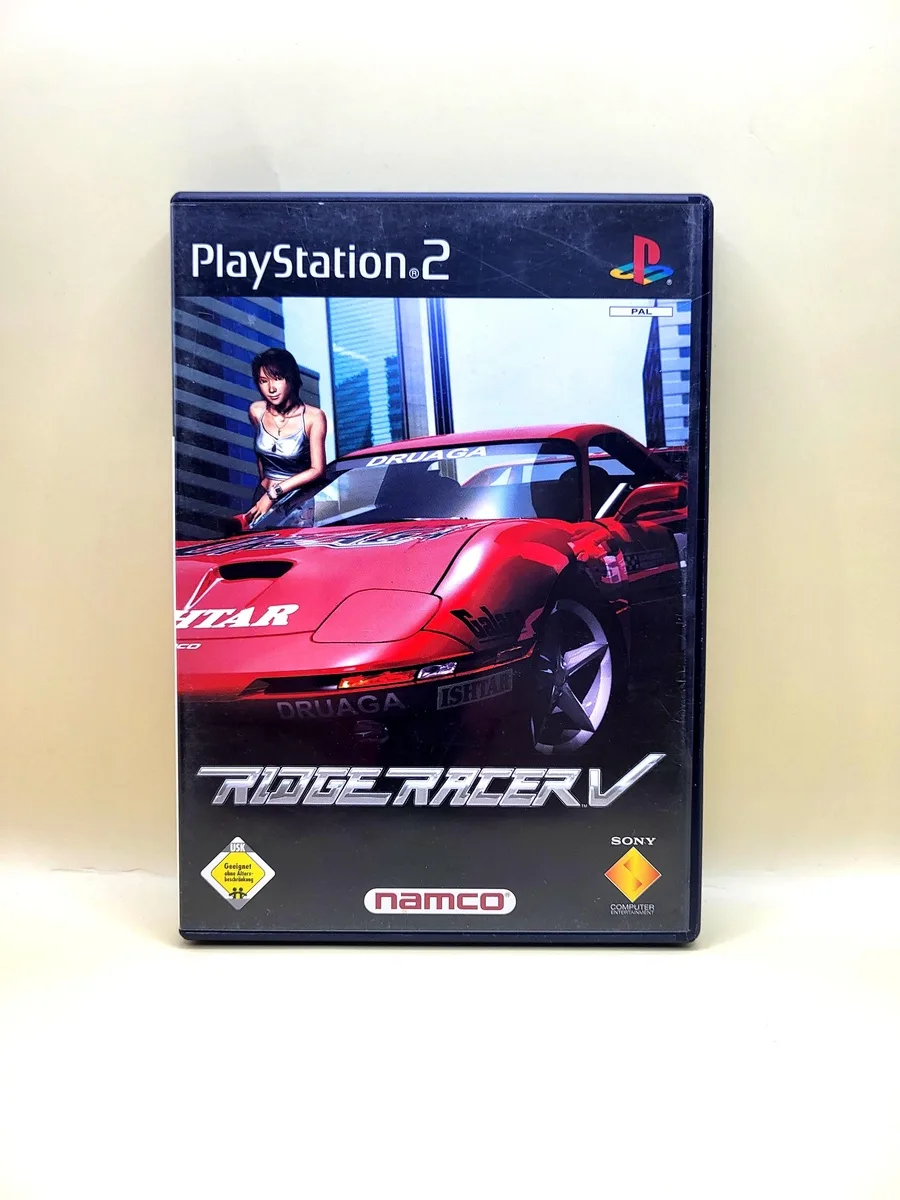
Ridge Racer V for PlayStation 2
Ridge Racer V for PlayStation 2 is an arcade racer that takes you through the streets and along the coast of Ridge City. The seven circuits use different parts of that fictional city, from Sunny Beach to wide roads near the airport. You start with six types of cars from imaginary manufacturers. Their handling differs: some hold their grip longer, while others slide more readily into a drift. You therefore learn not only the route, but also how early your car needs to turn into a corner.
In Grand Prix, you face computer-controlled opponents and unlock extra cars and races. Each event requires a particular finishing position to progress. Different rules appear later, including reversed routes and races with a time limit. Time Attack is about your own lap time; Free Run provides space to practise without other cars. With a brief touch of the brakes and precise countersteering, you seek a smooth line through the corner so that you retain speed on the next straight.
With two controllers, you can also play together on one PS2. The screen splits horizontally, and you choose a direct duel or a race with additional computer cars. No Multitap is needed. An optional catch-up feature gives the trailing player extra speed. You can drive with an ordinary DualShock 2; a steering wheel is not compulsory. The emphasis is on learning the circuits and mastering long drifts.
Region and language
Our PlayStation 2 games are PAL editions and come with a Dutch or English box, unless stated otherwise. By default, you receive the version for the European market. We note it in the product details if the region is different or the box is in another language. In almost all cases, the game is playable at least in English, and often in the other five common European languages too.
This copy of Ridge Racer V has a PAL case with a German USK age rating on the front. Please therefore expect German text on the packaging.
Manual
Ridge Racer V for PlayStation 2 includes the manual unless the product title states otherwise. If the booklet is missing, the title says “No Manual”. This lets you see before ordering whether the game comes with a manual.
The manuals included with our games usually contain at least English and often around six European languages. The exact languages vary by edition, so Dutch is not always included. The booklet explains the controls and the main rules. You can use it to check how to control the game, which actions are available and how its different features work.
The history of Ridge Racer V
Namco developed Ridge Racer V for the arrival of PlayStation 2 in 2000. It launched alongside the console in Japan in March; the European release followed in November that year. The series had done the same for the first PlayStation: the home version of Ridge Racer was part of its Japanese launch in 1994. The fifth instalment continued that association with new Sony hardware. Sony Computer Entertainment Europe handled the European release of this Namco-developed racer.
The series began with Namco's arcade game Ridge Racer in 1993. It combined three-dimensional circuits with deliberately sliding cars. In moving to PS2, Namco retained that principle while adding detail to cars and city scenery. Ridge City linked the different tracks into one recognisable setting. Fictional manufacturers gave the team room for its own division between grip and drift handling. The distinctive steering style therefore remained more important than reproducing an existing racing category or manufacturer.
An arcade edition followed the home version. Namco used a PlayStation 2-based system board and presented the six familiar car types again with a real steering wheel and pedals. With Ridge Racer V, the transfer therefore went from console to arcade, unlike the series' origins. The PS2 release retains its own Grand Prix progression, practice runs and split screen. Support for Namco's neGcon and JogCon also connected this new console generation with racing controllers from the previous generation.
Similar games for PlayStation 2
Gran Turismo 3: A-Spec likewise has you learn circuits and unlock cars on PS2, but builds a career involving driving licences, purchase prices and technical upgrades around that. Ridge Racer V uses fictional manufacturers and divides cars mainly by their steering behaviour. Here you think less about your next investment and more about the moment a drift begins. Both require repetition, but reward a different way of taking corners.
Ferrari F355 Challenge shares the arcade background and also offers races on a horizontally split screen. Sega focuses everything on one real Ferrari model, genuine circuits and carefully chosen braking points. Ridge Racer V gives you several fictional cars and encourages longer slides through city corners. Where Ferrari lets you investigate why a technical lap goes wrong, Ridge Racer mainly lets you feel how a different drift line preserves speed when leaving a corner.
Burnout 2: Point of Impact likewise centres on speed and drifting on PS2, but adds ordinary traffic and a boost meter. Dangerous driving close to other road users helps fill that meter. Ridge Racer V keeps its races on closed courses without that through traffic and makes steering itself the main challenge. You seek a flowing route in both games, but Burnout makes the risk of near misses count much more strongly during a run.
OutRun 2006: Coast 2 Coast combines long drifts with Ferraris, traffic and branching routes through varied scenery. Ridge Racer V has you return to fixed circuits within Ridge City and builds progression through Grand Prix races. Both have a clear arcade style, but you read the road differently. In OutRun, you decide which direction to take along the way, whereas in Ridge Racer you repeatedly refine the same corners and transitions.
R: Racing also comes from Namco and likewise lets you drive different cars on PlayStation 2. It uses real racing cars and follows driver Rena Hayami in Racing Life, with team contacts and rivals around the events. Ridge Racer V does not centre on a comparable personal story and sticks to its own manufacturers. The similarity lies in learning to read corners; the difference lies in R: Racing's story-led career and emphasis on real motorsport.