This product is like new. At NexWave Games, like new means:
Additionally, all discs at NexWave Games are carefully inspected and assessed for quality. When discs arrive, we do not accept any that are so badly damaged that they are unlikely to work. We only accept discs with light scratches at most. Discs with scratches are then treated in our professional disc repair machine. By warming the disc and polishing it with soft brushes, these machines can remove a very thin layer from the disc. This removes the layer containing surface scratches and improves the disc’s readability. This ensures the disc works properly, even on consoles with ageing lasers that have difficulty reading games! Great news for the player.
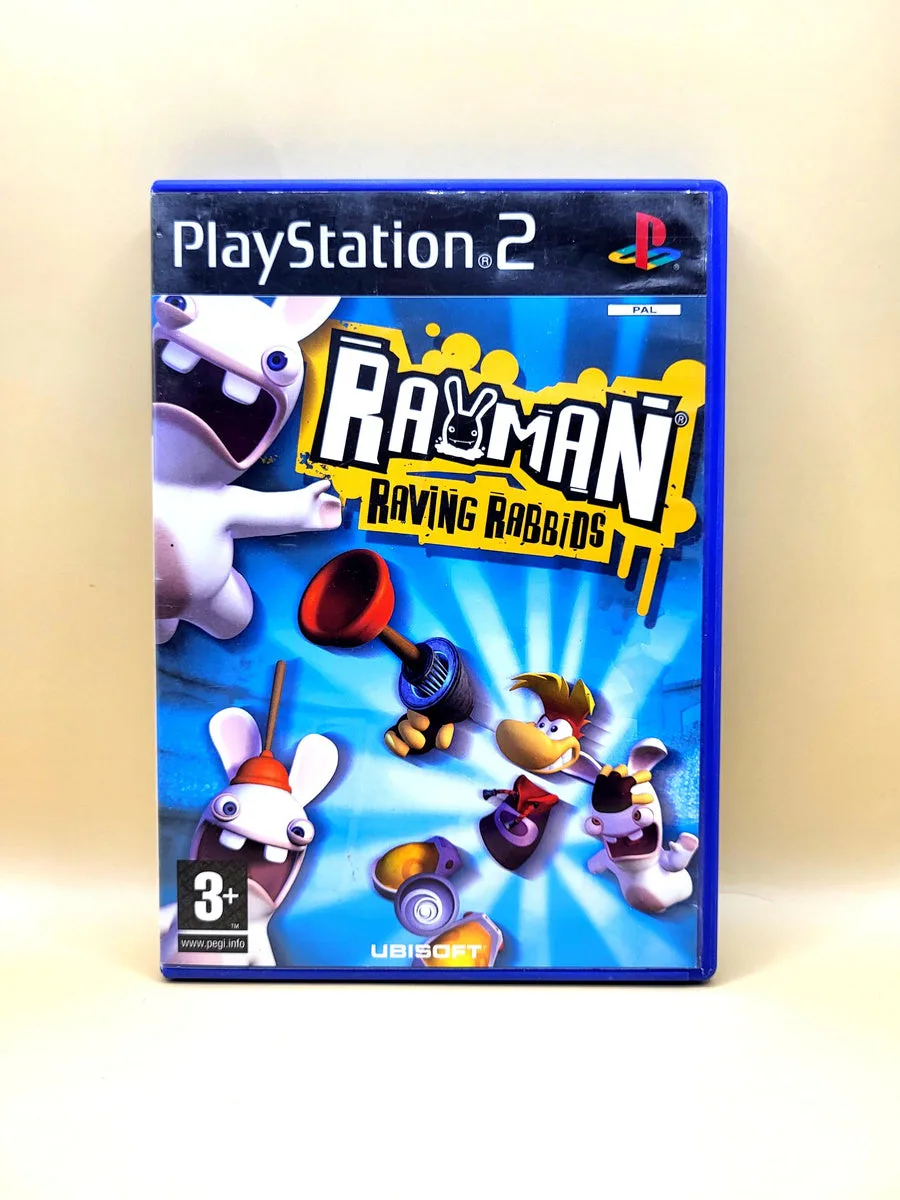
Rayman Raving Rabbids for PlayStation 2
Rayman Raving Rabbids for PlayStation 2 is a party game with short tasks involving rhythm, reactions and aiming. A group of crazed rabbits kidnaps Rayman and forces him to perform before a noisy audience. You try to win the trials to break his captivity. Each challenge first explains its own rules and controls. One may require precise reactions, another a steady rhythm or hitting targets with a toilet plunger.
A story day begins with four qualifying trials. Winning at least three opens the door to the final fifth trial. Rayman then returns to his cell, where you can listen to unlocked music and change clothing. Completed days can be replayed, and unlocked trials appear separately under Score. You therefore need not follow the whole story whenever you mainly want to improve a time or previous result.
This PS2 version uses the DualShock 2’s buttons and analogue sticks, not Wii motion controls. The story is single-player. In certain unlocked trials, two players can participate simultaneously with two controllers. Three or four participants take turns; that does not mean four simultaneous players in split-screen. Available co-operation or competition depends on the trial. Its own explanation therefore remains important when changing challenges.
Region and language
Our PlayStation 2 games are PAL editions and come with a Dutch or English box, unless stated otherwise. By default, you receive the version for the European market. We note it in the product details if the region is different or the box is in another language. In almost all cases, the game is playable at least in English, and often in the other five common European languages too.
Manual
Rayman Raving Rabbids for PlayStation 2 includes the manual unless the product title states otherwise. If the booklet is missing, the title says “No Manual”. This lets you see before ordering whether the game comes with a manual.
The manuals included with our games usually contain at least English and often around six European languages. The exact languages vary by edition, so Dutch is not always included. The booklet explains the controls and the main rules. You can use it to check how to control the game, which actions are available and how its different features work.
The history of Rayman Raving Rabbids
Ubisoft Montpellier developed Rayman Raving Rabbids, and Ubisoft released the PS2 version in 2006. The game introduced the Rabbids as Rayman’s new opponents. Their unpredictable behaviour became the basis for short trials and visual jokes. Rayman remained the controlled character, but progress did not follow continuous platform areas as in Revolution or Rayman 3. The arena, days and return to a cell connected the separate tasks.
The spring 2006 announcement still described a broader adventure plan. The final PS2 manual shows what reached stores: days with qualifying events, a final trial and separately replayable challenges. That distinction matters when reading older information. Early promises do not prove a feature appears on this disc. The description therefore follows the final rules and controls explained in the original PS2 booklet.
Raving Rabbids also appeared on other systems, but controls and sometimes structure differ by version. Wii presentations can particularly confuse a PS2 purchase. Buttons, sticks and the described turn-taking belong here. Separate handheld editions likewise cannot establish identical content. This first encounter with the Rabbids shows Rayman’s world becoming a series of short contests, emphasising scores and repetition over lengthy exploration.
Similar games for PlayStation 2
Rayman 3: Hoodlum Havoc shares hero and comic tone, but uses a continuous solo adventure with jumps, fighting and temporary powers. Raving Rabbids instead teaches different short rules repeatedly. Both involve improving performance, but Rayman 3 progresses through a world, while this game more often concerns winning a trial or raising a score.
Rayman M also uses the same world for competition. It establishes rules for foot races and shooting arenas, making route knowledge and positioning increasingly important. Raving Rabbids changes tasks and control actions more often. Competition overlaps, but mastering a route in Rayman M differs from quickly understanding the next rabbit trial.
Super Monkey Ball Deluxe shares short challenges, precision and separate party games. Its main game moves a ball through courses by tilting the field. Raving Rabbids instead changes successful actions from rhythm to aiming. Both reward retries, but Monkey Ball’s consistent ball physics require different practice from the Rabbids’ varied trials.
SpongeBob SquarePants: Lights, Camera, Pants! on PS2 combines cartoon humour with local minigame competition. Participants try to earn roles in a Bikini Bottom production. Rayman connects tasks through captivity and the rabbit arena. Both use short trials, but SpongeBob’s production premise and Rayman’s day structure give different reasons to continue.
Crash Tag Team Racing shares slapstick and varied short activities. Its main structure consists of car races, combining vehicles and exploring a theme park on foot. Raving Rabbids builds progress around separate trials and the cell. Crash therefore demands more knowledge of connected routes, while Rayman mainly switches rules, scores and repeated attempts.