This product is like new. At NexWave Games, like new means:
Additionally, all discs at NexWave Games are carefully inspected and assessed for quality. When discs arrive, we do not accept any that are so badly damaged that they are unlikely to work. We only accept discs with light scratches at most. Discs with scratches are then treated in our professional disc repair machine. By warming the disc and polishing it with soft brushes, these machines can remove a very thin layer from the disc. This removes the layer containing surface scratches and improves the disc’s readability. This ensures the disc works properly, even on consoles with ageing lasers that have difficulty reading games! Great news for the player.
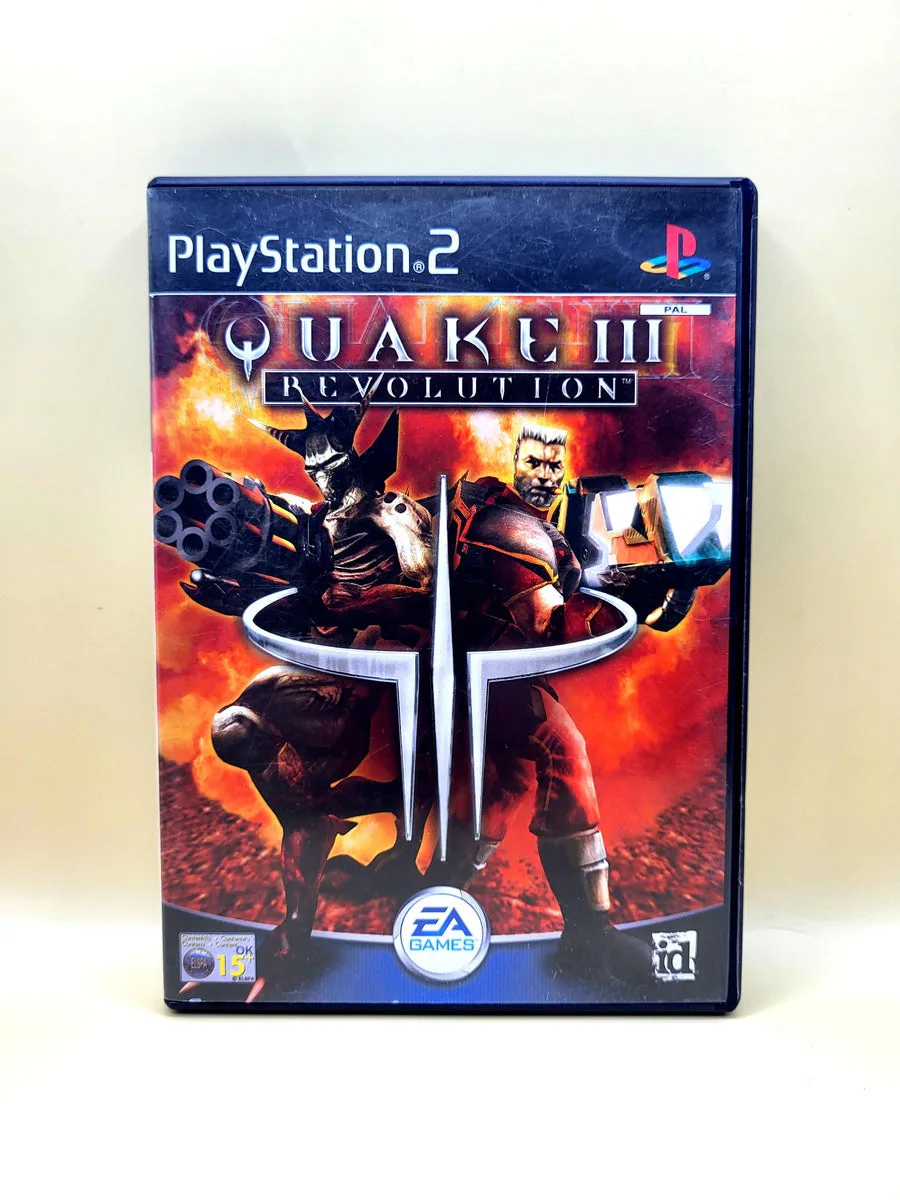
Quake III Revolution for PlayStation 2
Quake III Revolution for PlayStation 2 brings fast arena combat to console. In the solo campaign you choose a warrior and cross successive arenas against computer-controlled opponents. Guns, rocket launchers, lightning weapons and power-ups appear at fixed points. Knowing routes, respawn times and jump pads matters as much as precise aiming, because standing still makes you an easy target.
This adaptation adds a campaign with persistent statistic upgrades. After victories, opponents become stronger and teams and rules change. Alongside free fights are team matches and Capture the Flag. Up to four people can play locally on one PS2; three or four participants need a PlayStation 2 Multitap and extra controllers. Bots can fill empty match slots.
The PS2 version has no online multiplayer. All solo matches and local arenas work without internet. Controls use a DualShock 2 and offer sensitivity and button-layout settings, but play differently from the original PC version with mouse and keyboard. Quake III Revolution is a standalone console adaptation, not the same release as Quake III Arena on Dreamcast or PC.
Region and language
Our PlayStation 2 games are PAL editions and come with a Dutch or English box, unless stated otherwise. By default, you receive the version for the European market. We note it in the product details if the region is different or the box is in another language. In almost all cases, the game is playable at least in English, and often in the other five common European languages too.
Local matches with three or four players require a PlayStation 2 Multitap and three or four controllers. A Multitap is not required for one or two players.
Manual
Quake III Revolution for PlayStation 2 includes the manual unless the product title states otherwise. If the booklet is missing, the title says “No Manual”. This lets you see before ordering whether the game comes with a manual.
The manuals included with our games usually contain at least English and often around six European languages. The exact languages vary by edition, so Dutch is not always included. The booklet explains the controls and the main rules. You can use it to check how to control the game, which actions are available and how its different features work.
The history of Quake III Revolution
Quake III Arena appeared in 1999 as id Software's arena shooter without a traditional story campaign. Bullfrog Productions then made the PlayStation 2 adaptation, released by Electronic Arts in 2001. Revolution had to bring short matches, recognizable arenas and high speed to a young console. The developer therefore visibly changed interface, progression and controls.
The new campaign linked arenas with a simple tournament story and let the chosen character's attributes grow. This gave solo players a clearer path than other versions' separate ladders. Local matches became important: a Multitap let four people share one screen. The PS2 disc relied entirely on local connections and bots because network play was not included.
Quake III Revolution became one of the last projects under the Bullfrog name before Electronic Arts closed the studio. Quake later split between story-focused shooters and new arena releases. Revolution remained unique through its PS2 campaign and character growth. Later Quake III versions on other systems do not change that; their online features, maps or controls do not automatically belong to this disc.
Similar games for PlayStation 2
Unreal Tournament on PS2 also uses arenas, bots and local matches, but offers different weapons and rules. Quake III Revolution moves faster and emphasizes jump routes, rockets and short duels. Unreal has a broader range of team objectives; Quake builds its solo progression around increasingly strong arena opponents.
TimeSplitters combines fast shooting with story levels, challenges and extensive local multiplayer. Quake III Revolution makes nearly every environment function directly as an arena and has no full story missions. Both support four local players with a Multitap, but TimeSplitters varies more in eras and objectives.
Red Faction tells a linear science-fiction campaign on Mars and allows parts of walls to be damaged. Quake III Revolution focuses on compact arenas, repeating weapon positions and bot matches. Red Faction offers more story and exploration; Quake asks for faster movement, memorized routes and constant reactions to opponents.
Half-Life on PS2 builds tension through one continuous campaign with puzzles, platforming and scripted events. Quake III Revolution uses a tournament and separate fights without a comparable storyline. Half-Life rewards careful exploration; Quake rewards command of weapons, jumps and arena layout under constant pressure.
XIII uses comic-book visuals, a spy story and missions with stealth, weapons and objectives. Quake III Revolution chooses more abstract science-fiction arenas and nearly continuous matches. Both have local multiplayer on PS2, but XIII feels like a narrative console shooter while Quake is built around speed, scores and replayable combat.