This product is like new. At NexWave Games, like new means:
Additionally, all discs at NexWave Games are carefully inspected and assessed for quality. When discs arrive, we do not accept any that are so badly damaged that they are unlikely to work. We only accept discs with light scratches at most. Discs with scratches are then treated in our professional disc repair machine. By warming the disc and polishing it with soft brushes, these machines can remove a very thin layer from the disc. This removes the layer containing surface scratches and improves the disc’s readability. This ensures the disc works properly, even on consoles with ageing lasers that have difficulty reading games! Great news for the player.
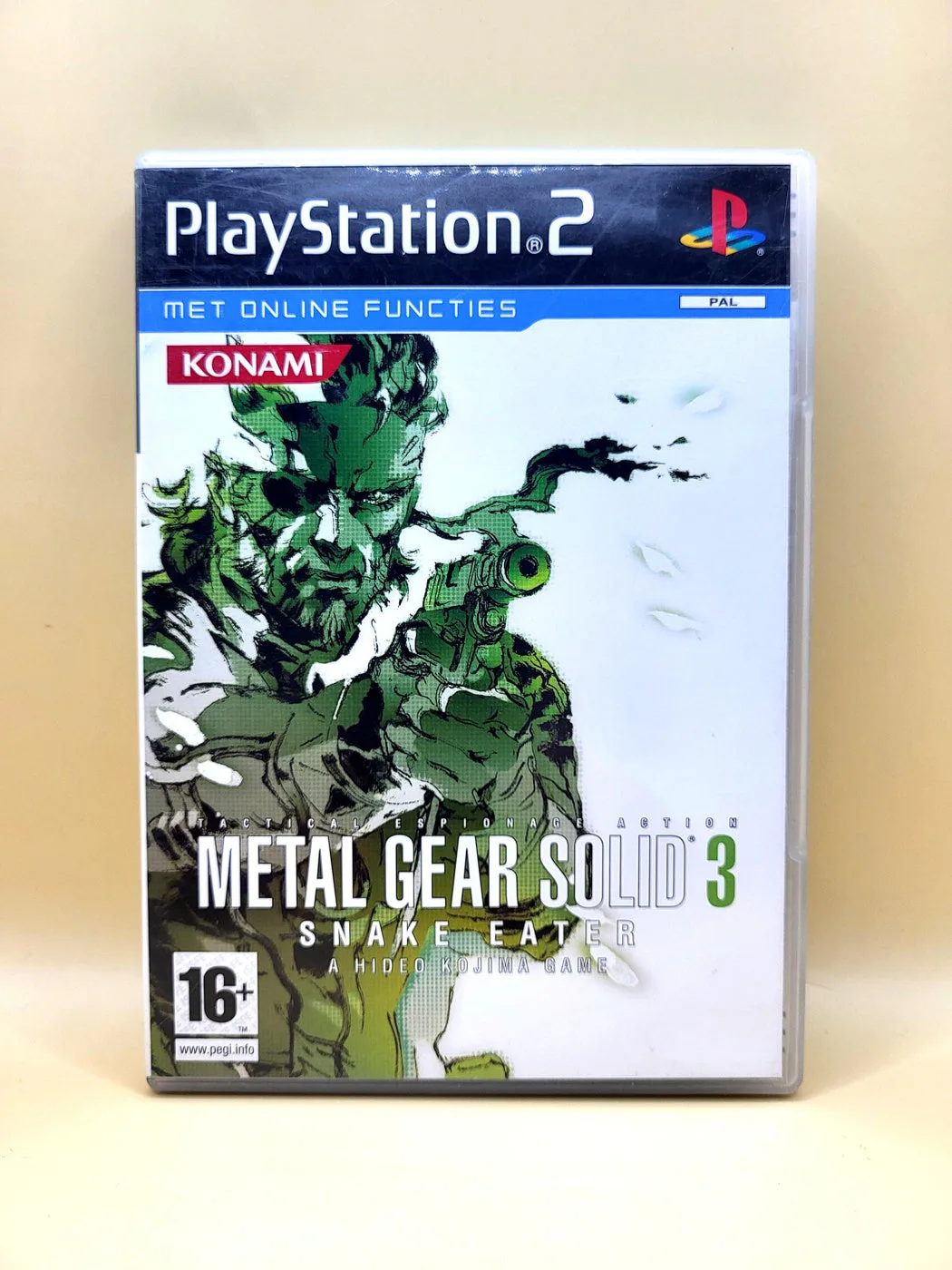
Metal Gear Solid 3: Snake Eater for PlayStation 2
Metal Gear Solid 3: Snake Eater for PlayStation 2 takes you to 1964, in the middle of the Cold War. As Naked Snake, you infiltrate enemy territory to rescue a Soviet scientist and stop a dangerous weapon. You crawl through grass, take cover behind trees and explore military buildings. Guards are not your only concern: animals, deep drops and injuries can also complicate the mission. The jungle is therefore both a hiding place and an environment you must learn to understand.
Camouflage clothing and face paint let you adapt Snake to his surroundings. The camouflage index shows how well he blends into the terrain. Food maintains his stamina, while the healing screen lets you examine and treat injuries. At close range, CQC allows you to grab, interrogate or throw an enemy. You repeatedly decide whether to wait, crawl past someone or incapacitate a guard. Sound and movement also reveal your position, so approaching carefully remains important even when your clothing matches the background.
You play the campaign alone with a DualShock 2 controller. The original Snake Eater mainly uses predetermined camera angles, supplemented by looking around and aiming through Snake's eyes; the later freely rotating Subsistence camera is not included. Radio conversations and cutscenes tell the story of Snake, The Boss and their opponents. Between stealth routes, boss fights test your weapons, patience and knowledge of the terrain in different ways.
Region and language
Our PlayStation 2 games are PAL editions and come with a Dutch or English box, unless stated otherwise. By default, you receive the version for the European market. We note it in the product details if the region is different or the box is in another language. In almost all cases, the game is playable at least in English, and often in the other five common European languages too.
Manual
Metal Gear Solid 3: Snake Eater for PlayStation 2 includes the manual unless the product title states otherwise. If the booklet is missing, the title says “No Manual”. This lets you see before ordering whether the game comes with a manual.
The manuals included with our games usually contain at least English and often around six European languages. The exact languages vary by edition, so Dutch is not always included. The booklet explains the controls and the main rules. You can use it to check how to control the game, which actions are available and how its different features work.
The history of Metal Gear Solid 3: Snake Eater
Konami Computer Entertainment Japan developed Metal Gear Solid 3 with Hideo Kojima as director. It appeared in 2004 and reached Europe in 2005. After the modern installations of Sons of Liberty, the team chose a story set much earlier chronologically. The Cold War and Naked Snake created room to explore the origins of important relationships within the series. The bond between a soldier, his mentor and his mission became a central subject.
The move to a natural environment changed stealth as well. A wall or box was no longer the only way to stay out of sight: camouflage clothing and face paint gained their own system. Hunting, gathering food and treating injuries added decisions outside a direct firefight. Konami presented that combination as survival during infiltration. CQC meanwhile made contact with a nearby guard more varied, as grabbing, interrogation and throws offered different solutions when keeping your distance was no longer possible.
The European Snake Eater release received extras including additional face paint and a separate option to replay boss fights. That does not make it the same as Subsistence, the later expanded edition with a different camera and additional content. The former camouflage downloads are not a promise of current online service either: Konami ended that service in March 2008. This original PlayStation 2 version preserves the adventure with its original camera approach, survival menus and extensive storytelling, without attributing the controls or presentation of later rereleases and remakes to it.
Similar games for PlayStation 2
Metal Gear Solid 2: Sons of Liberty on PlayStation 2 shares the combination of stealth, extensive radio conversations and boss fights. There, you move through a tanker and Big Shell, with modern security and clearly defined corridors. Snake Eater replaces much of this with vegetation, camouflage, hunting and treating injuries. Where Sons of Liberty mainly has you understand installations and patrol routes, Snake Eater also demands constant attention to your body and the natural environment in which you hide.
Tom Clancy's Splinter Cell for PlayStation 2 also has you control an isolated secret agent who prefers to avoid guards. Sam Fisher relies heavily on darkness, light sources and night-vision goggles. Snake Eater instead has you adapt clothing and face paint to grass, soil or an interior. Both reward slow observation, but Snake Eater adds food and medical care. The extensive personal history of Snake and The Boss also receives greater emphasis than a series of directly managed operations.
Hitman 2: Silent Assassin on PlayStation 2, like Snake Eater, asks you to read enemies before moving. Agent 47 mainly uses another identity and routes through buildings to reach a target. Naked Snake conceals his body with camouflage and uses the jungle as cover. In Hitman, you design the execution of an assassination within an individual assignment; Snake Eater follows an ongoing military mission in which food, injuries and boss fights repeatedly return.
Mission: Impossible – Operation Surma for PlayStation 2 shares infiltrating unseen, gathering information and avoiding alarms. Ethan Hunt receives modern equipment for this, including tools to disrupt cameras and look behind doors. Snake Eater takes place decades earlier and finds its added depth in camouflage, CQC and survival in nature. Both have a single-player campaign, but Surma focuses more on successive technical obstacles than on hunting and medical care.
Tenchu: Wrath of Heaven on PlayStation 2 also rewards waiting, approaching enemies from behind and using the environment. Its grappling hook opens rooftops and elevated stealth routes in a historically inspired Japan. Snake Eater more often uses grass, trees and camouflage within a Cold War story. Tenchu focuses more strongly on targeted silent attacks with ninja weapons; Snake Eater gives managing food and injuries a greater role alongside firearms and CQC.