This product is like new. At NexWave Games, like new means:
Additionally, all discs at NexWave Games are carefully inspected and assessed for quality. When discs arrive, we do not accept any that are so badly damaged that they are unlikely to work. We only accept discs with light scratches at most. Discs with scratches are then treated in our professional disc repair machine. By warming the disc and polishing it with soft brushes, these machines can remove a very thin layer from the disc. This removes the layer containing surface scratches and improves the disc’s readability. This ensures the disc works properly, even on consoles with ageing lasers that have difficulty reading games! Great news for the player.
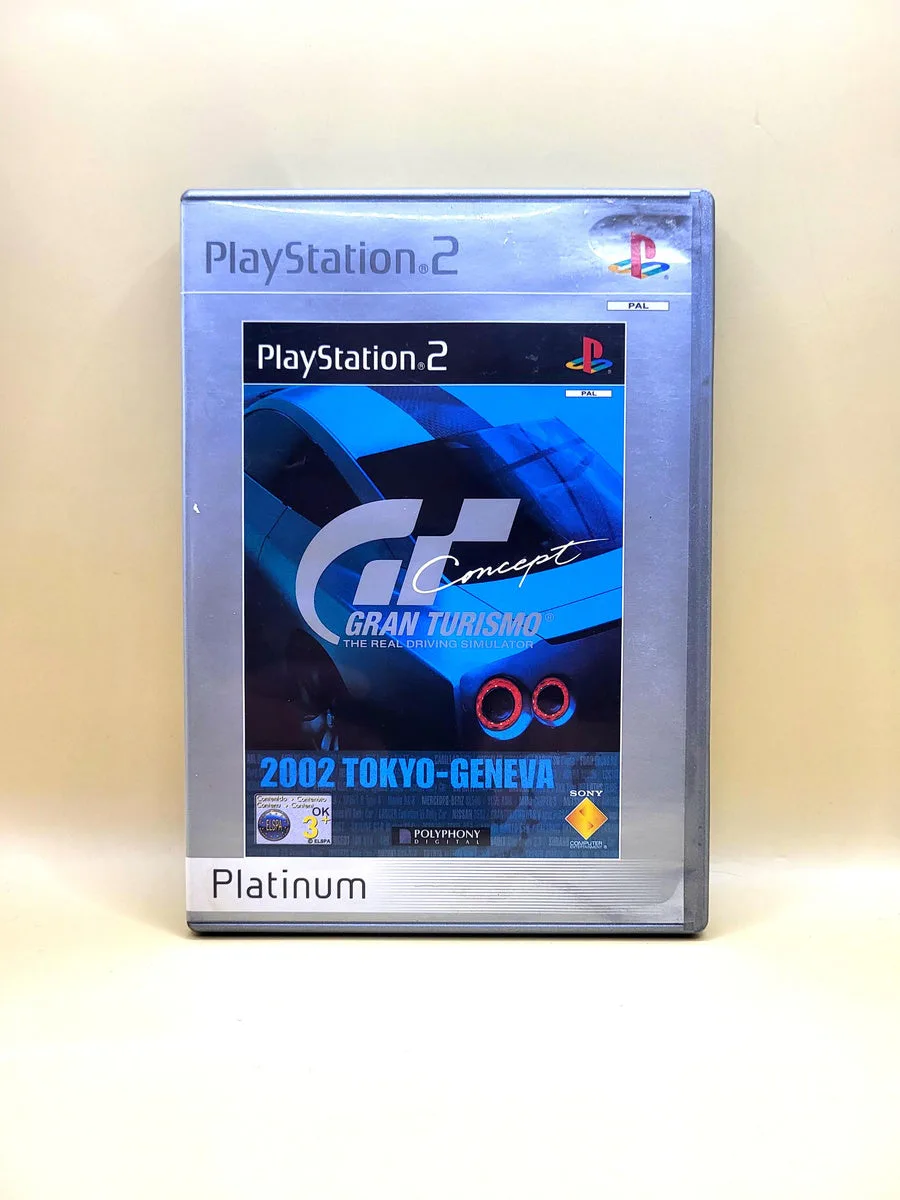
Gran Turismo Concept 2002 Tokyo-Geneva for PlayStation 2
Gran Turismo Concept 2002 Tokyo-Geneva for PlayStation 2 is a car racing game centred on concept cars, production models and racing cars. You try unusual designs displayed at the Tokyo and Geneva motor shows, but actually drive them around circuits and rally tracks. The collection combines widely differing drivetrains and power outputs. You therefore notice more than differences in top speed: weight and the way a car enters a corner also determine how you tackle a lap.
You begin with Course Licence, in which you must complete a lap within a specified time. An optional pace car shows the racing line and where you can brake. A satisfactory result unlocks the corresponding track for Single Race. Winning races then earns you other cars. The short selection of circuits helps you recognise changes in braking point, speed and line, because you drive the same corners again with very different vehicles.
This structure skips the lengthy process of buying and rebuilding a garage. You select a challenge, practise a lap and try to improve your result. Free Run gives you room to explore a car and track combination without immediately needing to win a race. With two controllers, you can also race each other on one PlayStation 2 in split-screen. The game is therefore chiefly about driving, unlocking content and comparing unusual cars.
Region and language
Our PlayStation 2 games are PAL editions and come with a Dutch or English box, unless stated otherwise. By default, you receive the version for the European market. We note it in the product details if the region is different or the box is in another language. In almost all cases, the game is playable at least in English, and often in the other five common European languages too.
Manual
Gran Turismo Concept 2002 Tokyo-Geneva for PlayStation 2 includes the manual unless the product title states otherwise. If the booklet is missing, the title says “No Manual”. This lets you see before ordering whether the game comes with a manual.
The manuals included with our games usually contain at least English and often around six European languages. The exact languages vary by edition, so Dutch is not always included. The booklet explains the controls and the main rules. You can use it to check how to control the game, which actions are available and how its different features work.
The history of Gran Turismo Concept 2002 Tokyo-Geneva
Gran Turismo Concept 2002 Tokyo-Geneva arrived in Europe in July 2002, after Gran Turismo 3: A-Spec. Polyphony Digital developed the game and Sony published it for PlayStation 2. The title refers to two actual motor shows: Tokyo in 2001 and Geneva in 2002. Their concept cars provided a reason to use Gran Turismo's technology for a different, more compact collection of cars than the main series offered.
Concept turned the motor show into part of a playable racing collection. Instead of merely looking at a future model, you could experience how it travelled around a track within Gran Turismo's driving rules. The official description names sports cars, four-wheel-drive cars and hybrids together. That broad view of automotive technology explains the selection better than any single championship: its subject is what manufacturers showcase and the different forms a car can take.
The limited number of tracks and short licence assignments were deliberate choices to get you driving sooner. Tokyo-Geneva is a separate release within the Concept series, not Gran Turismo 4 or the earlier Japanese Tokyo edition. Consequently, it does not provide a complete replacement for a numbered instalment's extensive career. Instead, the game preserves a moment from the early PS2 years, when new concept cars and a different kind of progression found room alongside Gran Turismo 3.
Similar games for PlayStation 2
Gran Turismo 3: A-Spec shares the emphasis on steering feel, braking points and diverse cars on PlayStation 2. However, you earn money, buy vehicles and parts, and build a much longer career. Tokyo-Geneva replaces that management with shorter licence laps and races that unlock cars. The actions behind the wheel therefore feel familiar, while the reason for entering another race changes from saving money to winning the next prize.
Gran Turismo 4 offers a much broader collection of cars and tracks, with an extensive career and additions such as B-Spec. Tokyo-Geneva focuses its selection on unusual models associated with the two motor shows and keeps the number of circuits small. In both games, experience with a car helps you set better times. Concept demands less garage management and lets you rediscover the same track more often from a different seat.
Tourist Trophy brings Polyphony Digital's licence tests and attention to vehicle behaviour to motorcycles. Like Tokyo-Geneva, it has you earn new machines through performance, but a motorcycle's riding position and balance change the steering. Concept remains a collection of cars with different drivetrains. If you enjoy investigating differences between vehicles, here you do it through four wheels rather than a rider's lean.
Ridge Racer V and Tokyo-Geneva quickly give you a concrete racing assignment without first making you undertake an extensive economic career. Ridge Racer emphasises drifting and a pronounced arcade feel; Concept stays closer to braking, grip and the characteristics of recognisable car brands. In both cases, you get to know a limited set of tracks thoroughly. However, the way you carry speed through a corner feels distinctly different.
Enthusia Professional Racing also explores how different production cars respond to throttle, brake and steering inputs. It uses its own career and a visible display of forces acting on the vehicle. Tokyo-Geneva chiefly presents its cars through short tests and unlockable races around a compact track selection. Both reward controlled driving, but Enthusia builds a longer progression system around it, while Concept puts the unusual car more directly at the centre.