This product is like new. At NexWave Games, like new means:
Additionally, all discs at NexWave Games are carefully inspected and assessed for quality. When discs arrive, we do not accept any that are so badly damaged that they are unlikely to work. We only accept discs with light scratches at most. Discs with scratches are then treated in our professional disc repair machine. By warming the disc and polishing it with soft brushes, these machines can remove a very thin layer from the disc. This removes the layer containing surface scratches and improves the disc’s readability. This ensures the disc works properly, even on consoles with ageing lasers that have difficulty reading games! Great news for the player.
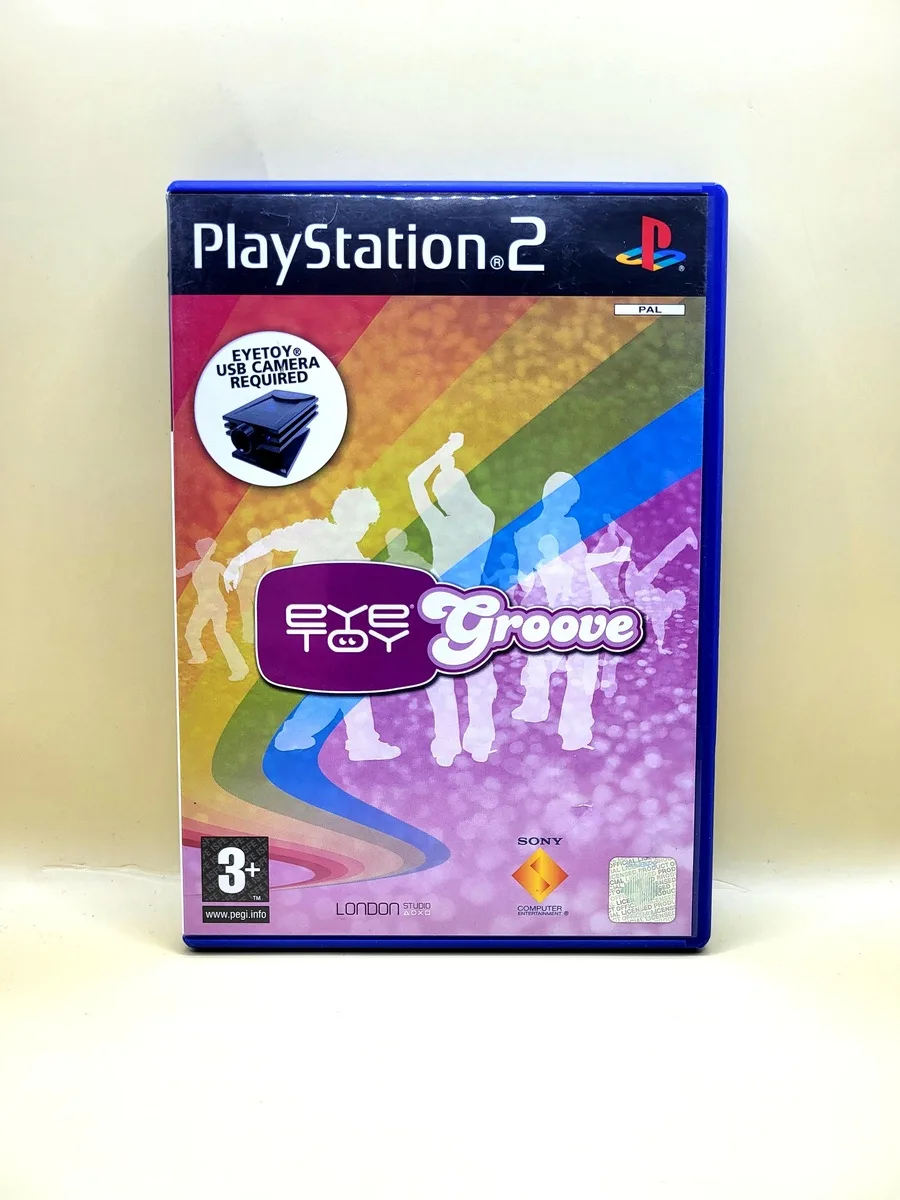
EyeToy: Groove for PlayStation 2
EyeToy: Groove for PlayStation 2 uses the EyeToy USB camera to read arm movements while you dance to music. Targets appear along the edges of the image and must be hit with your hands and arms at the right moment. The disc contains 28 licensed songs by artists including Madonna, Elvis Presley, Fatboy Slim, Jamiroquai and Village People. Each choreography combines fixed rhythm patterns with free movement; no dance mat is needed and a regular controller mainly serves the menus.
Besides individual songs, you can play longer sets and competitions. In Tournament, participants perform a song one after another and their scores are compared. Team Sync judges two players on simultaneous movements, so both must remain inside the camera image. Dance Move Maker lets you attach your own sequence of gestures to a selected song. A calorie counter gives a broad estimate of exertion, but is not a medical measuring device or personal training advice.
Place the camera securely above or below the television and keep your arms and upper body visible. Even lighting and a calm background help distinguish quick movements near the edge of the image; move furniture before making wide gestures. EyeToy: Groove requires a compatible EyeToy USB camera for PlayStation 2. This product page describes the game disc and does not guarantee that a separate camera is supplied. All music and multiplayer functions run locally on the console.
Region and language
Our PlayStation 2 games are PAL editions and come with a Dutch or English box, unless stated otherwise. By default, you receive the version for the European market. We note it in the product details if the region is different or the box is in another language. In almost all cases, the game is playable at least in English, and often in the other five common European languages too.
Manual
EyeToy: Groove for PlayStation 2 includes the manual unless the product title states otherwise. If the booklet is missing, the title says “No Manual”. This lets you see before ordering whether the game comes with a manual.
The manuals included with our games usually contain at least English and often around six European languages. The exact languages vary by edition, so Dutch is not always included. The booklet explains the controls and the main rules. You can use it to check how to control the game, which actions are available and how its different features work.
The history of EyeToy: Groove
London Studio developed EyeToy: Groove as the second game Sony built around the EyeToy camera. Sony Computer Entertainment Europe released it in November 2003, several months after EyeToy: Play. Where that first collection offered twelve different movement tests, Groove expanded the rhythm game Beat Freak into a complete music release with 28 songs and dedicated choreographies.
The camera took the place of dance mats and plastic instruments. Players hit targets around their own video image and immediately saw how timing and reach were measured. Tournament and Team Sync made the same songs useful for a group, while Dance Move Maker provided room to assemble a personal routine. The calorie indication matched the visible, physical nature of the controls.
Groove appeared before later rhythm series with guitars, microphones and extensive careers came to define the PlayStation 2 market. Its design remained deliberately compact: licensed songs, separate score attempts and local multiplayer without an online service. The game therefore records an early phase of camera control, in which movement was layered directly over live video and the hardware mainly acted as a musical instrument for the whole body.
Similar games for PlayStation 2
EyeToy: Play uses the same camera for twelve varied games such as Kung Foo, Wishi Washi and Beat Freak. Groove instead takes Beat Freak's rhythm idea as the basis for 28 complete songs, custom dance moves and tournaments. Play alternates action, sport and reaction tests; Groove keeps the focus on timing and arm movements.
EyeToy: Play 2 offers football, baseball, table tennis, DIY and dozens of bonus variations. Groove has fewer types of challenge, but develops every song with fixed choreography and free-dance sections. Both let several participants play locally; Groove adds Team Sync to judge two players on simultaneous movement.
EyeToy: Play 3 contains more than fifty sport, action and music challenges and can track four people at once in selected games. Groove focuses on 28 licensed songs and usually one or two dancers. Play 3 is a broad party collection; Groove offers a more consistent rhythm system and a creator for custom movements.
Dancing Stage Fever reads footwork on a dance mat and uses arrows that travel across the screen. EyeToy: Groove registers hands, arms and upper body with the camera and places the player in the image. Both judge timing to licensed music, but require a different accessory and a different way of moving.
Guitar Hero II has you use buttons and a strum bar on a guitar controller within a career containing unlockable songs. Groove measures free arm movements and centres your own video image. Guitar Hero II imitates instrumental parts; Groove revolves around dance gestures, short score attempts and shared play in front of the camera.