This product is like new. At NexWave Games, like new means:
Additionally, all discs at NexWave Games are carefully inspected and assessed for quality. When discs arrive, we do not accept any that are so badly damaged that they are unlikely to work. We only accept discs with light scratches at most. Discs with scratches are then treated in our professional disc repair machine. By warming the disc and polishing it with soft brushes, these machines can remove a very thin layer from the disc. This removes the layer containing surface scratches and improves the disc’s readability. This ensures the disc works properly, even on consoles with ageing lasers that have difficulty reading games! Great news for the player.
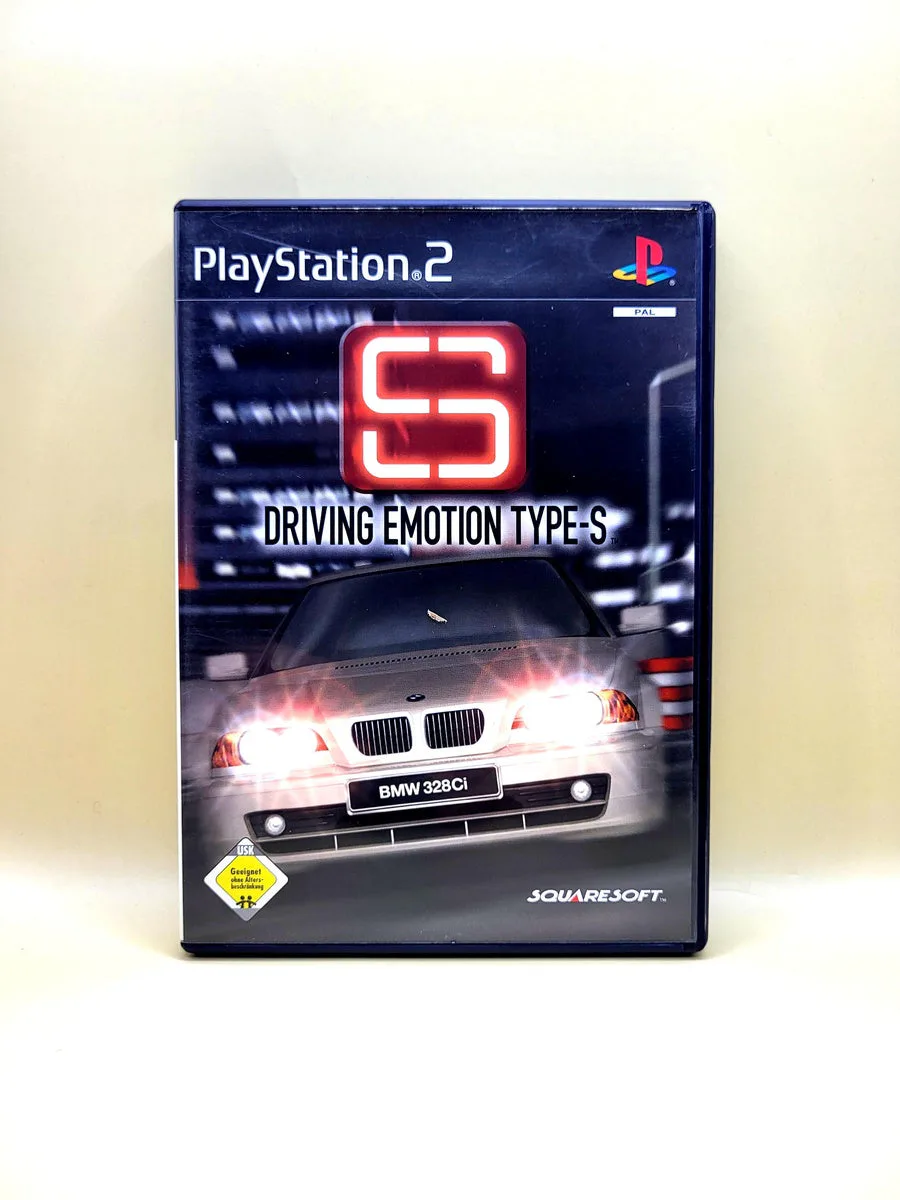
Driving Emotion Type-S for PlayStation 2
Driving Emotion Type-S for PlayStation 2 is a racing game featuring real road cars and racing machines. You drive models from Honda, Toyota, Porsche and Ferrari, among others, on circuits such as Suzuka and Tsukuba and on fictional courses. The cockpit camera shows your car's interior and makes the movement of the body clearly perceptible. You continually look for the right moment to brake, turn in and accelerate again to get through a corner without losing much time.
In Arcade Type-S, you win races to unlock more cars and tracks. The higher divisions introduce faster opponents and different vehicles, so you must learn to take the same corners at a different pace. Line Training helps with a drawn racing line and braking guidance. You can also race against the clock and challenge your own best lap. The choice between normal handling and a more demanding simulation setting changes how much the car asks of your steering inputs.
You can play alone with a standard PS2 controller; a local split-screen duel requires two controllers, not a Multitap. That two-player race does not use the cockpit camera from the solo game. Adjustments let you explore the car's response before heading back onto the track. Choosing another car therefore means more than looking at a new appearance: weight, grip and power call for different braking points and a different amount of throttle as you exit a corner.
Region and language
Our PlayStation 2 games are PAL editions and come with a Dutch or English box, unless stated otherwise. By default, you receive the version for the European market. We note it in the product details if the region is different or the box is in another language. In almost all cases, the game is playable at least in English, and often in the other five common European languages too.
This edition of Driving Emotion Type-S has a PAL case with a German USK age rating on the front. Please therefore expect German text on the packaging.
Manual
Driving Emotion Type-S for PlayStation 2 includes the manual unless the product title states otherwise. If the booklet is missing, the title says “No Manual”. This lets you see before ordering whether the game comes with a manual.
The manuals included with our games usually contain at least English and often around six European languages. The exact languages vary by edition, so Dutch is not always included. The booklet explains the controls and the main rules. You can use it to check how to control the game, which actions are available and how its different features work.
The history of Driving Emotion Type-S
Driving Emotion Type-S appeared in Japan in March 2000 and reached Europe in January 2001. Escape developed the game for Square; Electronic Arts handled its European publication. It therefore belongs to the early racing games for PlayStation 2, from a period when developers were still exploring what Sony's new hardware could show. Alongside its adventures and role-playing games, Square presented it as a separate attempt to reproduce the movement and feel of a real car.
The original credits name Toru Ikebuchi as director and system programmer and Shinji Hashimoto as producer. Hiroshi Tsuboi worked on simulation and artificial intelligence. Square also supplied staff for car models and track design. Its music came from Shinji Hosoe, Ayako Saso and Takayuki Aihara, among others, names that have also built a long history in game music beyond traditional motorsport games.
During its presentation for E3 2000, Square particularly emphasized the calculation of weight, air resistance and gravity and the view from inside the car. The international release followed months after the Japanese introduction and received handling adjustments and extra content. The European disc therefore does not simply reproduce the very first Japanese edition. Within the early PS2 catalogue, the game particularly shows how a publisher from a different background tried to create its own combination of licensed cars, interior views and driving training.
Similar games for PlayStation 2
Gran Turismo 3: A-Spec shares real cars, circuit racing and attention to braking and grip with Driving Emotion Type-S. Polyphony clearly divides the experience between quick Arcade races and longer progression involving cars and events. Driving Emotion Type-S ties new vehicles mainly to victories in its divisions. The visible cockpit also gives it a different view of the track; here you look through the interior rather than only at the road or bodywork.
Gran Turismo 4 takes collecting and tuning real cars much further on PS2 and adds features including B-Spec and photography. Driving Emotion Type-S focuses more closely on driving yourself, training and winning races to unlock something new. Both require adjusted braking points when you change vehicles. The difference mainly lies in the surrounding activities: Gran Turismo 4 gives you more ways to engage with cars beyond your own fast lap.
Enthusia Professional Racing, like Driving Emotion Type-S, explores how weight and grip affect steering. Konami makes those forces visible through the Visual Gravity System, including information on tyre loading. Driving Emotion Type-S mainly uses the car's movement and its cockpit view to convey that feeling. In both PS2 games you practise with real car models, but receive different clues to understand why a corner goes well or badly.
Ferrari F355 Challenge focuses its circuit work on a single Ferrari model, letting you spend longer learning the same car. Driving Emotion Type-S instead moves between different makes and vehicle types, from an ordinary hatchback to a faster racing car. Both PS2 games give braking, cornering and driving aids an important role. With Ferrari, you mainly seek refinement within that one car; here you must reassess a previously learned racing line whenever you set off with different grip or more power.
Grand Prix Challenge on PS2 revolves around Formula One in 2002, with a complete starting field, weather changes and pit strategy. Driving Emotion Type-S brings road cars and racing cars together without recreating an official championship season like that. The similarity lies in circuit knowledge and carefully measured steering, throttle and braking. Grand Prix Challenge also asks for decisions within a race weekend, whereas Type-S chiefly ties its progression to winning races and opening new cars and tracks.