This product is like new. At NexWave Games, like new means:
Additionally, all discs at NexWave Games are carefully inspected and assessed for quality. When discs arrive, we do not accept any that are so badly damaged that they are unlikely to work. We only accept discs with light scratches at most. Discs with scratches are then treated in our professional disc repair machine. By warming the disc and polishing it with soft brushes, these machines can remove a very thin layer from the disc. This removes the layer containing surface scratches and improves the disc’s readability. This ensures the disc works properly, even on consoles with ageing lasers that have difficulty reading games! Great news for the player.
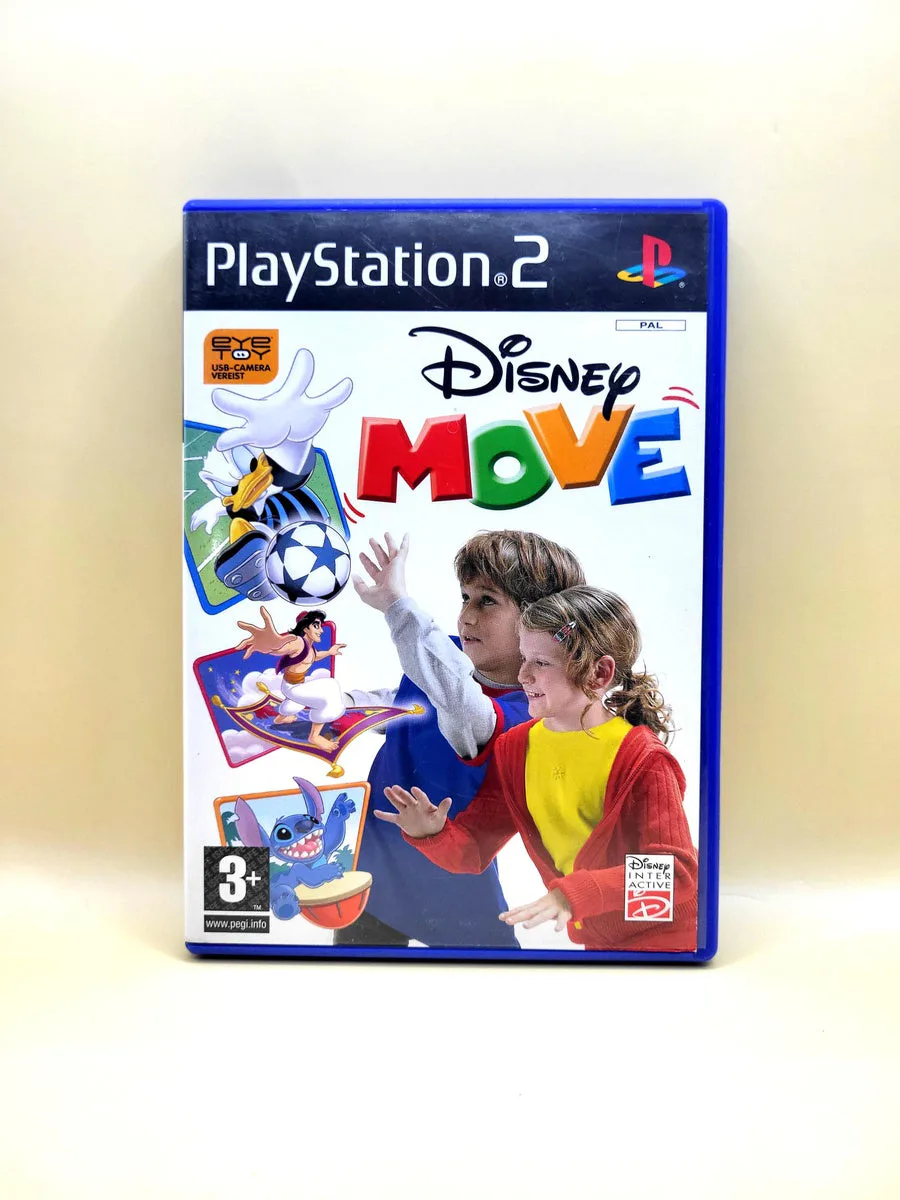
Disney Move for PlayStation 2
Disney Move for PlayStation 2 is a collection of motion games for the EyeToy USB camera. You stand in front of the television, see yourself and hit or avoid virtual objects by moving your arms and body. Fifteen Disney characters guide activities in six worlds based on The Jungle Book, Peter Pan, Winnie the Pooh and Lilo & Stitch.
The short games change tasks quickly. You defend a goal, hunt ghosts, play virtual drums and cymbals, and react to figures appearing around your camera image. First focus the camera and provide enough light and free space. A controller mainly handles menus; movement in front of the camera controls play.
Disney Move can be played alone and also suits taking turns with family or friends. The EyeToy camera is required and is not automatically included with a used standalone game. Check whether you own a PS2 EyeToy or the offered copy demonstrably includes one. Without the camera the activities cannot be played. No online features or downloads are needed.
Region and language
Our PlayStation 2 games are PAL editions and come with a Dutch or English box, unless stated otherwise. By default, you receive the version for the European market. We note it in the product details if the region is different or the box is in another language. In almost all cases, the game is playable at least in English, and often in the other five common European languages too.
Manual
Disney Move for PlayStation 2 includes the manual unless the product title states otherwise. If the booklet is missing, the title says “No Manual”. This lets you see before ordering whether the game comes with a manual.
The manuals included with our games usually contain at least English and often around six European languages. The exact languages vary by edition, so Dutch is not always included. The booklet explains the controls and the main rules. You can use it to check how to control the game, which actions are available and how its different features work.
The history of Disney Move
Buena Vista Games released Disney Move in Europe in November 2004. It was developed by Artificial Mind & Movement, the Canadian studio later renamed Behaviour Interactive. The game appeared only on PlayStation 2 and used Sony’s EyeToy, which had introduced a new kind of camera control a year earlier.
EyeToy places the player’s camera image directly in the play field. Software recognises changes in the image and turns movement into collisions with digital objects. Disney Move adapted this technology to short activities around existing films. Six settings provided varied characters without attempting a continuous story.
The release belongs to a period when publishers used EyeToy beyond Sony’s Play series. Sega Superstars, EyeToy: Antigrav and sports and dance games each found different uses. Disney Move remained a local family collection. Because the camera is a separate accessory, physical contents matter: disc-and-case copies are not playable on their own.
Similar games for PlayStation 2
EyeToy: Play introduced the camera with twelve general activities. Disney Move uses the same motion technology but replaces the neutral presentation with six Disney worlds and fifteen familiar characters.
EyeToy: Play 2 offers more numerous and technically varied camera activities, including sport and music toys. Disney Move is smaller but keeps its visuals and tasks recognisable to Disney film fans.
Sega Superstars applies EyeToy control to Sonic, Samba de Amigo and other Sega series. Disney Move follows the same collection concept with a younger tone and worlds from Disney animated films.
EyeToy: Groove builds almost everything around dancing to music. Disney Move includes rhythmic tasks too, but mixes them with goalkeeping, ghost hunting and other short dexterity games.
Disney’s Party is also a local party game with familiar characters, but uses a standard controller and board-game structure. Disney Move removes the board and demands physical movement in front of the camera.
Playtime uses the same camera for short games with Nickelodeon characters. Both show the player and let family members take turns. Disney Move differs through classic Disney and Pixar worlds, while Playtime uses Nickelodeon series. The choice is mainly about characters, because both need good light, space and EyeToy. Basic control remains similar: movement in the camera image hits on-screen objects without complex button combinations.