This product is like new. At NexWave Games, like new means:
Additionally, all discs at NexWave Games are carefully inspected and assessed for quality. When discs arrive, we do not accept any that are so badly damaged that they are unlikely to work. We only accept discs with light scratches at most. Discs with scratches are then treated in our professional disc repair machine. By warming the disc and polishing it with soft brushes, these machines can remove a very thin layer from the disc. This removes the layer containing surface scratches and improves the disc’s readability. This ensures the disc works properly, even on consoles with ageing lasers that have difficulty reading games! Great news for the player.
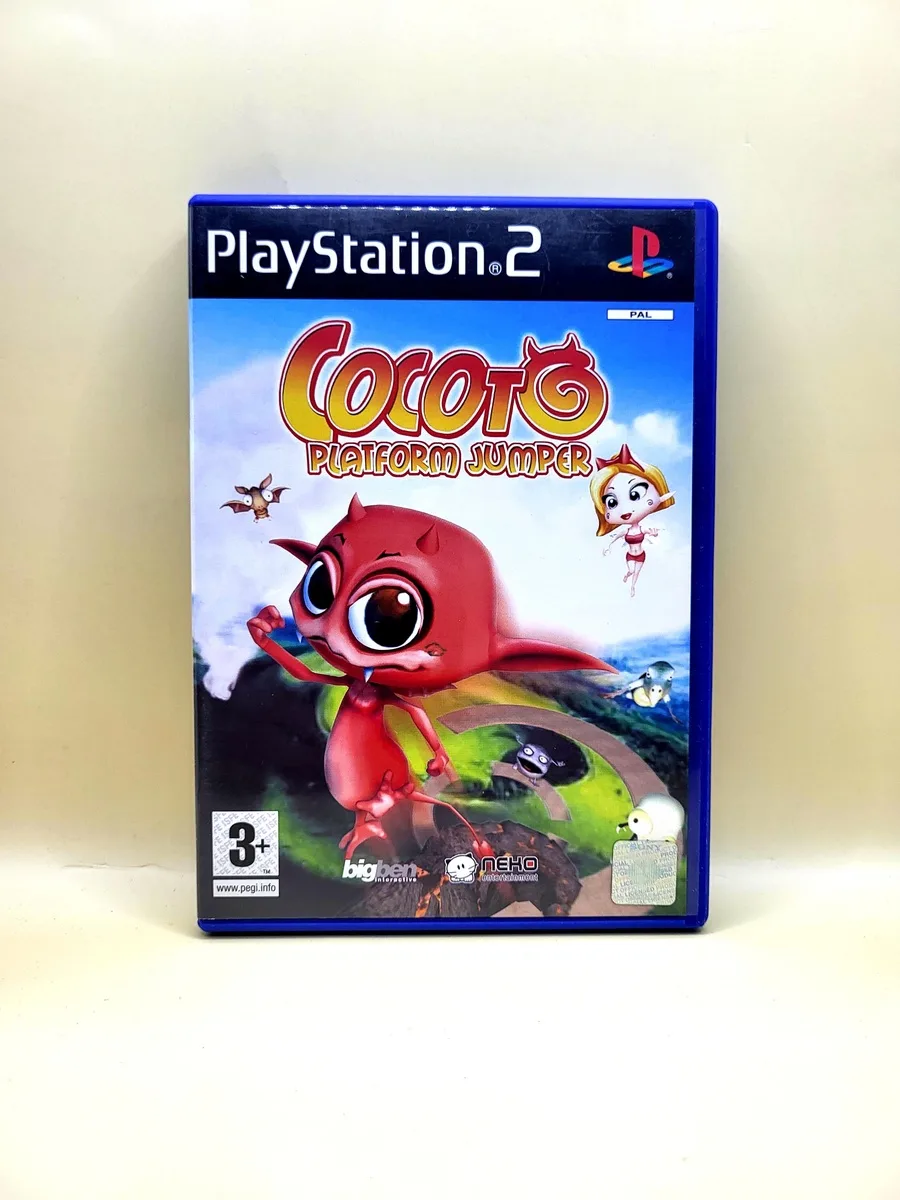
Cocoto Platform Jumper for PlayStation 2
Cocoto Platform Jumper for PlayStation 2 is a platform game in which the little demon Cocoto tries to save the secret of magma and his friends. Each level revolves around a vertical, cylindrical route. You jump between ledges, avoid moving or burning platforms and climb ever higher while the camera follows the circular structure.
Cocoto can use magma to create a temporary arch across gaps and employs other powers against enemies. The campaign has forty levels spread across five worlds, each with its own traps, opponents and a boss. Bonuses and power-ups help along the way, but careful landings and quick reactions before a temporary route disappears remain central. Three difficulty levels adjust the challenge.
Alongside the solo campaign, the PS2 version includes a battle for two players and races for up to four local participants. Three or four players require a PlayStation 2 Multitap and extra controllers; there is no online multiplayer. Progress is saved to a memory card. This page covers the original PAL disc from Neko Entertainment and BigBen Interactive, not the later WiiWare release. A standard controller is sufficient for solo or two-player play.
Region and language
Our PlayStation 2 games are PAL editions and come with a Dutch or English box, unless stated otherwise. By default, you receive the version for the European market. We note it in the product details if the region is different or the box is in another language. In almost all cases, the game is playable at least in English, and often in the other five common European languages too.
Local races with three or four players require a PlayStation 2 Multitap and three or four controllers.
Manual
Cocoto Platform Jumper for PlayStation 2 includes the manual unless the product title states otherwise. If the booklet is missing, the title says “No Manual”. This lets you see before ordering whether the game comes with a manual.
The manuals included with our games usually contain at least English and often around six European languages. The exact languages vary by edition, so Dutch is not always included. The booklet explains the controls and the main rules. You can use it to check how to control the game, which actions are available and how its different features work.
The history of Cocoto Platform Jumper
Neko Entertainment developed Cocoto Platform Jumper and BigBen Interactive released it in PAL territories for PlayStation 2 and GameCube in 2004. The game introduced Cocoto as a little demon in a colourful underworld. His first adventure did not use broad 3D fields, but vertical courses built around a central axis.
The temporary magma arch gave jumping its own rhythm: players had to create a link, wait until it became usable and then cross before the route disappeared. Forty levels across five worlds offered different platforms, traps and enemies. Local battles and races added separate competitive play, including four players with the required Multitap on PS2.
Cocoto later grew into a series including kart, fishing and shooting games. Platform Jumper itself returned as a WiiWare download with presentation adapted to that system. That rerelease does not change the content of the original PS2 disc. This product page therefore covers the PAL version, its forty vertical levels and the local player options of the PlayStation 2 release. Features or controls from WiiWare and other Cocoto games are not attributed to this version. The disc remains the original platform adventure that introduced the character.
Similar games for PlayStation 2
Klonoa 2 follows a 2.5D route through three-dimensional environments and uses enemies as tools for jumps. Cocoto moves around vertical cylinders and creates temporary magma arches. Both require precise timing along a fixed route, but Klonoa tells a more elaborate story while Cocoto places greater emphasis on climbing upward.
Rayman 3 offers broad 3D areas, combat and temporary powers. Cocoto is more compact and builds each main level around a vertical sequence of platforms. Both use colourful worlds and power-ups, but Rayman alternates freer exploration with action while Cocoto mainly tests jumping rhythm and quick route choices.
Quack Attack uses short linear platform levels, fixed camera angles and time trials. Cocoto shares the direct structure but sends its route upward around a cylinder and adds magma arches. Donald remains entirely single-player; Cocoto also has local battles and races for up to four participants.
Herdy Gerdy is also a colourful European platform game, but revolves around herding creatures in open areas and solving longer environmental puzzles. Cocoto uses short vertical challenges with traps and enemies. Both have their own fantasy world, while their pace and level structure differ greatly.
Pac-Man World 2 combines traditional jumping, collectibles and varied landscapes in fully three-dimensional levels. Cocoto more often confines movement to circular vertical courses and uses temporary bridges as a defining tool. Pac-Man offers more exploration; Cocoto instead provides separate local competitions. Both require timing, but distribute their challenges very differently across the levels.