This product is like new. At NexWave Games, like new means:
Additionally, all discs at NexWave Games are carefully inspected and assessed for quality. When discs arrive, we do not accept any that are so badly damaged that they are unlikely to work. We only accept discs with light scratches at most. Discs with scratches are then treated in our professional disc repair machine. By warming the disc and polishing it with soft brushes, these machines can remove a very thin layer from the disc. This removes the layer containing surface scratches and improves the disc’s readability. This ensures the disc works properly, even on consoles with ageing lasers that have difficulty reading games! Great news for the player.
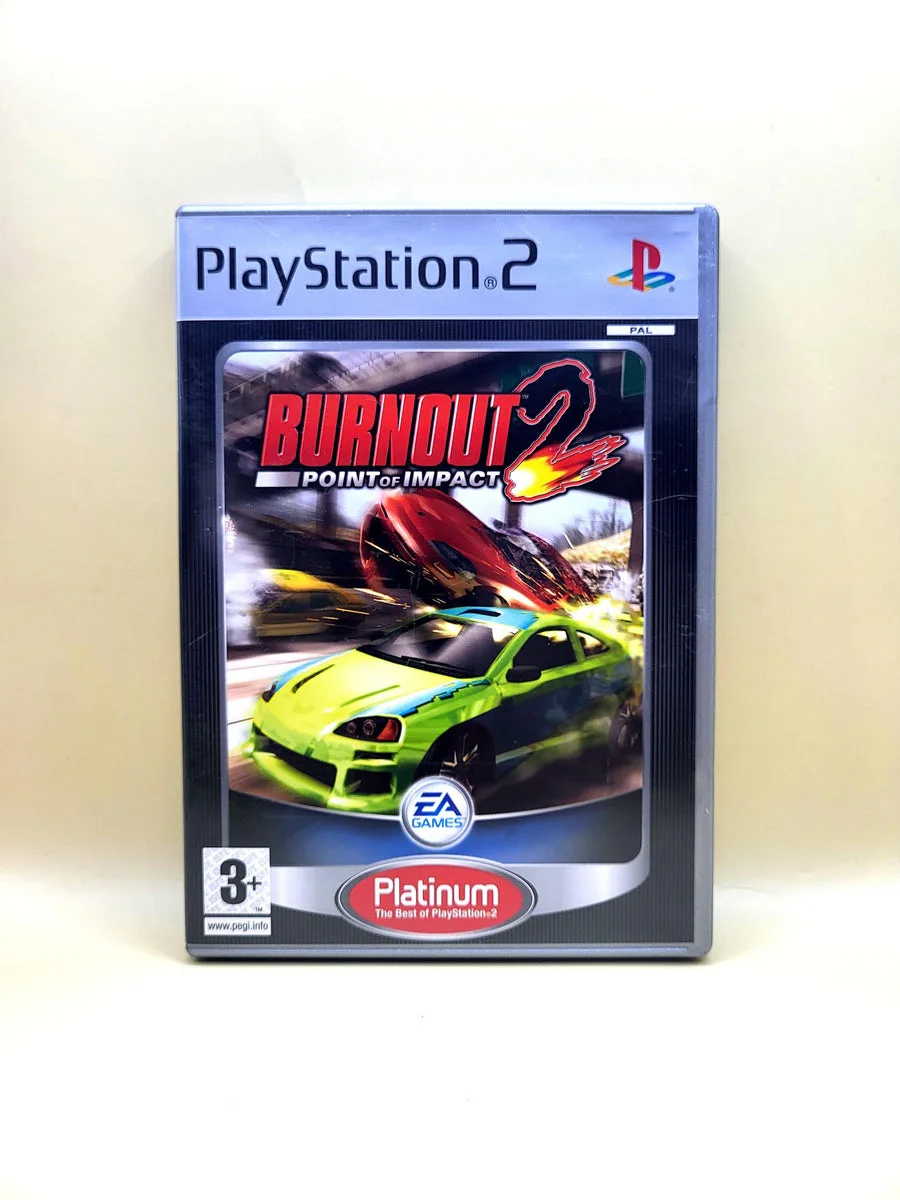
Burnout 2: Point of Impact for PlayStation 2
Burnout 2: Point of Impact for PlayStation 2 is an arcade racer in which you weave through ordinary traffic towards the finish line. You look beyond the next bend: a lorry, oncoming car or busy junction can suddenly change your line. Near misses, drifting and driving against the traffic fill your boost meter. You constantly decide how much space you dare to use to build up speed.
You can only activate boost with a full meter. During that burst of speed, you try to pull off more dangerous driving moves so you can link the next Burnout to the previous one. A long chain requires you to keep reading the route while travelling faster. A crash interrupts the attempt and costs time. Championships unlock new races and vehicles, while driving lessons explain how the boost system works.
Crash gives collisions a separate objective. You send a car into a traffic situation and try to cause as much damage as possible. The angle of impact, the first vehicle struck and the following collisions all matter. In Pursuit, you instead drive a police car to force another vehicle to stop. You can also race a second player locally in split screen.
Region and language
Our PlayStation 2 games are PAL editions and come with a Dutch or English box, unless stated otherwise. By default, you receive the version for the European market. We note it in the product details if the region is different or the box is in another language. In almost all cases, the game is playable at least in English, and often in the other five common European languages too.
Manual
Burnout 2: Point of Impact for PlayStation 2 includes the manual unless the product title states otherwise. If the booklet is missing, the title says “No Manual”. This lets you see before ordering whether the game comes with a manual.
The manuals included with our games usually contain at least English and often around six European languages. The exact languages vary by edition, so Dutch is not always included. The booklet explains the controls and the main rules. You can use it to check how to control the game, which actions are available and how its different features work.
The history of Burnout 2: Point of Impact
Burnout 2: Point of Impact was released in 2002 for PlayStation 2. Criterion Games developed the game and Acclaim Entertainment published it. It followed a year after the first Burnout, which linked racing through traffic to rewards for dangerous driving. The sequel retained that foundation, but Criterion expanded the way you progressed through races and challenges.
The Crash events gave an accident a different meaning within the series. In a normal race, it cost time; in a separate traffic scenario, damage became the result you tried to improve. Players therefore had to look differently at the same vehicles and junctions. Pursuit also added the role of a police pursuer. These choices gave the sequel different tasks around the same core: driving fast and judging traffic.
Acclaim cited American action films as an inspiration for the presentation and referred to the RenderWare technology developed by Criterion. GameCube and Xbox versions arrived in 2003, with changes from the earlier PlayStation 2 release. The series then moved to publisher Electronic Arts with Burnout 3: Takedown and more direct battles between racers. Burnout 2 represents the period in which uninterrupted boost chains and planning a single pile-up gained a central role.
Similar games for PlayStation 2
Burnout establishes the foundation with races through traffic and a boost meter filled by taking risks. There, too, you learn to judge the space between ordinary road users. Burnout 2: Point of Impact expands that approach with Crash and Pursuit, among other features, and puts more emphasis on linking boost sequences.
Burnout 3: Takedown rewards eliminating rivals and makes collisions between racers part of your attack. You can use boost sooner, without filling the entire meter first. Burnout 2: Point of Impact more often asks you to build a full meter before trying to maintain a longer burst of acceleration.
Burnout Revenge lets you knock aside smaller vehicles travelling in the same direction and use them as obstacles for rivals. The ordinary traffic flow therefore takes an active part in the fight. Racing in Burnout 2: Point of Impact focuses more on finding clear space, while you prepare large collisions separately in Crash.
Burnout Dominator returns to Burnout chains and asks you to take fresh risks while boosting so you can keep accelerating. It combines that approach with takedowns and its own circuits. Burnout 2: Point of Impact offers an earlier version of that boost system and adds the separate damage challenges of Crash.
Need for Speed: Hot Pursuit 2 combines fast road races with police chases and real sports cars. Reading traffic and corners matters in both games. Burnout 2: Point of Impact uses fictional vehicles and links your boost directly to driving risks; Pursuit also puts you behind a target car yourself.