This product is like new. At NexWave Games, like new means:
Additionally, all discs at NexWave Games are carefully inspected and assessed for quality. When discs arrive, we do not accept any that are so badly damaged that they are unlikely to work. We only accept discs with light scratches at most. Discs with scratches are then treated in our professional disc repair machine. By warming the disc and polishing it with soft brushes, these machines can remove a very thin layer from the disc. This removes the layer containing surface scratches and improves the disc’s readability. This ensures the disc works properly, even on consoles with ageing lasers that have difficulty reading games! Great news for the player.
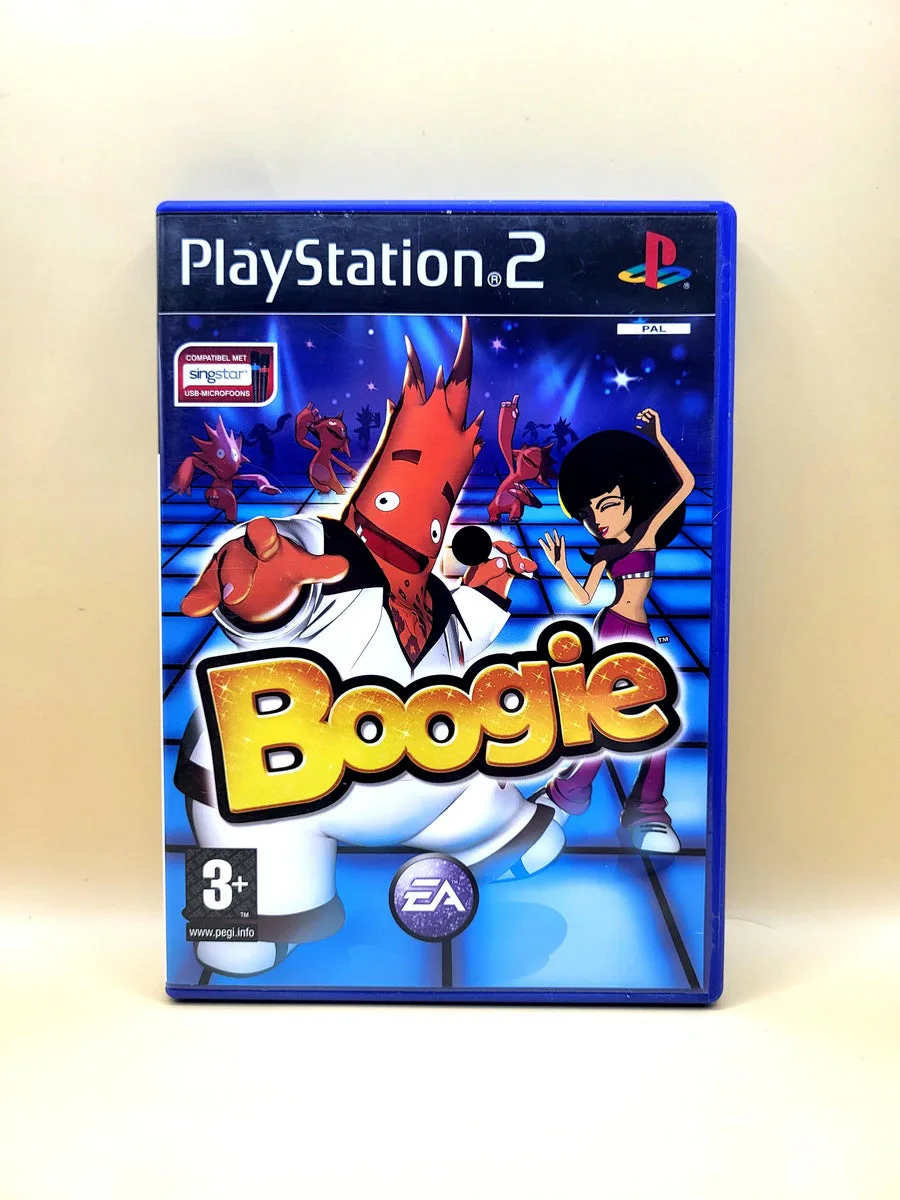
Boogie for PlayStation 2
Boogie for PlayStation 2 combines dancing, karaoke and music-video creation. Choose one of the alien Boogs and unlock songs across colourful stages. Dancing uses the DualShock 2 buttons and analogue sticks: a button selects the dance style, the left stick performs directions and the right stick moves around the stage. Successful moves fill the Boogie meter and raise your score.
For karaoke, connect a compatible USB microphone and sing along with the on-screen lyrics and melody. The selection includes familiar pop, funk and disco songs. Story introduces the characters and unlocks songs, venues and clothing; Quick Play goes straight to singing or dancing. The video maker lets you recut recorded performances by choosing camera angles and effects.
The PS2 version has no Wii motion controls and does not need an EyeToy. Dancing works with a standard DualShock 2; singing requires a compatible USB microphone. This listing does not mention a microphone bundle, so the accessory is included only when explicitly stated in the title or product information. Boogie is played locally without an online connection. Its disc content differs from the simplified Nintendo DS version.
Region and language
Our PlayStation 2 games are PAL editions and come with a Dutch or English box, unless stated otherwise. By default, you receive the version for the European market. We note it in the product details if the region is different or the box is in another language. In almost all cases, the game is playable at least in English, and often in the other five common European languages too.
Dancing in Boogie uses a DualShock 2 controller. Karaoke requires a compatible USB microphone. A microphone is included only when explicitly stated with the product; an EyeToy camera or dance mat is not required.
Manual
Boogie for PlayStation 2 includes the manual unless the product title states otherwise. If the booklet is missing, the title says “No Manual”. This lets you see before ordering whether the game comes with a manual.
The manuals included with our games usually contain at least English and often around six European languages. The exact languages vary by edition, so Dutch is not always included. The booklet explains the controls and the main rules. You can use it to check how to control the game, which actions are available and how its different features work.
The history of Boogie
EA Montreal originally developed Boogie for Wii, and Electronic Arts released it in 2007. Separate PlayStation 2 and Nintendo DS editions followed later that year. The concept remained a friendly mixture of singing, dancing and personalised performances, but controls had to suit each system. On PS2, DualShock 2 buttons and sticks replaced the Wii Remote movements.
Electronic Arts presented the PS2 edition as its characteristic singing and dancing plus voice recording and music-video creation. Exaggerated character shapes and clear animation kept every move readable from the sofa. New clothing, songs and stages provided progression. The USB microphone served karaoke, while dancing worked without a separate dance mat.
Boogie arrived amid a wave of PlayStation 2 music games. SingStar focused on vocals, Guitar Hero on instrument patterns and Dance Dance Revolution on a dance mat. Boogie tried to unite those audiences in one character-led show. It did not become a long console series, making this disc a self-contained snapshot of EA's experiment with karaoke, controller dancing and a simple video editor.
Similar games for PlayStation 2
SingStar scores two singers with USB microphones and strongly emphasises pitch and head-to-head results. Boogie also has karaoke, but adds controller dancing, characters and a video maker. SingStar offers the fuller vocal presentation; Boogie switches more quickly between performing, unlocking clothes and editing a clip.
Dance Dance Revolution SuperNOVA uses a mat on which your feet follow arrows. Boogie maps dance moves to buttons and both DualShock 2 analogue sticks. Both demand rhythm and timing, but DDR tests physical step patterns while Boogie moves the selected character and needs no mat.
EyeToy: Groove films the player and asks for arm movements to music. Boogie needs no EyeToy and controls dancing with a normal controller. Both use familiar songs and a playful stage presentation. EyeToy shows the player's body; Boogie keeps attention on a customisable animated character.
High School Musical: Sing It! uses film songs and characters for karaoke and simple dance sections. Boogie has its own alien cast and a broader pop selection. Both can use a USB microphone, but Boogie gives more freedom in clothing choices and re-editing a performance.
Guitar Hero II uses a guitar controller for coloured notes and builds tension through harder patterns. Boogie uses a DualShock 2 for dancing and a microphone for singing. Both unlock songs and stages through performances, but Guitar Hero focuses on instrumental precision while Boogie combines several parts of a show.